

Ultimate Gorilla Trekking Safaris in Uganda: The Complete Guide (2026)
Introduction to Gorilla Trekking Safaris in Uganda
Gorilla trekking safaris in Uganda offer travelers one of the most powerful wildlife experiences available anywhere in Africa: the opportunity to walk through a protected tropical forest and observe mountain gorillas living freely in their natural habitat. Unlike an ordinary wildlife drive where animals are viewed from a vehicle, gorilla trekking is an active forest adventure that takes visitors on foot into mist-covered hills, tangled vegetation, bamboo zones and ancient rainforest valleys under the guidance of experienced trackers and Uganda Wildlife Authority ranger guides. The experience combines physical adventure, wildlife observation, conservation, photography and a deep emotional connection with nature. After following fresh trails through the forest, trekkers may finally reach a habituated gorilla family resting, feeding, grooming, playing or slowly moving through the vegetation. Seeing a powerful silverback watching over his family, a mother holding her infant or young gorillas climbing through branches is often the defining moment of an entire African safari.
Uganda is one of the few countries where travellers can participate in organised mountain gorilla trekking, and the activity takes place in two protected areas in the southwestern part of the country: Bwindi Impenetrable National Park and Mgahinga Gorilla National Park. These destinations provide different landscapes, access routes, accommodation choices and safari-combination possibilities, allowing travellers to select an experience that suits their time, budget, physical ability and wider travel interests. Bwindi is the larger and more frequently visited gorilla destination, while Mgahinga offers a smaller park experience beneath the dramatic volcanic peaks of the Virunga Mountains. Uganda Wildlife Authority officially identifies both Bwindi and Mgahinga as the country’s mountain gorilla trekking destinations.
A gorilla trekking safari is much more than the hour eventually spent observing the gorillas. It begins with choosing the correct destination, checking the availability of Uganda gorilla permits, selecting a suitable trekking sector, reserving accommodation close to the correct briefing point and planning reliable transport into southwestern Uganda. It may also involve deciding whether to arrive through Entebbe International Airport or Kigali International Airport, determining how many days are available and choosing whether to combine the gorilla experience with chimpanzee trekking, savannah wildlife, boat cruises, cultural encounters, birdwatching or relaxation beside one of Uganda’s beautiful lakes. Because every traveller has different expectations, Uganda gorilla trekking safari packages can range from short two- or three-day journeys to complete ten-, twelve- or fourteen-day primate and wildlife adventures.
The Unique Experience of Meeting Mountain Gorillas in Uganda
The attraction of gorilla trekking comes from the rare opportunity to enter the natural world of one of humanity’s closest wild relatives without removing the animals from their forest environment. Visitors do not simply arrive at a fenced viewing area. They report to a designated park briefing point early in the morning, receive instructions from the ranger team and are assigned to a habituated gorilla family based on permit allocation, prevailing forest conditions and operational arrangements. They then enter the forest in a controlled group accompanied by professional guides, armed rangers where required and trackers who understand the gorillas’ daily movements, feeding signs, nesting areas and behaviour.
The trek may lead through forest paths, muddy ground, steep slopes, streams, fallen branches and dense vegetation. Its duration varies because the gorillas move freely and their location changes from one day to another. Some groups may be found relatively close to the trailhead, while others may require a longer and more demanding walk. Uganda Wildlife Authority advises that a standard gorilla trek can last approximately two to seven hours and allows one hour of observation after a habituated gorilla family is located.
That unpredictability is part of what makes gorilla trekking safaris in Uganda genuine wildlife experiences. The journey is not staged, and the gorillas are not positioned for visitors. Trackers begin their work early, searching for evidence such as nests, footprints, broken vegetation, feeding remains and other signs left by the gorilla family. Once the group is found, trekkers approach carefully and follow the ranger’s instructions. The forest may suddenly become quiet except for the movement of leaves, the sound of a gorilla feeding or the low vocalisations exchanged between family members.
The permitted observation period gives visitors time to notice details that are difficult to appreciate in photographs. A silverback may appear intimidating because of his size and strength, yet he may spend most of the encounter feeding quietly or watching over the group. Adult females may care for infants, juveniles may play with one another and younger gorillas may show curiosity while remaining under the protection of the family. Every encounter is different because weather, vegetation, group composition and gorilla behaviour continually change.
Gorilla Trekking in Bwindi Impenetrable National Park
Bwindi Impenetrable National Park is Uganda’s most extensive and widely known mountain gorilla trekking destination. Located in southwestern Uganda near the edge of the Albertine Rift, the park protects a biologically rich rainforest characterised by steep ridges, deep valleys, thick vegetation and mist-covered hills. Uganda Wildlife Authority describes Bwindi as an ancient forest and an important refuge for mountain gorillas, birds, mammals and numerous plant species.
Gorilla trekking in Bwindi is organised through four main sectors: Buhoma, Ruhija, Rushaga and Nkuringo. Each sector has its own park briefing point, allocated habituated gorilla families, access roads and nearby accommodation. This makes sector selection one of the most important parts of planning a Uganda gorilla trekking safari. A permit reserved for Rushaga, for example, requires the traveller to report to the Rushaga briefing point rather than staying in a distant sector and attempting a long early-morning transfer. Choosing a lodge near the correct trailhead reduces the risk of delays and allows travellers to begin the trekking day without unnecessary stress.
Buhoma is situated on the northern side of Bwindi and has a long history of organised gorilla tourism. It is often included in itineraries connecting Bwindi with the Ishasha sector of Queen Elizabeth National Park. Ruhija lies on the eastern side of the forest and is known for its high-altitude setting, forest views and birding opportunities. Rushaga and Nkuringo are positioned in southern Bwindi and are commonly reached through Kisoro, Kabale or cross-border routes from Kigali. Rushaga is particularly important for travellers interested in the gorilla habituation experience, while Nkuringo is recognised for its beautiful highland scenery and physically demanding terrain.
Because Bwindi has several trekking sectors, travellers can choose from a broad range of Uganda gorilla trekking safari packages. A short safari may concentrate entirely on one gorilla trek, while a longer journey can include two gorilla treks in different sectors. Other itineraries connect Bwindi with Lake Bunyonyi, Lake Mutanda, Queen Elizabeth National Park, Kibale National Park or Mgahinga Gorilla National Park. Accommodation ranges from simple guesthouses and budget camps to comfortable mid-range lodges and exclusive luxury properties overlooking the forest.
Gorilla Trekking in Mgahinga Gorilla National Park

Gorilla Trekking Safaris in Uganda: The Complete Guide(2026)
Mgahinga Gorilla National Park provides a different but equally memorable setting for gorilla trekking safaris in Uganda. Located in Kisoro District, the park protects Uganda’s section of the Virunga Mountains and forms part of the wider Virunga Conservation Area shared with Rwanda and the Democratic Republic of the Congo. It is Uganda’s smallest national park, covering approximately 33.7 square kilometres, but its combination of mountain gorillas, golden monkeys, bamboo forest and volcanic landscapes gives it exceptional importance.
The park rises from approximately 2,227 metres to more than 4,100 metres above sea level and is dominated by the extinct volcanoes of Mount Gahinga, Mount Sabyinyo and Mount Muhabura. These mountains create a dramatic background for gorilla trekking and make Mgahinga particularly attractive to travellers who enjoy scenery, hiking and primate experiences. Uganda Wildlife Authority states that the park protects one habituated transboundary gorilla group and is also an important habitat for the endangered golden monkey.
A gorilla safari in Mgahinga normally begins at the Ntebeko Visitor Centre, where trekkers receive their morning briefing before entering the forest. Trails may pass through farmland near the park boundary, regenerating vegetation, montane woodland and bamboo zones. Depending on the gorillas’ movements, the trek may be relatively manageable or may involve steeper sections of the lower volcanic slopes.
Mgahinga works particularly well for travellers staying in Kisoro, beside Lake Mutanda or near the foothills of the Virunga Mountains. It can also be combined with golden monkey trekking, volcano climbing, nature walks and cultural experiences associated with the Batwa community. Travellers with enough time can trek gorillas in Mgahinga and then continue to Rushaga or Nkuringo in southern Bwindi for a second gorilla experience. This combination provides an opportunity to compare the volcanic environment of Mgahinga with the dense rainforest landscape of Bwindi.
Uganda Gorilla Permits and Advance Safari Planning
Every visitor participating in gorilla trekking must hold a valid Uganda gorilla permit for a specific trekking date and destination. The permit controls the number of visitors entering the gorillas’ habitat, supports the management of the trekking programme and contributes to conservation financing. It also allows the traveller to join the morning briefing, trek with authorised guides and trackers and spend the permitted observation period with the assigned habituated gorilla family.
For foreign non-residents, the standard Uganda gorilla trekking permit costs USD 800 in 2026. Uganda Wildlife Authority has also introduced a discounted foreign non-resident rate of USD 600 for April, May and November, although these low-season permits cannot be rescheduled. UWA further announced that permits must be secured through full payment rather than being held through the previously available seven-day unpaid reservation window.
A permit is connected to a trekking date and location, making it essential to confirm availability before finalising lodge reservations, transport and international flights. Travellers planning to visit during popular months should begin arrangements early because each habituated gorilla family can receive only a controlled number of visitors per day. Permit availability can become particularly limited during the main travel seasons and around popular holiday periods.
The permit should be booked using the traveller’s correct passport details. Names, nationality, residency category and trekking date should be checked carefully before payment and confirmation. The selected accommodation must then be matched with the correct trekking sector. This coordination is one reason many travellers reserve their permits as part of complete Uganda gorilla trekking safari packages rather than purchasing the permit separately and trying to organise accommodation and transport afterwards.
Uganda Gorilla Trekking Safari Packages
Uganda gorilla trekking safari packages can be designed for almost every travel style. A traveller with limited time may choose a two-day or three-day gorilla safari beginning in Kigali and visiting southern Bwindi or Mgahinga. A visitor beginning in Entebbe or Kampala may select a three-day or four-day road safari through Uganda’s countryside, with possible stops around the Equator, Mbarara, Kabale or Lake Bunyonyi. Travellers seeking greater comfort can use a scheduled or chartered domestic flight from Entebbe to Kihihi or Kisoro before transferring by road to the selected lodge.
Budget packages normally use simple but clean accommodation and practical safari vehicles while keeping the gorilla permit and guided trekking experience unchanged. Mid-range packages provide greater comfort, private facilities, well-located lodges and more personalised services. Luxury gorilla safaris may include premium forest lodges, domestic flights, private transfers, fine dining, spa services, scenic locations and carefully paced itineraries. The essential gorilla encounter remains regulated in the same protected forest, but the transport, accommodation and additional services determine the overall safari style and price.
Packages can also be arranged for solo travellers, couples, honeymooners, families with eligible older children, senior visitors, photographers, small groups and travellers with mobility challenges. The best itinerary is not necessarily the longest or most expensive. It is the one that matches the traveller’s physical ability, available time, arrival airport, preferred accommodation level and wider interests.
Combining Gorilla Trekking With Wildlife and Chimpanzees

ultimate Gorilla Trekking Safaris in Uganda: The Complete Guide(2026)
One of the strongest reasons to choose gorilla trekking safaris in Uganda is the ease of combining mountain gorillas with other primates and classic African wildlife. Uganda offers a varied landscape that includes tropical forests, savannah plains, wetlands, crater lakes, mountains and major river systems. A traveller can therefore move from a close forest encounter with mountain gorillas to chimpanzee trekking, game drives, boat safaris and birdwatching within one carefully designed journey.
Gorilla trekking is commonly combined with chimpanzee trekking in Kibale National Park, which creates a complete primate-focused safari. Such an itinerary allows visitors to compare the quiet, ground-based social life of mountain gorillas with the faster movement and energetic vocal communication of chimpanzees in a different forest environment. A longer primate safari may also include golden monkey trekking in Mgahinga, nature walks in Bigodi Wetland Sanctuary and other forest activities.
Travellers interested in savannah wildlife can combine Bwindi with Queen Elizabeth National Park, where activities may include game drives, a boat cruise on the Kazinga Channel and exploration of the Ishasha sector. Bwindi can also be connected with Lake Mburo National Park, Murchison Falls National Park and Ziwa Rhino Sanctuary as part of a longer Uganda wildlife circuit. This makes it possible to create a safari featuring gorillas, chimpanzees, elephants, lions, hippos, buffaloes, rhinos and numerous bird species without treating gorilla trekking as an isolated excursion.
A well-paced itinerary is important because Uganda’s destinations are spread across different regions and some road transfers are long. Rather than rushing from one park to another, travellers should allow enough time for rest, scenic stops and unexpected road conditions. A thoughtfully planned safari may begin with wildlife, continue into the primate forests and conclude with gorilla trekking, or it may start with gorillas before travelling north toward Queen Elizabeth, Kibale and Murchison Falls.
Starting a Gorilla Safari From Entebbe, Kampala or Kigali
A Uganda gorilla safari can begin from Entebbe, Kampala or Kigali, and the best starting point depends on the traveller’s international flights, total holiday duration and other destinations included in the itinerary. Entebbe is Uganda’s main international arrival point and is suitable for travellers completing a longer Uganda circuit. From Entebbe, visitors can travel by road through central and western Uganda or take a domestic flight toward the southwestern region.
Kampala is a suitable departure point for travellers already staying in Uganda’s capital. Road safaris from Kampala provide an opportunity to observe changing landscapes, roadside communities, farmland and highland scenery while travelling toward Bwindi or Mgahinga. The journey can be divided with an overnight stop or combined with Lake Mburo National Park, depending on the number of available days.
Kigali is often selected by travellers planning a shorter gorilla trekking safari because Rwanda’s capital is geographically close to southwestern Uganda. From Kigali, visitors travel through Rwanda’s countryside, complete immigration procedures at an authorised border crossing and continue toward Kisoro, Kabale, southern Bwindi or Mgahinga. This route is especially convenient for safaris visiting Rushaga, Nkuringo or Mgahinga, although border requirements and entry documentation must be arranged correctly before travel.
Travellers can also begin in one country and finish in another. For example, a safari may start in Kigali, cross into Uganda for gorilla trekking and continue through Queen Elizabeth and Kibale before ending in Entebbe. Another itinerary may begin in Entebbe, travel through Uganda’s wildlife parks, complete a gorilla trek in Bwindi and end in Kigali. These open-jaw itineraries reduce unnecessary backtracking and allow travellers to experience more of the region.
Ultimately, gorilla trekking safaris in Uganda can be shaped around a short primate adventure, an extended wildlife holiday or a multi-country East African journey. Whether the trek takes place in the ancient forest of Bwindi or beneath the Virunga volcanoes of Mgahinga, the experience places travellers within one of Africa’s most important conservation landscapes. Careful permit booking, correct sector selection, suitable accommodation and a realistic route transform the gorilla encounter from a single activity into a complete and rewarding safari experience.
Why Choose Uganda for Gorilla Trekking Safaris?

Ultimate Gorilla Trekking Safaris in Uganda: The Complete Guide(2026)
Uganda is one of the best destinations for travellers who want a complete mountain gorilla experience rather than a short wildlife activity added to an ordinary holiday. Gorilla trekking safaris in Uganda combine rare primate encounters, ancient tropical forests, dramatic mountain scenery, cultural experiences and traditional African wildlife viewing within one destination. Travellers can walk through the thick vegetation of Bwindi Impenetrable National Park, explore the volcanic landscapes of Mgahinga Gorilla National Park, track chimpanzees in Kibale National Park, watch elephants beside the Kazinga Channel and meet communities living around Uganda’s protected areas. This variety makes Uganda suitable for visitors who want to spend only a few days with mountain gorillas as well as those planning a longer safari across several national parks.
Another important advantage is flexibility. Uganda does not offer only one gorilla park, one trekking point or one type of accommodation. Travellers can choose between two mountain gorilla destinations, several trekking sectors, standard gorilla trekking and the longer gorilla habituation experience. They can begin their journey in Entebbe, Kampala or Kigali and select budget, mid-range or luxury services according to their comfort level. A Uganda gorilla safari can therefore be adapted for a solo traveller, a couple, a family with eligible teenage children, a small private group, photographers or senior travellers who prefer a slower and more carefully planned itinerary.
Uganda Has Two Mountain Gorilla Trekking Destinations
One of the main reasons to choose Uganda is that the country has two protected mountain gorilla destinations: Bwindi Impenetrable National Park and Mgahinga Gorilla National Park. These parks offer different landscapes and trekking environments, giving travellers more choice when designing their safari. Uganda Wildlife Authority identifies both Bwindi and Mgahinga as the country’s official mountain gorilla trekking destinations. UWA also states that Uganda protects more than half of the world’s mountain gorilla population across the Bwindi and Virunga ecosystems.
Bwindi Impenetrable National Park is the larger and more widely visited of the two destinations. It protects a vast area of ancient montane and lowland forest in southwestern Uganda. The park is characterised by steep ridges, deep valleys, streams, thick vegetation and mist-covered hills. Its varied terrain creates an exciting and genuine forest adventure because mountain gorillas move freely through a large natural habitat rather than remaining in one fixed viewing area. Trackers must follow signs such as fresh nests, footprints, broken branches, feeding remains and flattened vegetation to determine where a gorilla family has moved.
Bwindi is often the preferred destination for travellers who want several choices of trekking sectors, lodges and access routes. It can be included in a short safari from Kigali, a road safari from Entebbe or a longer Uganda wildlife circuit. The park can also be combined conveniently with Queen Elizabeth National Park, Lake Bunyonyi, Lake Mutanda and other attractions in western and southwestern Uganda. Accommodation around Bwindi includes simple guesthouses, comfortable mid-range lodges and high-end properties overlooking the forest.
Mgahinga Gorilla National Park offers a different atmosphere. The park is located in Kisoro District and forms Uganda’s section of the wider Virunga Conservation Area. It covers approximately 33.7 square kilometres, making it Uganda’s smallest national park, and it lies between about 2,227 and 4,127 metres above sea level. Three extinct volcanoes—Mount Muhabura, Mount Gahinga and Mount Sabyinyo—rise above its forests and create one of the most striking landscapes in Uganda.
Gorilla trekking in Mgahinga takes visitors through a mixture of montane forest, bamboo vegetation and the lower slopes of the Virunga volcanoes. The park currently has one habituated transboundary gorilla group available for tourism. Its smaller number of daily trekking permits creates a quieter and more intimate atmosphere, although availability is more limited and should be checked before other safari services are confirmed.
Mgahinga is particularly suitable for travellers who want to combine gorilla trekking with golden monkey tracking, volcano hiking, birdwatching and cultural experiences. Uganda Wildlife Authority identifies Mgahinga as Uganda’s main habitat for the endangered golden monkey and offers both regular tracking and experiential tourism involving these colourful primates.
Having two gorilla destinations gives travellers a valuable alternative when permits or preferred lodges are unavailable in one location. It also makes it possible to arrange two different gorilla experiences during the same safari. A traveller may trek in the dense rainforest of Bwindi and then continue to Mgahinga for a second trek beneath the Virunga volcanoes. Although every gorilla encounter is unique, visiting both parks allows travellers to experience two contrasting habitats and wider areas of southwestern Uganda.
Uganda Offers Several Gorilla Trekking Sectors
Uganda provides more trekking-location choices than many first-time travellers expect. Bwindi Impenetrable National Park is divided into four main gorilla trekking sectors: Buhoma, Ruhija, Rushaga and Nkuringo. Mgahinga gorilla trekking begins from the Ntebeko or Muhavura visitor area. Uganda Wildlife Authority treats these locations as designated entry points, and permits are reserved according to the trekking date and entry location rather than according to a gorilla family selected by the traveller. The final allocation to a particular habituated family is normally completed on the trekking day under park procedures.
This sector system is a major advantage because it provides different routes, landscapes, accommodation choices and nearby attractions. It also makes Uganda gorilla trekking safari packages more flexible. Travelers do not all have to stay in one town or report to one park headquarters. They can select the sector that fits their arrival point, onward route, preferred lodge and wider itinerary.
Buhoma is located on the northern side of Bwindi. It is one of the park’s best-established tourism areas and has a broad selection of accommodation. Its position makes it useful for itineraries connecting Bwindi with the Ishasha sector of Queen Elizabeth National Park. Travelers moving between savannah wildlife experiences and gorilla trekking often find Buhoma convenient because it can reduce unnecessary backtracking.
Ruhija is located on the eastern side of Bwindi at a higher elevation. It is surrounded by beautiful forested hills and is especially attractive to travelers interested in birdwatching, quiet forest surroundings and scenic highland drives. Ruhija can be accessed from Kabale, Lake Bunyonyi and other parts of eastern Bwindi, depending on road conditions and the exact itinerary.
Rushaga lies in southern Bwindi and is commonly reached through Kisoro or Kabale. It is convenient for many travellers arriving from Kigali because it is positioned closer to Uganda’s southwestern border region than Buhoma. Rushaga also provides access to nearby attractions such as Lake Mutanda and community activities around southern Bwindi.
Nkuringo is also located in the southern part of the park. The area is known for its steep hills, wide views and dramatic highland scenery. Its terrain can be demanding, but many travellers appreciate the remote setting and beautiful surroundings. Nkuringo can be combined with Lake Mutanda, Lake Bunyonyi, Kisoro and routes towards Mgahinga Gorilla National Park.
Accommodation is available near the different Bwindi trailheads for budget, mid-range and upmarket visitors. Uganda Wildlife Authority’s park information also notes that visitors trekking from Ruhija may stay around Kabale or Lake Bunyonyi, while travellers using Rushaga and Nkuringo can consider accommodation around Kisoro or Lake Mutanda. However, staying close to the assigned briefing point is normally the safest arrangement because gorilla trekking starts early and road conditions can be unpredictable.
The availability of several sectors helps travelers avoid designing every Uganda gorilla safari in the same way. A short safari beginning in Kigali may focus on Rushaga, Nkuringo or Mgahinga. A longer safari arriving from Queen Elizabeth National Park may use Buhoma. Travelers approaching from Kabale or Lake Bunyonyi may consider Ruhija or southern Bwindi. The final choice should always depend on permit availability, road access, accommodation location and the destinations visited before and after the trek.
Uganda Offers Standard Gorilla Trekking and Gorilla Habituation
Uganda allows visitors to choose between standard gorilla trekking and the more specialised gorilla habituation experience. These activities are related, but they are not identical. This gives travellers an opportunity to select an experience that matches their interests, time and budget.
During standard gorilla trekking, visitors join an authorised group after a morning briefing and enter the forest with Uganda Wildlife Authority guides, trackers and other support staff. The trek continues until the assigned habituated gorilla family is located. According to Uganda Wildlife Authority, a standard gorilla trek can last approximately two to seven hours, depending on the gorillas’ location and forest conditions. Visitors normally receive one hour of observation after reaching the gorilla family.
The one-hour observation period may include watching the gorillas feed, groom, rest, play or move through the vegetation. Visitors may see a silverback monitoring the family, adult females caring for infants and younger gorillas climbing trees or interacting with one another. The ranger guides explain visible behaviour and help visitors follow the required health, safety and conservation rules.
Standard trekking is the best choice for most travellers. It fits comfortably into a three-day or four-day safari and leaves enough time for transfers, lodge stays and other activities. It is also less expensive than the habituation experience and is available from more trekking locations.
The gorilla habituation experience is designed for travellers who want a longer and more specialised time in the forest. Uganda Wildlife Authority defines it as an activity that allows visitors to accompany researchers and habituators during the process of gradually familiarising gorillas with controlled human presence. It starts earlier than standard trekking and involves more time in the field.
Habituation should not be described simply as four easy hours sitting beside gorillas. The total experience may involve searching, following fresh trails, moving through demanding vegetation and observing the work of trackers and researchers. The gorillas involved may behave differently from fully habituated tourism families because they are still becoming familiar with carefully managed human visits.
This experience is especially attractive to dedicated wildlife enthusiasts, conservation-minded visitors and photographers who want more time to observe changing behaviour. It also requires greater patience and physical preparation. Availability is limited, takes place only in selected areas of Bwindi and must be confirmed before the itinerary is finalised.
The presence of both activities makes Uganda suitable for first-time gorilla trekkers as well as returning visitors. A first-time traveller may choose a standard trek, while a photographer or primate enthusiast may select habituation or arrange two standard treks in different sectors. A longer Uganda gorilla trekking safari can even include both experiences, subject to permit availability.
Gorilla Trekking Can Be Combined With Wildlife Safaris
A major advantage of choosing Uganda is that gorilla trekking does not have to be treated as an isolated activity. The country has ten national parks that protect forests, savannahs, mountains, wetlands, lakes and river systems. These different ecosystems allow travellers to combine mountain gorillas with game drives, boat cruises, nature walks and other wildlife encounters during one holiday.
Queen Elizabeth National Park is one of the most natural additions to a Bwindi gorilla safari. Travellers can enjoy game drives in the park’s savannah areas, search for wildlife in Ishasha and take a boat cruise along the Kazinga Channel. The park may provide opportunities to see elephants, buffaloes, hippos, antelopes, crocodiles and numerous bird species. An itinerary combining Queen Elizabeth with Bwindi allows travellers to experience both open savannah and dense tropical forest within a few days.
Lake Mburo National Park is another practical addition, especially for travellers driving between Entebbe or Kampala and southwestern Uganda. It can serve as a comfortable break in the long journey while adding game viewing, birdwatching, nature walks or boat activities to the safari.
Travellers with more time can extend the journey to Murchison Falls National Park, Ziwa Rhino Sanctuary or other protected areas in northern and western Uganda. A complete safari can therefore include mountain gorillas, rhinos, elephants, giraffes, lions, hippos and many other animals.
This diversity is particularly valuable for first-time visitors to Africa. Some travellers want gorillas to remain the main purpose of their trip but still hope to enjoy a traditional safari. Uganda makes it possible to place both experiences into one private itinerary without requiring an additional international flight between unrelated destinations.
Gorilla Safaris Can Be Combined With Chimpanzee Trekking
Uganda is also an excellent destination for travellers interested in primates beyond mountain gorillas. Gorilla trekking can be combined with chimpanzee tracking in Kibale National Park, creating a safari centred on two of Africa’s most remarkable great apes.
The experiences are very different. Mountain gorillas often spend considerable time feeding or resting on the forest floor, although they can also climb and move quickly. Chimpanzees are generally more active, vocal and mobile. They may travel through the trees, call loudly across the forest and divide into smaller groups before joining together again.
Combining the two activities helps visitors appreciate the differences in habitat, movement, feeding behaviour and social organisation between gorillas and chimpanzees. The route between Bwindi, Queen Elizabeth National Park and Kibale can also create a balanced safari containing forest trekking, savannah wildlife and scenic drives through western Uganda.
Chimpanzee experiences are not limited to Kibale. Uganda Wildlife Authority also manages chimpanzee tracking in the Queen Elizabeth Conservation Area, including Kyambura, while Kibale has designated entry points for regular tracking and habituation activities.
A well-planned gorilla and chimpanzee safari normally allows enough recovery time between the treks. Both activities involve walking in humid forest environments, and the difficulty can vary according to weather, terrain and animal movements. Travellers should therefore avoid creating an itinerary that rushes them through several demanding activities without rest.
Uganda Offers Rich Cultural and Community Experiences
 The areas surrounding Bwindi and Mgahinga are not empty wildernesses separated from human life. They are part of wider landscapes inhabited by communities with deep historical, cultural and economic connections to the forests and highlands of southwestern Uganda. A thoughtfully designed safari can include respectful community experiences that help visitors understand the people living beside the protected areas.
Around Bwindi, travellers may participate in community walks, craft visits, traditional performances, storytelling, farming experiences or other locally managed activities. Uganda Wildlife Authority highlights opportunities to learn about Bakiga traditions and Batwa heritage in communities around Buhoma and Nkuringo.
Mgahinga also has strong cultural importance for the Batwa, whose ancestors depended on the forest as hunters and gatherers. UWA describes cultural visits led by Batwa guides as opportunities to learn about forest knowledge, traditional skills and the historical relationship between people and the Virunga environment.
These experiences should be approached respectfully. They should not present communities as attractions or reduce complex histories to short performances. Responsible cultural tourism should be organised with community participation, fair payment and clear permission for photography.
Community tourism can also make the safari more varied. After a demanding gorilla trek, travellers may enjoy a village walk, local cooking experience, craft demonstration or cultural performance close to their lodge. This adds a human story to the wildlife experience and helps visitors understand that successful gorilla conservation depends partly on cooperation with the people living around the parks.
Uganda Provides Budget Gorilla Trekking Safaris
Uganda can accommodate travellers who want to control their safari costs without compromising the legality of the permit or the quality of the regulated gorilla encounter. Budget Uganda gorilla trekking safaris normally use simple lodges, guesthouses or camps located near the park. Transport may be arranged in a practical safari vehicle, and the itinerary may concentrate on one gorilla trek rather than several additional activities.
Budget accommodation should not mean unsafe or unsuitable accommodation. A good budget lodge should provide a clean room, secure surroundings, reliable meals and convenient access to the assigned trekking sector. Location is especially important because a cheaper lodge can create additional expense and stress when it is too far from the morning briefing point.
A short safari beginning in Kigali can sometimes reduce the amount of road travel required to reach southern Bwindi or Mgahinga. However, the total price should still include proper transport, border arrangements, accommodation, meals, guide services and the correct Uganda gorilla permit. Travellers should be cautious about offers that appear unusually cheap but do not explain what is included.
The actual gorilla trekking procedure remains regulated whether a traveller stays in a budget guesthouse or an expensive lodge. Visitors still report for the same official briefing, follow the same park rules and trek with authorised ranger guides. The main differences are found in accommodation comfort, vehicle type, meal quality, additional services and itinerary pace.
Uganda Provides Comfortable Mid-Range Gorilla Safaris
Mid-range gorilla trekking safaris are popular because they balance comfort and cost. They usually include private transport, an experienced driver-guide, well-located accommodation, private bathrooms, reliable meals and a thoughtfully paced itinerary.
A mid-range lodge may not provide the exclusivity of a high-end property, but it should offer comfortable rooms, warm hospitality and convenient access to the forest. Some properties provide views of Bwindi, the Virunga volcanoes, Lake Mutanda or the surrounding highlands.
Mid-range packages can be designed for couples, families, friends and small private groups. They may include one or two gorilla treks, chimpanzee tracking, game drives, boat cruises and cultural experiences. This level is suitable for travellers who want dependable comfort but prefer to spend more of their budget on permits and activities rather than luxury accommodation.
Uganda Offers Luxury Gorilla Trekking Safaris
Luxury gorilla trekking safaris in Uganda are designed for travellers who value privacy, excellent service, spacious accommodation and carefully managed logistics. They may include premium forest lodges, private transfers, domestic flights, personalised dining, massage services, upgraded rooms and longer stays that allow time to rest before and after trekking.
Domestic flights from Entebbe can reduce long road transfers. UWA notes that scheduled and charter flights operate towards Kisoro, with the flight taking roughly one hour and ten minutes before a road transfer to Mgahinga or nearby accommodation. Other air arrangements can serve the Bwindi region through the most suitable airstrip for the selected sector.
Luxury travel does not remove the physical nature of gorilla trekking. Every visitor must still enter the forest on foot unless a special assistance arrangement has been made in advance. Weather, mud, vegetation and the location of the gorillas remain beyond the control of a lodge or tour operator. Luxury therefore improves the comfort surrounding the trek rather than changing the natural conditions of the activity.
A well-designed luxury itinerary should not be rushed. It may include a night in Entebbe, a flight to southwestern Uganda, two or three nights near the forest and sufficient time for relaxation. Travellers can then continue to a luxury wildlife lodge in Queen Elizabeth National Park or a primate lodge near Kibale.
Gorilla Destinations Can Be Reached From Entebbe or Kampala
Travellers arriving directly in Uganda usually begin their safari from Entebbe, where the country’s principal international airport is located. From Entebbe, gorilla destinations can be reached by road or domestic flight.
A road safari allows travellers to see more of Uganda’s countryside. The journey passes through towns, farms, trading centres, rolling hills and rural communities. It can also include an overnight stop or another national park. Travellers may visit Lake Mburo before continuing to Bwindi, or they may complete a longer route through Kibale and Queen Elizabeth National Park.
Kampala can also serve as the starting point for travellers already staying in the capital. However, the road journey to southwestern Uganda is long. UWA estimates that travel from Kampala to Kisoro, the closest major town to Mgahinga, takes about nine hours via Kabale under suitable conditions. Actual journey time can vary because of traffic, roadworks, weather and stops.
Starting from Entebbe or Kampala is particularly suitable for travellers who want a complete Uganda safari rather than only a short gorilla trek. It allows the itinerary to follow a natural circuit through several national parks before ending in Bwindi, Mgahinga or Kigali.
Uganda’s Gorilla Parks Can Also Be Reached From Kigali
Travellers can also begin Uganda gorilla trekking safaris from Kigali in Rwanda. This option is especially useful for visitors with limited time or flights arriving conveniently at Kigali International Airport. From Kigali, travellers drive through Rwanda, complete the required immigration procedures and enter southwestern Uganda before continuing towards Kisoro, Kabale, Mgahinga or the southern sectors of Bwindi.
Uganda’s official immigration service lists Katuna in the Kabale region and Cyanika in the Kisoro region among the recognised southwestern border posts. The most suitable crossing depends on the trekking sector, road conditions and the complete itinerary.
Travellers who require a Uganda visa should complete the appropriate online process before travelling. Uganda’s immigration authority states that the standard tourist visa is available through its online portal and requires documents such as a passport copy, travel plan and itinerary. Visitors travelling through Uganda and Rwanda may also consider the East African Tourist Visa when eligible. The joint visa covers Uganda, Rwanda and Kenya, is issued by the traveller’s first entry country and is valid for tourism within the participating countries under its stated conditions.
Starting from Kigali works particularly well for short two-day or three-day safaris to Mgahinga, Rushaga or Nkuringo. It can also be used for longer itineraries that begin in Rwanda, enter Uganda for gorilla trekking and continue through Queen Elizabeth, Kibale and other national parks before ending in Entebbe.
The route can also operate in reverse. A traveller may begin in Entebbe, explore Uganda’s wildlife parks, trek gorillas in Bwindi and finish in Kigali. This open-jaw arrangement can reduce backtracking and create a more efficient regional journey.
Uganda Is Suitable for Solo Travellers
Solo travellers can enjoy gorilla trekking safaris in Uganda without needing to wait for a private group of friends or relatives. The gorilla trekking activity itself is organised in controlled visitor groups, so a solo traveller joins other permitted trekkers at the briefing point while still having a private safari vehicle, guide and itinerary outside the park if preferred.
A private arrangement offers flexibility. The traveller can choose the departure time, accommodation category, number of safari days and additional activities. Solo female travellers may also prefer a private professional driver-guide who remains responsible for transport and daily logistics throughout the journey.
Solo travel is normally more expensive per person because transport and guide costs are not shared. The safari can still be managed carefully by selecting suitable accommodation, avoiding unnecessary vehicle changes and choosing a route that does not include excessive backtracking.
Uganda Is Ideal for Couples and Honeymooners
Gorilla trekking can be a meaningful experience for couples because it combines adventure with quiet time in beautiful natural surroundings. Couples can share the physical challenge of the forest walk, the excitement of locating a gorilla family and the emotional experience of observing the animals together.
A couple’s itinerary can include scenic accommodation near Bwindi, private dining, relaxation beside Lake Mutanda or Lake Bunyonyi and wildlife activities in Queen Elizabeth National Park. Honeymooners may prefer a slower itinerary with at least two nights near the gorilla park instead of arriving late and leaving immediately after the trek.
The safari can also be designed around two gorilla experiences. Couples may trek in different Bwindi sectors or combine Bwindi and Mgahinga. This creates more opportunities for observation and photography while reducing the disappointment that can arise when a single trekking day has poor weather.
Uganda Works Well for Small and Large Groups
Private groups can share transport and guiding costs, making the safari more economical per traveller. Friends, photography groups, university groups and extended families can travel together while enjoying a programme designed around their shared interests.
Group planning requires early organisation because gorilla permits are limited. Larger groups may be divided between different gorilla families or entry points, depending on permit availability and park procedures. Accommodation must also have enough rooms in the correct location.
Groups should book well in advance, especially during popular travel periods. Passport details, permit payments and room arrangements need to be collected early to prevent delays. An experienced organiser should ensure that every participant understands the physical requirements, packing list and health rules before travel.
Uganda Can Be Suitable for Families
Families can include gorilla trekking in their Uganda safari when the children meet the minimum age requirement. Current UWA guidelines state that visitors participating in gorilla tracking must be at least 15 years old. Families travelling with younger children therefore need alternative activities and responsible supervision during the adults’ trekking day.
A family with eligible teenagers may find gorilla trekking educational as well as exciting. The experience can encourage interest in conservation, ecology, local communities and responsible travel. It also provides an active adventure that is very different from viewing animals through a vehicle window.
The itinerary should consider the fitness and interests of every family member. Long transfer days should be divided where possible, and accommodation should be selected carefully. Families may combine gorilla trekking with boat cruises, easy nature activities, wildlife drives and cultural visits to create variety.
Uganda Is a Strong Choice for Senior Travellers
Age alone does not prevent a traveller from participating in gorilla trekking. Many senior visitors complete the trek successfully with suitable preparation, realistic expectations and the support of porters and guides. The more important factors are general health, balance, mobility, endurance and the ability to walk on uneven or slippery ground.
Senior travellers should discuss their fitness honestly during the planning stage. The operator can then select the most practical accommodation, avoid unnecessary road transfers and allow enough recovery time. At the morning briefing, visitors may explain their walking ability to the ranger team. However, the gorillas’ location changes daily, so an easy trek can never be guaranteed.
Hiring a porter is strongly recommended. Porters can carry a daypack, provide a steady hand on steep sections and help the traveller move across muddy or uneven terrain. Their work also provides direct income to people living near the protected areas.
A senior-friendly itinerary should include at least two nights near the trekking location, limited travel immediately before the trek and a relaxed afternoon afterwards. Domestic flights may also reduce long driving times for travellers who value comfort.
Uganda Offers Greater Freedom to Design a Complete Gorilla Safari
The strongest reason to choose Uganda is the freedom to create a safari around the traveller rather than forcing every visitor into the same route. Uganda has two gorilla parks, several trekking sectors, standard trekking, habituation, varied accommodation and access from both Uganda and Rwanda. It also offers wildlife parks, chimpanzee destinations, lakes, cultural experiences and mountain adventures that can be connected to the gorilla trek.
A traveller with limited time can complete a short safari from Kigali. A first-time visitor can begin in Entebbe and combine gorillas with Queen Elizabeth and Kibale. A photographer can arrange several primate experiences. A honeymooning couple can select luxury forest accommodation, while a budget traveller can use simple lodges and a shorter route. Families with eligible teenagers, solo travellers, private groups and seniors can all receive itineraries adapted to their needs.
For these reasons, gorilla trekking safaris in Uganda are not limited to one type of visitor. They can be adventurous or relaxed, short or extended, affordable or highly luxurious. What remains constant is the opportunity to enter a protected natural forest, follow the work of experienced trackers and spend a remarkable period observing mountain gorillas in the wild.

Where to See Mountain Gorillas in Uganda
Mountain gorillas in Uganda can be seen in two protected destinations in the southwestern part of the country: Bwindi Impenetrable National Park and Mgahinga Gorilla National Park. Both parks offer regulated gorilla trekking experiences managed by the Uganda Wildlife Authority, but they provide noticeably different landscapes, trekking arrangements and safari-combination opportunities. Bwindi is a large, ancient rainforest with four separate gorilla trekking sectors and a wider selection of trekking permits and accommodation, while Mgahinga is a much smaller volcanic park where visitors trek beneath the peaks of the Virunga Mountains. Together, these destinations make Uganda suitable for short gorilla trekking trips, longer primate safaris and complete wildlife journeys starting from Entebbe, Kampala or Kigali.
Choosing between Bwindi Impenetrable National Park and Mgahinga Gorilla National Park does not simply involve deciding which park has gorillas. Travellers must also consider the location of their accommodation, permit availability, the route used to reach the park, their physical fitness, preferred scenery and the activities they want to enjoy before or after the trek. Bwindi generally provides more flexibility because it has several trailheads and a wider geographical area, whereas Mgahinga provides a more compact experience combining gorillas, golden monkeys, volcanic scenery and mountain hiking in one small park. Neither destination offers an identical trek from one day to another because mountain gorillas move freely through their habitat and their location changes continuously.
Uganda’s mountain gorillas belong to two geographically separated populations. One population lives in the Bwindi–Sarambwe forest ecosystem, while the other occupies the wider Virunga volcanic region shared by Uganda, Rwanda and the Democratic Republic of the Congo. This means that trekking in Bwindi and trekking in Mgahinga allow visitors to experience two different mountain-gorilla landscapes within Uganda. Bwindi is dominated by dense, broken rainforest spread across ridges and valleys, while Mgahinga forms part of the high-altitude Virunga environment characterised by bamboo zones, montane vegetation and volcanic slopes.
A Brief Comparison of Bwindi and Mgahinga

Bwindi Impenetrable National Park is the main choice for most gorilla trekking safaris in Uganda. It offers more trekking sectors, more habituated groups used for tourism and a broader selection of nearby lodges. The park’s four principal trekking sectors—Buhoma, Ruhija, Rushaga and Nkuringo—make it possible to approach Bwindi from different directions and connect the gorilla trek with destinations such as Queen Elizabeth National Park, Lake Bunyonyi, Lake Mutanda, Kabale and Kisoro. Its larger trekking operation also normally provides greater flexibility when searching for permits for couples, families, private groups and travellers wishing to trek more than once.
Mgahinga Gorilla National Park provides a smaller and more concentrated gorilla destination. It is Uganda’s smallest national park, covering about 33.7 square kilometres, and rises through the foothills of Mount Muhabura, Mount Gahinga and Mount Sabyinyo. Gorilla trekking here is centred on a more limited tourism programme, meaning permit availability is lower than in Bwindi. However, visitors are rewarded with dramatic Virunga scenery and the opportunity to combine gorilla trekking with golden monkey tracking, volcano climbing, birdwatching and cultural activities around Kisoro.
Bwindi is usually better suited to travellers who want the widest possible selection of permits, sectors, lodges and safari routes. Mgahinga is particularly attractive to travellers who prefer a smaller park, volcanic scenery and several mountain and primate activities within the same destination. The most suitable park therefore depends on the complete itinerary rather than on a simple claim that one park is universally better than the other.
| Feature | Bwindi Impenetrable National Park | Mgahinga Gorilla National Park |
|---|---|---|
| General setting | Ancient tropical and montane rainforest | Virunga volcanic and bamboo landscape |
| Size | Approximately 32,000 hectares | Approximately 33.7 square kilometres |
| Main trekking areas | Buhoma, Ruhija, Rushaga and Nkuringo | Trekking begins from the Mgahinga visitor area |
| Gorilla trekking availability | Wider selection of habituated gorilla groups and trekking permits | More limited permit and trekking availability |
| Accommodation | Large selection of budget, mid-range and luxury lodges across four sectors | Accommodation is mainly located around the park, Kisoro and nearby lakes |
| Main additional activities | Forest walks, birdwatching, waterfalls and community experiences | Golden monkey tracking, volcano hiking, birdwatching and cultural experiences |
| Best for | Travellers wanting flexibility, several trekking sectors and more itinerary options | Travellers wanting a compact volcanic, hiking and primate adventure |
| Convenient connections | Queen Elizabeth National Park, Lake Bunyonyi, Lake Mutanda and western Uganda | Kisoro, Lake Mutanda, southern Bwindi and Rwanda |
| Gorilla habituation | Available in selected parts of Bwindi, subject to permit availability | Not the main destination for the gorilla habituation experience |
| Overall atmosphere | Larger, highly varied and divided into several tourism sectors | Smaller, scenic, volcanic and more concentrated |
Mobile tip: Swipe the table from side to side on a mobile phone to view all the comparison details.
Park conditions, habituated groups and tourism arrangements can change, so the final destination should be selected only after checking permit availability for the intended trekking date.
Bwindi Impenetrable National Park
Bwindi Impenetrable National Park is located in southwestern Uganda within the Kigezi Highlands. The park protects approximately 32,000 hectares of exceptionally diverse forest where lowland and montane ecosystems meet. UNESCO recognises Bwindi as a World Heritage Site because of its outstanding biodiversity and conservation importance. Its landscape consists of steep forested ridges, narrow valleys, rivers, tangled vegetation and elevations that create several ecological zones within a relatively compact area.
The word “impenetrable” reflects the density of parts of the forest rather than suggesting that visitors cannot enter it. Gorilla trekking takes place along ranger-managed routes and through sections opened by trackers when necessary. The terrain can still be physically demanding. Trekkers may cross muddy ground, climb steep slopes, step over roots and fallen branches or move through vegetation where a clear trail does not exist. This natural difficulty forms an important part of the experience because visitors are tracking free-ranging gorillas rather than walking to animals kept in a predictable location.
Bwindi is Uganda’s most established gorilla trekking destination and is the park most commonly included in Uganda gorilla safari packages. UWA records that the Mubare family became Uganda’s first gorilla group habituated for tourism, with organised visits beginning in the Buhoma area in 1993. Gorilla tourism later expanded to other parts of the forest, resulting in the development of four main trekking sectors that now serve different regions of the park.
The park’s four-sector system is one of its greatest advantages. Buhoma is situated in northern Bwindi and is frequently used by travellers arriving from the Ishasha area of Queen Elizabeth National Park. Ruhija lies on the eastern side of the forest and is known for its highland setting and strong birdwatching opportunities. Rushaga is found in southern Bwindi and is convenient for many itineraries arriving through Kisoro, Kabale or Kigali. Nkuringo, also in southern Bwindi, is recognised for its steep terrain, scenic ridges and access to Lake Mutanda and surrounding highlands. UWA identifies all four as the principal gorilla trekking sectors in Bwindi.
Each Bwindi sector operates as a distinct trekking base. Visitors must therefore stay close to the location shown on their permit. A traveller holding a Rushaga permit should not reserve accommodation in Buhoma merely because both places are described as being in Bwindi. Driving between sectors may involve rough mountain roads, considerable distances and unpredictable travel times. Correctly matching the permit, sector and lodge is essential for reaching the morning briefing on time.
The presence of several sectors gives Bwindi a broader accommodation range than Mgahinga. Travellers can choose from simple guesthouses, budget camps, comfortable mid-range lodges and exclusive luxury properties. Some lodges are situated close to park headquarters, while others overlook forest valleys, tea plantations, lakes or the mountains surrounding the park. The most expensive lodge is not automatically the most practical choice; location in relation to the assigned trailhead remains more important than brand name or room category.
Bwindi is also the main Ugandan destination for travellers interested in the gorilla habituation experience. This specialised activity is offered only in selected areas and allows visitors to accompany the field team working with gorillas that are gradually becoming accustomed to controlled human presence. It differs from standard trekking in duration, group arrangements, cost and the behaviour visitors may observe. Availability is very limited, so it must be confirmed before other safari services are booked.
Beyond gorillas, Bwindi is important for forest biodiversity. UNESCO notes that the park contains more than 160 tree species and over 100 fern species, while UWA highlights its rich mammal, bird, butterfly, reptile and amphibian life. Forest wildlife is generally harder to observe than animals on open savannah, but trekkers may hear primates and birds, notice forest antelopes or identify tracks and feeding signs while moving through the park.
Bwindi also provides excellent opportunities to extend a gorilla safari. Travellers can add forest and waterfall walks, birdwatching, community visits and cultural experiences around the different sectors. Southern Bwindi can be combined with Lake Mutanda, Lake Bunyonyi and Mgahinga, while northern Bwindi connects naturally with Queen Elizabeth National Park. This makes the park suitable for both short gorilla trips and longer itineraries involving chimpanzees and savannah wildlife.
Bwindi is generally the better choice for travellers seeking the greatest flexibility. It works well for first-time trekkers, private couples, families with eligible teenagers, groups requiring several permits, travellers wanting two gorilla treks and visitors combining gorillas with Queen Elizabeth or Kibale. It is also suitable for photographers who may want to remain in the region for several nights and experience more than one forest activity.
Mgahinga Gorilla National Park
Mgahinga Gorilla National Park is located in the far southwestern corner of Uganda near Kisoro. It forms part of the Virunga Conservation Area, a transboundary mountain ecosystem extending into Rwanda and the Democratic Republic of the Congo. The park protects the Ugandan slopes of three extinct volcanoes: Mount Muhabura, Mount Gahinga and Mount Sabyinyo. Its altitude ranges from approximately 2,227 metres to 4,127 metres, creating a dramatic progression from lower montane vegetation to bamboo, heath and higher mountain habitats.
Although Mgahinga is much smaller than Bwindi, it offers an exceptionally varied landscape. A trek may pass through open areas near the park boundary, regenerating vegetation, thick bamboo and forest growing across old volcanic ground. When clouds lift, visitors may see the steep outlines of the Virunga volcanoes rising above the surrounding farms and villages. The scenery gives Mgahinga a distinctive character that differs from Bwindi’s enclosed rainforest valleys.
Gorilla trekking in Mgahinga focuses on a more limited number of permits because the park has one principal habituated transboundary group used for regular tourism. This creates both an advantage and a limitation. Permit availability is lower, particularly for larger groups, but the small trekking operation can give the destination a quieter and more personal atmosphere. UWA currently describes Mgahinga as an alternative to the denser forests of Bwindi and notes that its tourism permit allocation is considerably smaller.
The gorillas in the Virunga ecosystem live in a landscape extending across national boundaries, but tourism visits operate under the management arrangements of the park in which the habituated group is being tracked. Travellers should therefore avoid relying on old claims about gorilla groups permanently migrating away from Uganda. Current permit availability and UWA information should always determine whether Mgahinga trekking can be included in a particular itinerary.
Mgahinga is particularly attractive because gorilla trekking is only one of several major activities available within the park. Visitors can track endangered golden monkeys, which are associated with the bamboo forests of the Virunga region. Golden monkey tracking provides a faster and more energetic primate experience, with visitors watching groups move through bamboo and forest vegetation. The activity can be completed on a separate day before or after the gorilla trek.
The park is also suitable for adventurous travellers interested in volcano hiking. Routes lead towards Mount Gahinga, Mount Muhabura and Mount Sabyinyo, although the difficulty, duration and border conditions differ between trails. These hikes require considerably more physical preparation than an ordinary nature walk. They should be planned as full activities rather than added casually to an already demanding trekking day.
Cultural experiences around Mgahinga can introduce travellers to Batwa history, traditional forest knowledge and the complex relationship between conservation and communities formerly dependent on the forest. These visits are most meaningful when they are locally managed, fairly paid and presented respectfully rather than treated as staged entertainment.
Most travellers visiting Mgahinga stay around the park, Kisoro or Lake Mutanda. The accommodation selection is smaller than the combined range found across Bwindi’s four sectors, but it includes options for budget, mid-range and luxury travellers. Staying close to the park is recommended because the gorilla trekking day begins early and morning travel from distant locations can create unnecessary risk.
Mgahinga is easily combined with southern Bwindi. Travellers may trek gorillas in Mgahinga and then continue towards Rushaga or Nkuringo for another gorilla experience, subject to permit availability. The route can also include Lake Mutanda, Kisoro and entry or exit through Rwanda. This makes the park particularly useful for short cross-border itineraries and longer safaris concentrating on the mountains and primates of southwestern Uganda.
Mgahinga is best suited to visitors who value scenery, a quieter park environment and several active experiences in one location. It is an excellent option for repeat gorilla trekkers, golden monkey enthusiasts, hikers, photographers and travellers staying around Kisoro. It can also be a strong alternative when Bwindi permits are unavailable, provided the smaller Mgahinga permit allocation still has space.
Should You Choose Bwindi or Mgahinga?
 Travellers seeking the greatest number of permit, lodge and route choices will usually find Bwindi Impenetrable National Park more suitable. Its four trekking sectors make it easier to design different itineraries, accommodate larger parties and connect gorilla trekking with Queen Elizabeth National Park, Lake Bunyonyi or other destinations in western Uganda. Bwindi is also the destination to consider when the gorilla habituation experience is an important part of the safari.
Travellers who prefer volcanic scenery, golden monkey tracking and a smaller park atmosphere may favour Mgahinga Gorilla National Park. Its proximity to Kisoro, Lake Mutanda, southern Bwindi and the Rwandan border makes it especially useful for safaris concentrating on the far southwest. However, its smaller daily permit allocation means that availability must be checked before the itinerary is confirmed.
The choice may also be determined by the direction of travel. Visitors arriving from Queen Elizabeth National Park often use northern or eastern Bwindi, while travellers beginning in Kigali commonly consider Mgahinga, Rushaga or Nkuringo. Visitors flying or driving from Entebbe can choose either park depending on the rest of their safari.
Both destinations provide the same central privilege: entering a protected mountain forest with authorised guides to search for a habituated mountain gorilla family in the wild. The difference lies in the landscape surrounding that experience. Bwindi offers a larger and more varied rainforest adventure, while Mgahinga offers a concentrated Virunga experience beneath volcanic peaks. Including either park in an itinerary creates a memorable Uganda gorilla safari, while visiting both allows travellers to appreciate the remarkable contrast between Uganda’s two mountain gorilla habitats.
Gorilla Trekking in Bwindi Impenetrable National Park
Gorilla trekking in Bwindi Impenetrable National Park is one of Uganda’s most important wildlife experiences and one of the principal reasons travellers visit the southwestern part of the country. The adventure gives visitors an opportunity to enter a protected tropical forest, follow experienced trackers through steep valleys and forested hills, and spend a carefully controlled period observing habituated mountain gorillas in their natural habitat. Bwindi is not a wildlife park where animals are viewed from open safari vehicles. It is a living rainforest in which visitors travel on foot, sometimes following established paths and sometimes moving through thick vegetation as trackers search for signs left by a particular gorilla family.
The park’s appeal extends beyond the final gorilla encounter. A complete Bwindi experience includes the misty highland scenery, the physical challenge of walking through the forest, the sounds of birds and primates hidden in the canopy, the knowledge shared by ranger guides and the communities living around the park. The unpredictability of the trek is also part of its value. Mountain gorillas move freely through the forest, which means that their location, the duration of the walk and the conditions experienced by visitors change from one day to another.
Bwindi is Uganda’s largest and most flexible gorilla trekking destination. The park is divided into four principal tourism sectors—Buhoma, Ruhija, Rushaga and Nkuringo—each with its own visitor briefing point, permit allocation, nearby accommodation and approach routes. This gives travellers more choices when organising a gorilla safari and makes it possible to connect Bwindi with Queen Elizabeth National Park, Lake Bunyonyi, Lake Mutanda, Mgahinga Gorilla National Park, Kibale National Park or a cross-border journey beginning or ending in Kigali. Uganda Wildlife Authority officially recognises the four sectors as Bwindi’s designated gorilla trekking entry points.
Location of Bwindi Impenetrable National Park
Bwindi Impenetrable National Park is located in southwestern Uganda along the edge of the Albertine Rift. It lies within the mountainous Kigezi region, close to the borders with Rwanda and the Democratic Republic of the Congo. The protected forest covers approximately 321 square kilometres, or about 32,000 hectares, and rises from roughly 1,160 metres to 2,607 metres above sea level. This considerable difference in elevation helps create the park’s varied vegetation, changing temperatures and physically demanding landscape.
The park is not centred around a single entrance or one easily defined tourism town. Its forest spreads across steep highlands and is approached from several districts and directions. Buhoma is positioned on the northern side, Ruhija lies on the eastern side, and Rushaga and Nkuringo are found in the south. The correct location for a visitor depends on the sector shown on the gorilla permit rather than simply on the general name “Bwindi.”
This distinction is extremely important when planning accommodation. A lodge may advertise itself as being near Bwindi while still being several hours from the traveller’s assigned briefing point. Roads between sectors pass through mountainous countryside and may be rough, winding or affected by rain. Travellers should therefore confirm their permit location before reserving a lodge.
Bwindi’s northern side connects naturally with the Ishasha region of Queen Elizabeth National Park. This makes Buhoma practical for travellers approaching from a wildlife safari. The eastern side around Ruhija can be approached from Kabale, Lake Bunyonyi and other parts of the Kigezi Highlands. Southern Bwindi is usually reached through Kisoro or Kabale and works well for visitors travelling from Kigali, Lake Mutanda or Mgahinga Gorilla National Park.
This geographical variety allows Bwindi to fit into several safari routes. A traveller can begin in Entebbe and reach the park as part of a longer journey through western Uganda. Another traveller can arrive in Kigali and cross into Uganda for a shorter safari to Rushaga or Nkuringo. Visitors can also trek in Bwindi near the end of a wildlife safari and then continue to Kigali rather than returning to Entebbe.
History of Conservation and Gorilla Tourism in Bwindi
Bwindi’s history as a protected area developed over many decades. The forest received different forms of government protection before it was gazetted as a national park in 1991. It was declared a UNESCO Natural World Heritage Site in 1994 because of its exceptional biodiversity, ecological importance and role in protecting endangered species, particularly the mountain gorilla.
Organised gorilla tourism in Bwindi began in the Buhoma area. The Mubare gorilla family was the first group in the park to be habituated for tourism, and visitor trekking began in 1993. Habituation is a gradual process through which trained researchers and trackers carefully introduce a wild gorilla family to controlled human presence. The process does not domesticate the gorillas. They remain wild animals living freely in their natural territory, but they become familiar enough with the presence of authorised visitors to allow regulated observation.
The introduction of gorilla tourism changed Bwindi from a little-known protected forest into one of Africa’s most important primate destinations. As tourism developed, additional gorilla families were habituated and new trekking sectors were opened in Ruhija, Rushaga and Nkuringo. This expansion helped distribute tourism activity around the park and created more accommodation, guiding, porter, transport and community-tourism opportunities in different parts of southwestern Uganda.
Gorilla tourism has also become an important source of conservation funding and community revenue. Permit income supports park operations, ranger work, monitoring and wider wildlife-management activities. Revenue-sharing programmes are intended to direct a portion of tourism income towards communities neighbouring protected areas. In June 2025, Uganda Wildlife Authority reported disbursing UGX 2.19 billion in revenue-sharing funds to communities around the Bwindi–Mgahinga Conservation Area.
The history of tourism in Bwindi should not be separated from the history of the communities around it. Bakiga communities have long lived and farmed in the surrounding highlands, while Batwa communities have deep historical and cultural connections to the forest. Conservation brought important protection for wildlife but also major changes to traditional access and livelihoods. Responsible tourism should therefore acknowledge these histories and support cultural experiences that are community-led, respectful and fairly paid.
Bwindi’s Ancient Forest Landscape
Bwindi is positioned where lowland and montane forests meet, creating an unusually rich ecological transition. UNESCO records more than 160 tree species and over 100 fern species within the park, together with significant numbers of birds, butterflies and threatened animals. The landscape is formed by densely forested ridges, narrow valleys, streams, rivers, tree ferns, vines, epiphytes and thick undergrowth.
The forest is frequently described as ancient. Uganda Wildlife Authority states that parts of it date back more than 25,000 years and notes that its varied vegetation supports hundreds of plant species. The forest’s age and geographical position helped it survive periods of historical climatic change that affected many other African forests.
The term “impenetrable” does not mean that the park cannot be entered. Visitors follow ranger-managed trails and routes used by trackers, researchers and patrol teams. However, the name accurately suggests the density of certain parts of the vegetation. Some sections contain tangled vines, shrubs, roots, bamboo, ferns and fallen branches. When a gorilla family moves away from an established path, trackers may need to clear a careful route through the undergrowth.
Bwindi’s altitude produces noticeable changes in vegetation. Lower areas can feel warmer and support mixed forest, while higher sections are cooler and more strongly influenced by montane conditions. Recent research has also confirmed that chimpanzees are widely distributed through habitats ranging from mixed Afromontane forest to higher-elevation montane ecosystems. A 2025 census estimated 426 chimpanzees across the park, although these chimpanzees are not currently the focus of a regular tourist-tracking programme comparable with Kibale National Park.
The forest forms an important watershed. Rivers and streams rise within its ridges and valleys before flowing towards the wider Lake Edward system. These waterways contribute to the humid environment and create scenic waterfalls, muddy sections and stream crossings along some walking routes. UWA describes Bwindi as a landscape of rivers, steep ridges and deep valleys.
Visitors should not expect the open wildlife visibility found in Queen Elizabeth or Murchison Falls national parks. Forest animals can remain hidden even when they are close. The experience is more sensory: bird calls, movement in the canopy, broken branches, footprints, nests and occasional views through gaps in the vegetation. This makes ranger interpretation particularly valuable.
Mountain Gorilla Population in Bwindi
Bwindi protects one of the world’s two remaining populations of mountain gorillas. The Bwindi population forms part of the Bwindi–Sarambwe ecosystem, which includes the contiguous Sarambwe Nature Reserve across the border in the Democratic Republic of the Congo. The other mountain gorilla population lives in the Virunga Massif shared by Uganda, Rwanda and the Democratic Republic of the Congo.
The 2018 Bwindi–Sarambwe survey produced a minimum count of 459 mountain gorillas, an increase from the earlier estimate of 400 recorded during the 2011 survey. Researchers arrived at the figure by collecting biological samples from gorilla nest sites and using genetic analysis to distinguish individual animals. The result helped raise the published global mountain gorilla total to 1,063 when combined with the earlier Virunga Massif survey.
A new Bwindi–Sarambwe census began in 2025 to assess how the population had changed since 2018. The exercise included repeated forest sweeps, nest searches, sample collection and regional genetic analysis. Uganda Wildlife Authority’s 2026 State of Wildlife Resources report continued to use 459 as the official mountain gorilla figure, meaning this remains the latest published number that should be used cautiously until a newer detailed mountain gorilla count is formally released.
Not all mountain gorillas in Bwindi are available for tourism. Some live in wild, unhabituated families that should not be approached by visitors. Others belong to habituated groups monitored for tourism or research. The number and composition of individual families may change through births, deaths, transfers, group splits and interactions between silverbacks. For this reason, travel pages should avoid publishing fixed lists of gorilla family names without regular verification.
Travellers do not normally select a specific family when initially booking their permit. The permit secures a date and trekking sector. Visitors are assigned to available groups during the morning briefing according to park procedures, group size, operational considerations and, where possible, information about trekking ability. No operator should promise a particular family unless this has been officially arranged and confirmed through the responsible authority.
Bwindi’s gorilla population is not only valuable for tourism. It represents a globally important conservation population confined to a relatively small forest surrounded by densely settled agricultural land. Long-term survival depends on habitat protection, disease prevention, law enforcement, veterinary support, research and cooperation with neighbouring communities.
The Gorilla Trekking Experience in Bwindi
A gorilla trekking day normally begins early. Visitors have breakfast at their lodge and travel to the visitor information centre listed for their sector. They register, present the required documentation and attend a briefing conducted by Uganda Wildlife Authority staff. The briefing explains forest behaviour, health rules, photography requirements and what visitors should do when they meet the gorillas.
Trekkers are then organised into controlled groups and assigned ranger guides and support staff. Porters can usually be hired near the briefing point. Hiring a porter is strongly recommended, even for physically fit travellers. A porter can carry water, camera equipment, rain gear and other personal items while also offering support on steep, muddy or slippery ground. The arrangement provides direct employment income to people from communities around the park.
The trek may begin from the main briefing point, or the group may first drive to a separate trail entrance. The route then enters farmland, forest-edge vegetation or dense protected forest, depending on the sector and location of the assigned gorilla family. Trackers who entered the forest earlier communicate information to the guiding team and follow signs from the gorillas’ previous nesting site.
The duration of the walk cannot be predicted precisely. Uganda Wildlife Authority advises that gorilla trekking may take approximately two to seven hours, depending on the location of the family, the terrain and the movement of the animals. This period includes the outward search and return journey rather than only the time spent observing the gorillas.
Some visitors may locate their gorilla family after a relatively short walk. Others may climb for several hours through demanding terrain. Even groups that start from the same sector can have very different experiences because each family occupies a different part of the forest. A short trek is not necessarily better, and a long trek is not evidence of poor organisation. The gorillas are free-ranging wild animals whose movements depend on food, social behaviour, nesting sites and interactions with other groups.
Once the gorilla family has been located, visitors prepare their cameras, leave unnecessary bags with the porters and approach under the ranger’s direction. Standard gorilla trekking permits provide one hour of observation with a habituated family. During that time, visitors may see the gorillas feeding, grooming, resting, playing or moving through the vegetation.
The encounter may be quiet and gentle, or the gorillas may be highly active. A silverback may remain partly hidden while younger animals climb vines and branches. An adult female may carry an infant through thick vegetation. A gorilla may move closer than the recommended viewing distance, in which case visitors must remain calm and follow ranger instructions rather than trying to touch it or move suddenly.
Photography can be challenging because the forest is shaded, the vegetation is dense and the animals may move between bright openings and darker undergrowth. Flash photography is prohibited. Travellers benefit from equipment that performs well in limited light, but the experience should not be viewed entirely through a camera. Taking time to observe the gorillas without continually photographing them often becomes one of the most memorable parts of the encounter.
After the viewing period, the group moves away and begins the return trek. Depending on the sector and trail conditions, the return can be shorter, longer or physically more difficult than the approach. Visitors may later receive a trekking certificate at the park office before returning to their lodge.
Bwindi’s Four Gorilla Trekking Sectors
Bwindi has four principal gorilla trekking sectors: Buhoma, Ruhija, Rushaga and Nkuringo. Each offers access to habituated mountain gorilla families, but the surrounding scenery, access routes, accommodation and safari connections differ.
Buhoma is located in northern Bwindi and is the original centre of gorilla tourism in the park. It has a well-developed range of accommodation and works especially well for travellers arriving from Queen Elizabeth National Park through Ishasha. The area also offers established forest trails and community activities.
Ruhija lies on the eastern side of Bwindi at a comparatively high elevation. It is known for cool conditions, birdwatching and forest scenery. Ruhija can connect with Kabale and Lake Bunyonyi, but road transfers should be planned carefully, particularly in wet weather.
Rushaga is situated in southern Bwindi and is often selected for safaris beginning in Kigali or Kisoro. It has access to several tourism gorilla families and is the principal area associated with Uganda’s gorilla habituation experience, subject to current permit availability and operational arrangements.
Nkuringo is also in southern Bwindi. The sector is known for steep terrain, wide highland views and access to the Lake Mutanda region. It appeals to active travellers and visitors seeking a quieter or more scenic setting, although the physical demands of trekking can be significant.
The next main section of the page should examine all four sectors separately. At this stage, the most important planning principle is that the permit sector, lodge and transport route must match.
Accessibility of Bwindi Impenetrable National Park
Bwindi can be reached by road from Entebbe, Kampala, Queen Elizabeth National Park, Kabale, Kisoro and Kigali. It can also be reached through a combination of domestic flight and road transfer. The best route depends on the traveller’s assigned sector and the destinations visited before and after the gorilla trek.
Driving from Entebbe or Kampala normally requires a full travel day. A road itinerary passes through central and western Uganda before climbing into the southwestern highlands. The journey can be divided by visiting Lake Mburo National Park, staying near Mbarara or including other destinations along the western Uganda circuit.
Travellers coming from Queen Elizabeth National Park can approach Buhoma from the Ishasha area. Uganda Wildlife Authority places Bwindi approximately 64 kilometres from Ishasha and about 160 kilometres from Mweya, although journey times depend on road conditions, weather and stops.
Visitors travelling from Kigali usually enter Uganda through an authorised border crossing and continue to Kisoro, Kabale or the appropriate southern Bwindi sector. This route works especially well for Rushaga and Nkuringo. It may also be used for Ruhija, depending on the itinerary, while Buhoma is generally farther from the border and requires a longer road transfer.
Domestic flights are useful for travellers who want to reduce driving time. Kihihi Airstrip serves the northern side of Bwindi and is generally used for Buhoma and nearby areas. Kisoro Airstrip serves southern Bwindi, including Rushaga and Nkuringo. Scheduled and charter flights from Entebbe generally take approximately one hour and ten minutes, followed by a road transfer in a suitable vehicle.
The final road section is important. Mountain roads may be unpaved, narrow or affected by rain. A four-wheel-drive vehicle is strongly recommended for many routes. UWA notes that some transfers between Kabale, Ruhija, Buhoma and Nkuringo involve winding murram roads and can take several hours despite moderate distances.
Travellers should arrive near their trekking sector at least one day before the permit date. Attempting to complete a long cross-country or international transfer on the morning of the trek creates a serious risk of missing the briefing. Gorilla permits operate on fixed dates, and late arrival may result in losing the trekking opportunity.
Accommodation Around Bwindi
Bwindi offers accommodation for budget, mid-range and luxury travellers. Lodges and camps are distributed around all four trekking sectors rather than concentrated at one central gate. UWA confirms that the four main trailheads provide accommodation for different budgets.
Budget properties generally provide simple rooms, private or shared facilities, meals and convenient access to the briefing centre. They are suitable for travellers whose priority is the gorilla permit and trekking experience rather than high-end lodge services. Location and reliability should remain more important than finding the lowest possible room price.
Mid-range accommodation usually includes private bathrooms, comfortable beds, restaurant services, electricity or solar power and more spacious shared areas. Many mid-range lodges are located on forested hills or within nearby communities and provide views of the park or surrounding farmland.
Luxury lodges may offer larger cottages, fireplaces, private decks, upgraded dining, personalised service, spa treatments and highly scenic settings. Some properties are located very close to the forest edge, while others occupy elevated positions overlooking valleys and ridges.
The accommodation level does not change the official gorilla encounter. Budget and luxury travellers attend the same ranger briefing and follow the same trekking rules. The difference lies in room comfort, meal quality, service, setting, transport and the experience before and after the trek.
The most important consideration is sector proximity. A traveller with a Ruhija permit should stay in Ruhija or at a property with a realistic and confirmed morning transfer. A Rushaga permit should normally be matched with Rushaga accommodation. Crossing from one distant sector to another before sunrise is uncomfortable and may be unreliable.
Travellers should ideally spend at least two nights near Bwindi: one before the trek and one after it. This arrangement allows time to arrive without pressure, prepare equipment, complete the trek and recover afterwards. Visitors adding forest walks, birdwatching or community experiences may benefit from three or more nights.
Weather in Bwindi Impenetrable National Park
 Bwindi has a cool, wet highland rainforest climate. Rain can occur at any time of year, including during months usually described as dry. Official climate assessments record annual rainfall ranging from approximately 1,130 to 2,390 millimetres, with the heaviest rainfall generally occurring from March to April and from September to November. Temperatures commonly range from about 7°C to 20°C, and June and July are among the colder periods.
Mornings and evenings can feel cold, particularly in higher areas such as Ruhija and Nkuringo. The temperature often rises after the trek begins, especially during steep climbs, but shade and rain can quickly make conditions cool again. Travellers should dress in layers rather than depending on one heavy garment.
Rainfall affects forest trails and access roads. During wetter periods, paths may become muddy and slippery, vegetation can hold large amounts of water, and unpaved roads may require slower driving. UWA notes that wet-season conditions can interfere with forest activities and worsen trail conditions.
Dry-season travel does not guarantee a dry gorilla trek. Bwindi’s vegetation depends on frequent moisture, and rain showers can develop quickly. Waterproof boots, a lightweight rain jacket, long trousers and protection for cameras and documents are useful throughout the year.
The wetter months also have advantages. The landscape is intensely green, the atmosphere can be quieter and mist moving across the hills creates beautiful photographic conditions. The most suitable travel period therefore depends on whether the visitor prioritises drier trails, fewer travellers, birding, lodge availability or particular safari combinations.
Terrain and Physical Demands
Bwindi’s terrain is one of the defining features of the gorilla trekking experience. The park consists of steep ridges, deep valleys, uneven forest floors, roots, rocks, streams and dense vegetation. The elevation difference across the park means that some treks involve substantial climbing or descending.
A visitor does not need to be an athlete, but reasonable fitness, balance and endurance are valuable. Trekking may continue for several hours, and the most tiring part can be the repeated movement up and down slippery slopes rather than the total distance covered.
Terrain varies between sectors and between gorilla families, but no sector can guarantee an easy trek. Even a family that was close to the briefing point on one day may move farther away before the following morning. Travellers should therefore avoid selecting a sector solely because it has been described online as “easy.”
Porters greatly improve the experience. In addition to carrying equipment, they can provide a steady hand when crossing muddy ground or climbing steep sections. Walking sticks are commonly available at briefing points or lodges and are helpful for balance.
Travellers should begin basic physical preparation several weeks before the safari. Regular walking, stair climbing, hill walking and moderate cardiovascular exercise can make the trek more comfortable. Hiking boots should be broken in before travel rather than worn for the first time on the trekking day.
Senior travellers and people with mobility concerns should discuss their needs during the planning stage. Suitable transport, nearby accommodation, rest days and porter assistance can be arranged. Sedan-chair or stretcher assistance may be available through local porter teams in some situations, but it must be organised honestly and in advance. The forest remains natural and unpredictable, so accessibility claims should never be presented as guarantees.
Other Activities Around Bwindi
Although gorilla trekking is the principal attraction, Bwindi offers several additional experiences that can justify a longer stay. Forest walks lead through different vegetation zones to rivers, waterfalls and viewpoints. UWA highlights Buhoma’s waterfall route, which passes through rainforest containing tree ferns, orchids and epiphytes before reaching a series of waterfalls.
The Rushura Hill Trail offers views across the Albertine Rift landscape and, in clear conditions, towards Lake Edward and the distant Rwenzori Mountains. Other routes include the Munyanga River Trail near Buhoma, the River Ivi Trail and birding walks around Ruhija’s bamboo and swamp habitats.
Birdwatching is one of Bwindi’s strongest additional activities. All four trailheads offer forest birding, while Ruhija is particularly important for travellers searching for Albertine Rift species. Birding requires patience because the forest is dense and many species are identified first by sound.
Community experiences can introduce travellers to local farming, crafts, food preparation, music, dance and community-development projects. These activities vary between sectors and should be selected according to how they are organised and how income reaches participating communities.
Batwa-guided forest experiences are available in selected areas. A UWA project document describes a Batwa Forest Experience launched in southern Bwindi in 2019, involving interpretive walks about forest knowledge, traditional medicine, fire-making, hunting techniques, music and places of cultural importance. These visits should be presented with sensitivity and should not reduce Batwa history to entertainment.
Travellers can also combine Bwindi with nearby lakes. Lake Mutanda is convenient for southern Bwindi and offers scenic views, canoeing and relaxation. Lake Bunyonyi is commonly used as a rest destination before or after trekking and can be connected with Ruhija or southern park routes.
Queen Elizabeth National Park is a natural wildlife addition, particularly from Buhoma. Visitors can add game drives, the Ishasha area and a boat cruise on the Kazinga Channel. Mgahinga Gorilla National Park can be combined with Rushaga or Nkuringo for golden monkey trekking, volcano hiking or a second gorilla trek.
Who Should Choose Bwindi?
 Bwindi is the strongest choice for travellers who want the widest selection of gorilla trekking sectors, accommodation categories and safari routes within Uganda. Its four sectors provide greater flexibility than a destination with only one briefing point, although permits must still be booked early.
First-time gorilla trekkers often choose Bwindi because it offers a broad range of packages and can be included in both short and long itineraries. Travellers beginning from Kigali can use the southern sectors, while visitors completing a Uganda wildlife circuit can approach Buhoma or Ruhija from Queen Elizabeth National Park, Kabale or Lake Bunyonyi.
Bwindi is also suitable for travellers who want more than one gorilla experience. Subject to availability, visitors can reserve separate treks on different dates or combine standard gorilla trekking with the specialised gorilla habituation experience in selected parts of the park.
Photographers may value Bwindi’s multiple sectors, varied forest backgrounds and opportunity to remain in the region for several nights. However, they should prepare for low light, thick vegetation and rapidly changing exposure rather than expecting open, unobstructed views.
Birdwatchers should strongly consider Bwindi because of its Albertine Rift biodiversity and range of forest trails. Travellers interested in community tourism, conservation and forest ecology can also build a deeper itinerary around the gorilla trek.
Couples and honeymooners can choose scenic lodges and combine the adventure with quiet time at Lake Mutanda or Lake Bunyonyi. Budget travellers can use simple properties and road transport, while luxury visitors can combine premium forest lodges with domestic flights.
Solo travellers can join an official trekking group while retaining a private guide and vehicle for the rest of the safari. Families can include gorilla trekking when all participating children meet the official minimum age requirement. Senior travellers can also enjoy Bwindi when the itinerary is paced carefully and physical needs are communicated in advance.
Travellers who dislike walking on muddy, uneven or steep ground should consider the physical realities carefully. Bwindi is not a controlled zoo visit, and no sector can guarantee a short or easy trek. The destination is best appreciated by visitors who accept some unpredictability and view the forest journey as an essential part of the experience.
For travellers seeking the greatest combination of mountain gorillas, rainforest scenery, accommodation choice, cultural encounters and connections to other Uganda destinations, gorilla trekking in Bwindi Impenetrable National Park offers exceptional flexibility. The park works equally well as the focus of a short gorilla safari or as the central primate experience within a longer journey combining chimpanzees, wildlife, lakes and cultural activities across Uganda.
Gorilla Trekking Sectors in Bwindi Impenetrable National Park
Bwindi Impenetrable National Park is divided into four main gorilla trekking sectors: Buhoma, Ruhija, Rushaga and Nkuringo. These sectors are not simply different names for the same entrance. Each has its own Uganda Wildlife Authority visitor information centre, morning briefing point, surrounding accommodation, access roads and habituated gorilla families. A traveller’s permit is booked for a particular date and designated sector, and the specific gorilla family is normally assigned by park officials on the morning of the trek. This means that selecting the correct sector is one of the most important decisions when planning a gorilla trekking safari in Bwindi.
The four gorilla trekking sectors in Bwindi are spread around a large, mountainous forest rather than being located next to one another. Buhoma is found in northern Bwindi, Ruhija is on the eastern side, while Rushaga and Nkuringo are in southern Bwindi. Travelling between sectors can take several hours because the roads cross steep hills, rural communities and unpaved mountain sections. A lodge described as being “near Bwindi” may still be too far from the visitor’s assigned trekking centre for a comfortable early-morning transfer. The gorilla permit, lodge and transport route must therefore be matched before the safari is confirmed. Uganda Wildlife Authority recommends four-wheel-drive transport for Bwindi’s access roads, especially when travelling to the southern and eastern sectors.
Every sector provides a genuine opportunity to trek habituated mountain gorillas, but no sector can promise a completely easy walk, a particular gorilla family or a fixed trekking duration. Mountain gorillas move freely within the forest, and visitors are allocated to available families under park procedures. The location of a family may be close to the trailhead on one day and several hours away on another. Weather, food availability, social movements and the position of the previous night’s nests all influence the trek.
The names and composition of gorilla families can also change. Families may split, new groups may complete habituation, dominant silverbacks may take control and individual gorillas may transfer between groups. The families mentioned in this section are those commonly associated with each sector, but travellers should not treat the list as a permanent guarantee. Uganda Wildlife Authority books permits according to the date and designated entry point, while allocation to a particular gorilla family takes place on the trekking day.
Buhoma Gorilla Trekking Sector
Location of the Buhoma Sector
Buhoma Gorilla Trekking Sector is situated on the northern side of Bwindi Impenetrable National Park in the Kanungu area of southwestern Uganda. It is the oldest and most established tourism sector in the park. Buhoma became the starting point of organised gorilla tourism in Uganda when the Mubare gorilla family was opened for visitor trekking in April 1993. The sector later developed into one of Bwindi’s best-known tourism centres, with a Uganda Wildlife Authority visitor information centre, lodges, community enterprises, craft shops, restaurants and guiding services located near the forest boundary.
The Buhoma landscape lies below some of Bwindi’s higher eastern and southern ridges. The surrounding area contains forested hills, river valleys, farmland and communities positioned close to the park boundary. Visitors arriving in Buhoma often notice a gradual transition from the open countryside into thick forest rather than the wide volcanic views associated with southern Bwindi and Mgahinga.
Buhoma is an important choice for travellers approaching Bwindi from Queen Elizabeth National Park. It is positioned close to the Ishasha region and therefore fits naturally into safari itineraries that begin with savannah wildlife before continuing to a mountain gorilla trek. It is also convenient for travellers flying into Kihihi Airstrip and transferring by road to the forest.
Accessibility of Buhoma
Buhoma can be reached from Kampala or Entebbe through several routes. One of the principal road routes passes through Mbarara, Ntungamo, Rukungiri, Kihihi and Butogota before reaching Buhoma. Most of the journey is on surfaced roads, but the final approach includes winding unpaved sections through the highlands. Travellers should allow a complete travel day when driving from Kampala or Entebbe rather than planning another major activity immediately after arrival.
Visitors travelling by air can fly from Entebbe or Kajjansi to an airstrip serving northern Bwindi, followed by a road transfer to Buhoma. Current flight schedules, luggage limits and transfer arrangements should be confirmed when booking because services can change according to the airline and season. The flight reduces the long cross-country journey but does not remove the final road transfer through the rural highlands.
Buhoma can also be approached from Kabale through Ruhija. Uganda Wildlife Authority describes the Kabale–Ruhija–Buhoma route as approximately 95 kilometres over winding murram roads, with a journey time of around four hours under suitable conditions. Although this route is possible, it should not be used for an unplanned transfer on the morning of a gorilla trek. Wet weather, road repairs and slow traffic can extend the journey.
The sector is less convenient than Rushaga or Nkuringo for travellers starting from Kigali because Buhoma lies farther north. A Kigali–Buhoma journey is possible, but it normally requires more road travel after crossing into Uganda. Travellers with limited time who arrive through Kigali often find the southern Bwindi sectors more practical.
Gorilla Families in Buhoma

Buhoma is historically associated with some of Bwindi’s best-known habituated gorilla families. These commonly include Mubare, Habinyanja, Rushegura, Katwe and Muyambi. Mubare is especially important in Uganda’s gorilla tourism history because it was the first Bwindi family habituated for tourism and opened to visitors in 1993. Habinyanja and Rushegura are also long-established families, while Katwe and Muyambi became part of the sector’s tourism programme more recently.
These family names should help readers understand the history and variety of the sector, but they should not be used to promise a particular encounter. Gorilla groups change naturally, and operational availability may be adjusted by Uganda Wildlife Authority. Visitors reserve a Buhoma permit rather than purchasing a ticket for Mubare, Rushegura or another named family. The final allocation considers current gorilla locations, visitor numbers and park-management procedures.
A group allocated to Rushegura may occasionally find the gorillas relatively close to the forest edge, while another family may require a considerably longer walk. However, past trekking patterns should never be treated as a guarantee. A family that remained close to Buhoma for several days may move deeper into the forest before the next trek.
Terrain in Buhoma
Buhoma is sometimes described as Bwindi’s easiest gorilla trekking sector, but this description can be misleading. The sector begins at a lower elevation than some parts of Ruhija and Nkuringo, and some gorilla families may occasionally be found near the visitor centre. Nevertheless, Buhoma still forms part of Bwindi’s landscape of steep ridges, valleys, streams, tangled vegetation and uneven forest floors.
A Buhoma trek may include muddy trails, exposed roots, fallen branches, river crossings and steep climbs. During wet periods, apparently gentle slopes may become slippery and tiring. The duration and difficulty depend more on the assigned family’s location than on the sector’s general reputation.
Travellers should carry waterproof boots, long trousers, a rain jacket, drinking water and gardening gloves. Hiring a porter is strongly recommended. Porters can carry bags and camera equipment while providing a steady hand on difficult sections. Their services also provide direct income to people from communities neighbouring the park.
Accommodation in Buhoma
Buhoma has one of the widest accommodation selections of Bwindi’s four sectors. Travellers can choose from luxury forest lodges, comfortable mid-range properties, community-owned accommodation, guesthouses and simple camps. This variety makes Buhoma suitable for travellers with very different budgets and comfort expectations. Uganda Wildlife Authority confirms that accommodation around Bwindi’s trailheads ranges from budget to upmarket.
Established higher-end options in and around Buhoma include properties such as Gorilla Forest Lodge, Bwindi Lodge, Mahogany Springs and Buhoma Lodge. Mid-range and more affordable choices include Engagi Lodge, Silverback Lodge, Buhoma Community Rest Camp and other locally operated properties. Lodge ownership, names, room categories and pricing may change, so availability should be checked for the exact travel dates. Mahogany Springs, for example, is located within a short walk or drive of the park entrance, while Bwindi Lodge promotes direct access towards the forest through its private footpath.
The best Buhoma accommodation is not necessarily the most expensive property. Travellers should consider proximity to the briefing centre, room comfort, meal arrangements, electricity, road access and the activities included in the complete itinerary. Staying close to the visitor centre is particularly useful on trekking morning because registration and briefing begin early.
Community Activities in Buhoma
Buhoma has one of the most developed ranges of community activities around Bwindi. Visitors can participate in guided village walks, cultural performances, craft demonstrations, local food experiences and visits to community projects. These activities introduce travellers to the Bakiga communities living around the forest as well as Batwa history and traditional forest knowledge. Uganda Wildlife Authority identifies Buhoma as one of the principal areas for community walks around Bwindi.
Community walks may include visits to craft centres, farms, traditional healers, schools or community organisations, depending on the programme selected. Visitors may learn how crops are grown on the steep hillsides, how local drinks and foods are prepared and how tourism income supports households near the park.
Cultural experiences should be selected carefully. A responsible programme should involve genuine community leadership, fair payment and permission before photography. The Batwa should not be presented as a spectacle. Their forest history, displacement and current livelihoods are complex subjects that deserve respectful explanation.
Buhoma also provides several forest walks. The Munyanga River Trail offers a shorter forest-edge experience, while the Waterfall Trail leads through rainforest containing tree ferns, orchids and epiphytes to a series of waterfalls. Longer walks may provide views across the Albertine Rift landscape or connect towards other parts of Bwindi.
Connecting Buhoma With Queen Elizabeth National Park
Buhoma is the most convenient Bwindi sector for travellers combining gorilla trekking with the Ishasha region of Queen Elizabeth National Park. Uganda Wildlife Authority places Bwindi approximately 62–64 kilometres from Ishasha and about 160 kilometres from Mweya in central Queen Elizabeth National Park. The road from Ishasha is mainly unpaved and should be travelled in a suitable four-wheel-drive vehicle.
A common safari route includes game drives in Queen Elizabeth National Park, a visit to Ishasha and an onward transfer to Buhoma. Ishasha is known for its open plains and the possibility of searching for tree-climbing lions, although wildlife sightings can never be guaranteed. Travellers can arrive in Buhoma during the afternoon, rest overnight and complete their gorilla trek the following morning.
The connection can also be completed in reverse. Visitors may trek gorillas in Buhoma, spend another night near the forest and then travel north to Ishasha or the Mweya area. This creates a smooth transition from dense rainforest to open savannah.
Travellers Suited to Buhoma
Buhoma is especially suitable for first-time gorilla trekkers who want a well-established tourism area with a wide accommodation choice. It is also a strong choice for travellers connecting Bwindi with Queen Elizabeth National Park, visitors using Kihihi Airstrip and travellers interested in combining gorilla trekking with community activities and forest walks.
Luxury travellers benefit from the number of premium lodges, while budget and mid-range visitors have several practical choices close to the visitor centre. Couples, solo travellers and small groups can all use Buhoma comfortably.
Buhoma may be less suitable for travellers arriving from Kigali for a very short safari because the journey is longer than the transfer to Rushaga, Nkuringo or Mgahinga. It is also not automatically the correct choice for someone seeking an easy trek, since every gorilla family can move into challenging terrain.
Ruhija Gorilla Trekking Sector
Location of Ruhija
Ruhija Gorilla Trekking Sector is located on the eastern side of Bwindi Impenetrable National Park. It occupies a higher and generally cooler part of the forest than Buhoma. The sector is characterised by misty ridges, deep valleys, bamboo areas, montane vegetation and extensive views across the forested highlands.
Ruhija has a quieter and more remote atmosphere than Buhoma. Tourism facilities are spread across the highland landscape rather than concentrated in a large settlement. The Institute of Tropical Forest Conservation is also located in the wider Ruhija area, reflecting the sector’s importance for ecological research and monitoring. Uganda Wildlife Authority launched the 2025 Bwindi–Sarambwe mountain gorilla and chimpanzee census from the institute in Ruhija.
The sector’s high elevation means that mornings and evenings can be cold. Mist, rain and wind may develop quickly, particularly during the wetter seasons. Visitors should carry warm clothing in addition to their normal trekking gear.
Access Routes to Ruhija
Ruhija is commonly accessed from Kabale and the main Kabale–Kisoro road. Uganda Wildlife Authority explains that the Ruhija trailhead is reached by turning north from the surfaced highway beyond Kabale and continuing through the highlands. The final sections are unpaved, and four-wheel-drive transport is recommended.
Ruhija can also be reached from Lake Bunyonyi, making it possible to combine the gorilla trek with a lakeside stay. The exact driving time depends on the lodge’s location, the route used and road conditions. Visitors staying around Lake Bunyonyi must leave early enough to reach Ruhija before registration and briefing, and this transfer should be confirmed in advance.
Travellers arriving from Kampala or Entebbe generally drive through Mbarara and Kabale before continuing to Ruhija. The journey requires most of the day. A safari may be made more comfortable by including an overnight stop at Lake Mburo, Mbarara, Kabale or Lake Bunyonyi.
Ruhija may also be reached from northern Bwindi through Buhoma. The connecting road passes through mountainous terrain and forest-edge areas. Although Buhoma and Ruhija are part of the same national park, they should not be treated as neighbouring gates. Uganda Wildlife Authority places the complete Kabale–Ruhija–Buhoma route at about 95 kilometres and approximately four hours under suitable conditions.
Domestic flights to Kisoro can be used for an onward road transfer towards Ruhija, although travellers should compare this arrangement with flights serving northern Bwindi. The best flight depends on the full itinerary, lodge position and road conditions.
Gorilla Families in Ruhija

Gorilla families commonly associated with Ruhija include Bitukura, Oruzogo, Kyaguriro and Mukiza. Bitukura and Oruzogo have long been linked with tourism in the sector, while the history of Kyaguriro and Mukiza reflects the natural changes that occur when gorilla groups split and leadership structures develop.
As in every Bwindi sector, family status can change. Some groups may be used for tourism, research, habituation or monitoring under different management arrangements. Travellers should therefore avoid choosing Ruhija because they have seen a particular family name on an old travel page. A Ruhija permit secures entry through the Ruhija visitor centre, while the specific gorilla family is allocated under Uganda Wildlife Authority procedures on the trekking morning.
The trekking experience varies widely. Some Ruhija families may be found in bamboo or montane forest, while others may move through deep valleys and steep slopes. The highland environment provides a different atmosphere from the lower northern areas of Bwindi.
Terrain in Ruhija
Ruhija’s terrain is hilly, cool and frequently wet. Visitors may walk along forest ridges before descending into valleys where the gorillas have been located. This can produce a demanding return journey, particularly when the group has descended considerably below the trailhead.
The vegetation includes dense forest, bamboo, shrubs and areas of exposed roots. Rainfall may turn narrow trails into slippery tracks, while morning mist can reduce visibility. Because Ruhija lies at a higher elevation, travellers may notice the effects of altitude more strongly during steep climbs.
Ruhija should not be described as consistently more difficult or easier than the other sectors. Trek difficulty changes with the assigned family’s location. However, visitors should be prepared for cool conditions, sustained climbs and long periods of walking on uneven terrain.
Birdwatching in Ruhija
Ruhija is particularly important for birdwatching. Uganda Wildlife Authority identifies it as one of Bwindi’s strongest areas for Albertine Rift endemic birds. The Bamboo Trail, which leads towards Rwamunyoni Peak, and the Mubwindi Swamp Trail are among the sector’s best-known birding routes. Species associated with the wider Bwindi forest include the African green broadbill, Shelley’s crimsonwing, short-tailed warbler and blue-headed sunbird.
The Mubwindi Swamp Trail is especially valuable to serious birders, but it can be physically demanding. Reaching the swamp may require a long descent followed by a steep climb back to the starting point. Birders should allocate a separate day rather than trying to add the full experience immediately after a tiring gorilla trek.
Bwindi’s forest birding is different from birdwatching in an open savannah park. Birds may remain hidden in thick vegetation, and identification often begins with calls. Hiring an experienced local bird guide greatly improves the experience.
Ruhija is therefore an excellent choice for travellers who want gorilla trekking to form part of a wider birdwatching safari. It connects well with Lake Bunyonyi, Echuya Forest, Mgahinga and other Albertine Rift birding locations.
Accommodation in Ruhija
Ruhija has fewer lodges than Buhoma, but it provides accommodation across several comfort levels. Well-known examples include Ruhija Gorilla Safari Lodge, Bakiga Lodge and other smaller camps and guesthouses positioned around the sector. Bakiga Lodge describes its location as approximately a ten-minute drive from the Ruhija gorilla trekking meeting point.
Some travellers stay in Kabale or around Lake Bunyonyi and drive to Ruhija in the morning. Uganda Wildlife Authority confirms that the Ruhija trailhead can be reached from accommodation in these areas. However, the transfer must be planned carefully because gorilla trekking begins early and mountain roads may be slow.
Staying directly in Ruhija provides greater convenience and reduces the risk of delays. It also allows travellers to experience the quiet forest environment, cool evenings and early-morning bird activity around their lodge.
Connection Between Ruhija, Buhoma and Kabale
Ruhija occupies a useful position between Kabale and northern Bwindi. Travellers can approach from Kabale, trek in Ruhija and later continue towards Buhoma. This route makes it possible to combine two sectors or connect an eastern Bwindi stay with Queen Elizabeth National Park.
The transfer from Ruhija to Buhoma passes through hilly, unpaved terrain. Travellers should treat it as a planned safari transfer rather than a short drive. During periods of heavy rain, road conditions may increase the journey time.
Ruhija also connects naturally with Lake Bunyonyi and Kabale. A safari may include a night beside the lake before travelling to Ruhija, or visitors may complete their gorilla trek and continue to Lake Bunyonyi for relaxation. This works particularly well for travellers who prefer a quiet afternoon after trekking.
Travellers Suited to Ruhija
Ruhija is best suited to birdwatchers, nature enthusiasts and travellers who enjoy quiet, high-altitude forest settings. It is also a good choice for visitors connecting Bwindi with Kabale or Lake Bunyonyi.
Travellers who prefer a less commercial tourism atmosphere may appreciate Ruhija. The sector generally feels more remote than Buhoma, while still providing suitable lodges and professional trekking arrangements.
Ruhija may not be ideal for travellers who want the widest possible luxury accommodation selection or extensive evening entertainment. It is also important for visitors to prepare for colder weather and potentially steep terrain.
Rushaga Gorilla Trekking Sector
Location of Rushaga
Rushaga Gorilla Trekking Sector is located in southern Bwindi Impenetrable National Park. It lies within the highlands between Kisoro, Kabale, Lake Mutanda and the southern forest boundary. Rushaga has become one of Bwindi’s most important trekking areas because of its broad permit availability, range of accommodation and connection with the gorilla habituation experience.
The surrounding landscape includes forested mountains, cultivated hills, small communities and distant views towards the Virunga region. Rushaga works particularly well for safaris beginning in Kigali or Kisoro and for travellers combining Bwindi with Lake Mutanda or Mgahinga Gorilla National Park.
Gorilla Families in Rushaga
Rushaga is commonly associated with a large number of habituated gorilla families. Names frequently linked with the sector include Nshongi, Mishaya, Bweza, Busingye, Kahungye, Bikingi, Mucunguzi, Kutu and Rwigi. Several of these groups were formed through natural family divisions, changes in silverback leadership and the movement of individuals between groups.
The long list does not mean that every named family will always be available for normal tourism trekking. Some may be undergoing habituation, monitoring or changes in operational status. The number of family members also changes through births, deaths, transfers and group splits.
Travellers should book a Rushaga permit rather than requesting a guaranteed family. Uganda Wildlife Authority assigns visitors to available families on the trekking day. Allocation may take account of family location, visitor mobility and operational requirements, but an easy trek cannot be promised.
Rushaga’s number of gorilla groups makes it useful for couples, families with eligible older children and small groups seeking several permits for the same date. It can also accommodate travellers who want to trek on two separate days, subject to availability.
Gorilla Habituation Experience in Rushaga
Rushaga is the Bwindi sector most closely associated with Uganda’s gorilla habituation experience. This specialised activity allows visitors to accompany trackers, researchers and habituation teams as they work with gorillas that are gradually becoming familiar with carefully controlled human presence.
The habituation experience begins earlier than a standard trek. Uganda Wildlife Authority guidelines state that it can begin from 6:30 a.m. and allows a maximum viewing period of four hours once the gorillas are encountered. Standard gorilla trekking provides a maximum of one hour with a fully habituated family.
The activity should not be described as four effortless hours sitting beside gorillas. Participants may spend considerable time searching, following trails and moving through thick vegetation before the observation period begins. The gorillas may also be less relaxed around visitors than fully habituated tourism families because they are still becoming accustomed to human presence.
Gorilla habituation is suitable for serious primate enthusiasts, conservation-minded travellers and photographers who want more time to observe behaviour. It is more expensive than standard trekking and has very limited availability. Permit location and current operating arrangements must be checked before accommodation and transport are confirmed.
Terrain in Rushaga
Rushaga has varied terrain. Some trekking routes begin through community farmland and then enter dense forest, while others involve immediate climbs or descents through thick vegetation. The sector includes steep hills, valleys, streams and areas where trackers may need to clear a route.
The southern highland setting can provide beautiful scenery, but the walk may be physically demanding. Trekkers should prepare for mud, rain and changes in elevation. A porter and walking stick are strongly recommended.
Because Rushaga has several gorilla families, different groups leaving from the same visitor centre can experience very different trekking conditions. One group may locate its family relatively quickly, while another may spend much of the day in the forest.
Accommodation in Rushaga
Rushaga has developed a large selection of lodges, camps and guesthouses. Accommodation ranges from simple budget properties to comfortable mid-range lodges and more exclusive forest stays. Examples commonly associated with the area include Rushaga Gorilla Camp, Rushaga Gorilla Havens Lodge, Nshongi Camp, Ichumbi Gorilla Lodge, Bweza Gorilla Lodge, Gorilla Valley Lodge, Four Gorillas Lodge and Gorilla Leisure Lodge.
Four Gorillas Lodge is one of the better-known higher-end properties in the sector and is located a short drive from the Rushaga briefing centre. Other lodges provide different combinations of forest views, community settings and access to Lake Mutanda.
Travellers must confirm that their accommodation is genuinely convenient for Rushaga rather than merely being in southern Bwindi. Some Lake Mutanda and Kisoro properties can serve the sector, but they require an early road transfer.
Access to Rushaga From Kigali
Rushaga is one of the most convenient Bwindi sectors for travellers beginning their safari in Kigali. The journey crosses Rwanda’s highland countryside before entering Uganda through an authorised southwestern border post and continuing towards Kisoro, Kabale or Rushaga.
Driving time is commonly around four hours before allowing for traffic, immigration procedures, weather and road conditions. Travellers should not schedule an international arrival and gorilla trek on the same morning. They should reach Rushaga the day before the permit date.
The Kigali route is especially useful for short two-day and three-day gorilla safaris. It also allows travellers to combine Uganda gorilla trekking with time in Rwanda or to begin in Kigali and continue through Uganda towards Queen Elizabeth, Kibale and Entebbe.
Travellers must carry the correct visa, passport and entry documentation. Border requirements should be checked before departure because immigration rules can change.
Access to Rushaga From Kisoro
Rushaga can be reached from Kisoro using mountain roads through communities and farmland. Uganda Wildlife Authority identifies Kisoro as one of the main access points for the southern trailheads and recommends four-wheel-drive transport. Kisoro Airstrip also serves travellers flying from Entebbe to visit Rushaga and Nkuringo.
The road journey from Kisoro normally takes around one to two hours depending on the lodge, road condition and route. The scenery includes terraced hills, rural villages and views towards the volcanic highlands.
Kisoro is also useful for combining Rushaga with Mgahinga Gorilla National Park. A traveller may trek gorillas in Rushaga, return towards Kisoro and continue to Mgahinga for golden monkey trekking or volcano hiking.
Lake Mutanda Activities From Rushaga
Lake Mutanda is one of the most attractive additions to a Rushaga gorilla safari. The lake lies among the southwestern highlands with views towards the Virunga volcanoes. Visitors can stay beside the lake before or after trekking and enjoy a quieter pace away from the forest trails.
Activities commonly offered around Lake Mutanda include canoeing, guided boat trips, birdwatching, village walks, photography and light hiking. Visitors may explore small islands and observe fishing and farming activities around the shoreline. The lake also provides a pleasant setting for relaxation after a demanding trek.
Lake Mutanda can be used as an accommodation base for Rushaga, but the morning transfer must be confirmed carefully. Not every lakeside lodge is equally close to the trekking centre.
Travellers Suited to Rushaga
Rushaga is particularly suitable for travellers arriving from Kigali, visitors staying around Kisoro or Lake Mutanda and people interested in the gorilla habituation experience. It is also a strong choice for groups requiring several permits and travellers planning two gorilla experiences.
Photographers and dedicated primate enthusiasts may prefer Rushaga because of the habituation option and broad family network. Budget, mid-range and luxury accommodation is available, making the sector suitable for several travel styles.
Rushaga is also convenient for travellers combining Bwindi with Mgahinga, golden monkeys, Lake Mutanda or Rwanda. However, it should not be selected on the assumption that every trek will be easy. Its valleys and steep forest slopes can be physically demanding.
Nkuringo Gorilla Trekking Sector
Location of Nkuringo
Nkuringo Gorilla Trekking Sector is situated in southern Bwindi, west of Rushaga and within reach of Kisoro and Lake Mutanda. The name Nkuringo is commonly translated as “round hill,” reflecting the rolling ridges and elevated landscape surrounding the sector.
Nkuringo occupies one of Bwindi’s most scenic positions. On clear days, travellers may see the Virunga volcanoes rising beyond the cultivated highlands. The forest spreads below the ridge, creating impressive views from lodges and community roads.
The sector has a quieter, more remote character than Buhoma. It is well suited to travellers who appreciate dramatic landscapes, challenging walks and accommodation positioned on high ridges overlooking the forest.
Gorilla Families in Nkuringo
Gorilla families commonly associated with the Nkuringo sector include Nkuringo, Bushaho and Christmas. The Nkuringo family was the first group habituated for tourism in this part of the park, while Bushaho developed after changes involving members of the original family. Christmas takes its name from its dominant silverback.
Family numbers and tourism status may change, and some newer sources mention additional groups undergoing monitoring or habituation. Travellers should therefore rely on current Uganda Wildlife Authority permit availability rather than an old online list.
As elsewhere in Bwindi, visitors purchase a permit for Nkuringo and receive their specific family allocation during the morning briefing. The location of the family determines the route and difficulty of the trek.
Scenic Views Around Nkuringo
Nkuringo is widely valued for its highland scenery. The ridge overlooks layers of cultivated hills, forested valleys and distant volcanic peaks. Sunrise and sunset can be especially beautiful when mist settles over Bwindi and clouds move between the mountains.
The sector’s elevation also creates cooler evenings. Many lodges use fireplaces or warm communal areas because temperatures can fall after sunset. Travellers should carry warm clothing even when visiting during Uganda’s drier months.
Views depend on the weather. Heavy cloud, rain and mist may hide the Virunga volcanoes, but these conditions also create the dramatic atmosphere for which Bwindi is known.
Challenging Terrain in Nkuringo
Nkuringo is often regarded as one of Bwindi’s more physically demanding trekking sectors. Many routes require visitors to descend from the high ridge towards the forest and later climb back towards the visitor centre. The return can be tiring because it may involve a long uphill walk after the gorilla encounter.
The terrain includes steep slopes, loose soil, roots, mud, thick vegetation and narrow paths. Rain can make the climb considerably harder. Visitors should prepare through regular walking, hill climbing and basic cardiovascular exercise before travel.
Nevertheless, difficulty changes each day. A gorilla family may be found closer to the ridge, or trackers may need to lead visitors deep into a valley. No operator can guarantee that Nkuringo will be extremely hard or unexpectedly easy.
Porters are particularly valuable in this sector. They carry bags and help visitors maintain balance during steep descents and climbs. Travellers should also use a walking stick and wear boots with good ankle support.
Accommodation in Nkuringo
Nkuringo provides a smaller but attractive selection of accommodation. Established properties include Nkuringo Bwindi Gorilla Lodge, Clouds Mountain Gorilla Lodge and other camps and guesthouses serving southern Bwindi. Gorilla Heights Lodge and more affordable community-based properties may also be considered depending on current availability.
Clouds Mountain Gorilla Lodge is known for its high-elevation setting and wide views, while Nkuringo Bwindi Gorilla Lodge is positioned close to the visitor reception area and offers several cottage and villa categories. The best property depends on the traveller’s preferred comfort level, room arrangement and full safari route.
Because Nkuringo is remote, travellers should confirm meal plans, electricity arrangements and transfer services when booking. Most visitors stay at least two nights: one before the trek and one afterwards.
Access to Nkuringo From Kisoro
Nkuringo is commonly reached through Kisoro. Uganda Wildlife Authority describes the road from Kisoro towards the southern Bwindi sectors as winding and recommends four-wheel-drive transport. Travellers flying from Entebbe can land at Kisoro Airstrip and continue by road to their lodge.
The journey passes through steep cultivated hills and small rural communities. Travel time varies with road conditions and the exact lodge, but visitors should normally allow at least one to two hours.
Nkuringo can also be reached from Kabale, although the route is longer and crosses mountainous unpaved roads. UWA places the Kabale–Nkuringo journey at approximately 105 kilometres and around four hours under suitable conditions.
Travellers arriving from Kigali commonly cross into Uganda and continue through Kisoro. This makes Nkuringo practical for short cross-border safaris, although the journey to Rushaga may sometimes be slightly more direct depending on the lodge.
Connecting Nkuringo With Lake Mutanda
Nkuringo combines naturally with Lake Mutanda. Travellers can spend a night beside the lake before moving to the Nkuringo ridge or stay at Nkuringo and visit the lake after their trek.
The connection creates an attractive balance between physical adventure and relaxation. After completing the steep forest walk, visitors can enjoy canoeing, a boat trip, birdwatching or a quiet afternoon overlooking the water.
Some itineraries also include a guided walk between Nkuringo and other parts of the Bwindi landscape. Uganda Wildlife Authority recognises the River Ivi Trail and the longer Buhoma–Nkuringo forest route, which allow adventurous visitors to cross sections of the park with authorised guides.
Connecting Nkuringo With Lake Bunyonyi
Lake Bunyonyi lies farther east than Lake Mutanda but can still be included after a Nkuringo trek. The transfer passes through the Kigezi Highlands towards Kabale and the lake’s surrounding hills.
Lake Bunyonyi is commonly used as a relaxation destination after gorilla trekking. Travellers can stay on the mainland or one of the islands and enjoy boat trips, birdwatching, community walks and quiet views across the lake.
Because the road journey from Nkuringo takes time, visitors should avoid scheduling an early activity at Lake Bunyonyi immediately after a full trekking day. It is normally better to return to the Nkuringo lodge after the trek and transfer to the lake the following morning.
Community and Forest Activities Around Nkuringo
Nkuringo offers community walks that introduce visitors to the Bakiga and Batwa communities living around southern Bwindi. Uganda Wildlife Authority highlights community experiences in Nkuringo and identifies the Buniga Forest Walk as an activity conducted by Batwa guides who share traditional forest knowledge.
Visitors may also explore farms, craft initiatives and local villages. These activities provide context for understanding the relationship between the protected forest and the communities living around it.
Responsible visits should be arranged through established community organisations and local guides. Payment should directly benefit participating residents, and photography should be based on consent.
Travellers Suited to Nkuringo
Nkuringo is best suited to active travellers who are comfortable with steep terrain and want one of Bwindi’s most scenic settings. Hikers, photographers, honeymooners and repeat gorilla trekkers may find the combination of mountain views, forest and remote lodges particularly attractive.
The sector is also suitable for travellers arriving from Kigali or Kisoro and those combining Bwindi with Lake Mutanda. Visitors can connect Nkuringo with Rushaga, Mgahinga and other southern Uganda experiences.
Luxury travellers have several strong accommodation choices, while budget and mid-range visitors can use smaller lodges and guesthouses. Couples may appreciate the quiet atmosphere, while private groups can combine the trek with guided forest walks.
Nkuringo may be less suitable for travellers with serious mobility limitations unless special assistance is arranged well in advance. Senior travellers who are fit and prepared can still complete the trek, particularly with porter support and a carefully paced itinerary.
Choosing the Correct Bwindi Gorilla Trekking Sector
The best Bwindi sector depends on more than the number of gorilla families. Travellers should consider the direction from which they are arriving, the destination they will visit after Bwindi, permit availability, accommodation preferences, physical ability and additional activities.
Buhoma is usually the strongest choice for travellers connecting Bwindi with Queen Elizabeth National Park or flying through Kihihi. It also offers the widest established accommodation and community-tourism infrastructure.
Ruhija is particularly suitable for birdwatchers, travellers approaching through Kabale and visitors who prefer a quiet high-altitude forest atmosphere.
Rushaga works very well for travellers arriving from Kigali or Kisoro, groups seeking several permits and visitors interested in the gorilla habituation experience.
Nkuringo suits active travellers who value dramatic scenery, quiet lodges and connections with Lake Mutanda, although its terrain can be challenging.
The final choice must always begin with current permit availability. Once the permit sector is confirmed, the lodge and transport route should be selected around that sector. Booking a beautiful lodge in the wrong part of Bwindi can create a long, stressful and sometimes impractical transfer on trekking morning. Proper coordination of the permit, trailhead and accommodation is therefore essential for a successful gorilla trekking safari in Bwindi Impenetrable National Park.
Comparison of Bwindi Gorilla Trekking Sectors
Bwindi Impenetrable National Park is divided into four main gorilla trekking sectors: Buhoma, Ruhija, Rushaga and Nkuringo. Although all four sectors provide opportunities to track habituated mountain gorilla families, they differ considerably in location, accessibility, terrain, accommodation, nearby attractions and the types of travellers they suit. Uganda Wildlife Authority treats the four sectors as separate designated entry points, and gorilla permits are booked according to the trekking date and entry point. Visitors are then allocated to a specific gorilla family under park procedures on the morning of the trek.
Choosing the correct Bwindi gorilla trekking sector is therefore an important part of planning a successful safari. Travellers should not select a lodge simply because it is described as being near Bwindi Impenetrable National Park. The four sectors are spread around a large mountainous forest, and travelling between them can require several hours on winding and sometimes unpaved roads. The gorilla permit, accommodation and transport route should always be matched before the safari is confirmed.
Buhoma is generally the most practical sector for travellers arriving from the Ishasha area of Queen Elizabeth National Park or flying into Kihihi Airstrip. Ruhija is positioned on the eastern side of Bwindi and is particularly attractive to birdwatchers and visitors approaching through Kabale or Lake Bunyonyi. Rushaga is one of the most convenient sectors for travellers arriving from Kigali or Kisoro and is strongly associated with Uganda’s gorilla habituation experience. Nkuringo is known for dramatic highland scenery, quiet lodges and physically challenging trekking terrain.
No sector can guarantee an easy trek. Mountain gorillas move freely through the forest, and the location of a family can change from one day to another. A family that is found close to a briefing centre today may travel much deeper into the forest before tomorrow’s trek. Visitors should therefore choose a sector according to the overall safari route, permit availability, lodge location and preferred nearby attractions rather than relying only on claims about trekking difficult
| Sector | Location | Nearest Town | Accessibility | Terrain | Accommodation Range | Gorilla Habituation | Nearby Attractions | Best-Suited Travellers |
|---|---|---|---|---|---|---|---|---|
| Buhoma | Northern Bwindi, near the Kanungu and Kihihi side of the park. | Kihihi and Butogota are the main nearby service and access centres. | Conveniently reached from Kihihi Airstrip and the Ishasha sector of Queen Elizabeth National Park. It can also be reached by road from Kampala, Entebbe, Kabale and Ruhija, although some routes include long unpaved sections. | Mixed forest terrain with hills, valleys, streams, exposed roots and muddy trails. It is sometimes considered less demanding than Nkuringo, although the actual difficulty depends on the gorillas’ location. | Bwindi’s widest established range, including budget camps, community accommodation, comfortable mid-range lodges and premium luxury forest properties. | Not the main base Visitors normally undertake standard gorilla trekking from Buhoma. |
Ishasha and Queen Elizabeth National Park, Munyanga River Trail, Bwindi Waterfall Trail, community walks, craft centres and cultural activities. | First-time trekkers, luxury travellers, visitors flying through Kihihi and travellers combining gorillas with Queen Elizabeth National Park. |
| Ruhija | Eastern Bwindi in a cool, high-altitude section of the forest. | Kabale is the principal nearby town, while Lake Bunyonyi is also used as an accommodation and relaxation base. | Reached from Kabale, Lake Bunyonyi, the Kabale–Kisoro road or Buhoma. Final access roads are mountainous and mainly unpaved, making a four-wheel-drive vehicle advisable. | High-altitude ridges, valleys, bamboo zones and montane forest. Treks may involve long descents followed by challenging climbs back towards the briefing point. | A smaller but useful selection of budget and mid-range lodges, with some higher-comfort properties. Visitors may also stay around Kabale or Lake Bunyonyi when transfers are carefully planned. | Not normally offered Ruhija is principally used for standard gorilla trekking and ecological research. |
Mubwindi Swamp, Bamboo Trail, Lake Bunyonyi, forest walks and some of Bwindi’s strongest Albertine Rift birdwatching locations. | Birdwatchers, nature enthusiasts, visitors seeking a quieter forest atmosphere and travellers approaching Bwindi through Kabale or Lake Bunyonyi. |
| Rushaga | Southern Bwindi, within reach of Kisoro, Lake Mutanda and Uganda’s border region with Rwanda. | Kisoro is the principal nearby town, while Kabale can also be used depending on the safari route. | One of the most convenient sectors from Kigali and Kisoro. It can be reached by road after crossing into Uganda or through a domestic flight to Kisoro followed by a road transfer. | Mountainous forest with steep hills, valleys, streams and thick vegetation. The difficulty varies considerably according to the assigned gorilla family. | A broad and growing selection of budget camps, mid-range lodges and luxury properties close to the visitor centre and across the southern highlands. | Available Rushaga is the sector most strongly associated with the gorilla habituation experience, subject to current permit allocation. |
Lake Mutanda, Kisoro, Mgahinga Gorilla National Park, golden monkey trekking, canoeing, community walks and Virunga scenery. | Visitors arriving from Kigali, photographers, primate enthusiasts, travellers interested in habituation and groups requiring several permits. |
| Nkuringo | Southern Bwindi on an elevated ridge west of Rushaga and within reach of Kisoro. | Kisoro is the main access town, while Lake Mutanda and Kabale can be included in the wider route. | Reached from Kisoro, Kigali, Kabale or Lake Mutanda. The roads cross steep cultivated highlands and are best travelled in a four-wheel-drive vehicle. | Generally regarded as one of Bwindi’s most challenging sectors because visitors may descend steeply into the forest and later complete a long uphill return. | A smaller but attractive range that includes community accommodation, comfortable mid-range lodges and some of southern Bwindi’s most scenic luxury properties. | Confirm availability Nkuringo is mainly associated with standard trekking. Habituation permits should be confirmed for the current entry-point allocation. |
Lake Mutanda, Lake Bunyonyi, Buniga Forest Walk, community experiences, forest trails and panoramic views towards the Virunga volcanoes. | Active travellers, experienced hikers, photographers, honeymooners and visitors seeking dramatic scenery, quieter surroundings and scenic luxury accommodation. |
Mobile viewing: Swipe the table horizontally to compare all four Bwindi gorilla trekking sectors.
Important planning note: Gorilla-family composition, permit allocation and habituation arrangements may change as families split, move or undergo different stages of habituation. Travellers should confirm current Uganda Wildlife Authority availability before paying for accommodation or finalising transport. UWA currently recognises Buhoma, Ruhija, Rushaga and Nkuringo as Bwindi’s four designated gorilla-tracking entry points.
Which Bwindi Gorilla Trekking Sector Is Best?
There is no single Bwindi gorilla trekking sector that is best for every traveller. The most suitable choice depends on where the safari begins, which destination comes before or after Bwindi, the availability of permits, the preferred accommodation category and the traveller’s personal interests.
Buhoma is usually the strongest option for visitors travelling from Queen Elizabeth National Park, particularly those coming through Ishasha. It also works well for travellers flying into Kihihi and visitors who want the widest choice of established lodges, forest walks and community experiences.
Ruhija is an excellent choice for birdwatchers and travellers who prefer a quiet, high-altitude forest setting. Its position makes it convenient for itineraries that include Kabale or Lake Bunyonyi. Visitors should, however, be prepared for cooler weather and potentially demanding climbs through the eastern forest.
Rushaga is particularly convenient for short gorilla trekking safaris beginning in Kigali. It is also the most suitable sector for travellers interested in Uganda’s gorilla habituation experience, subject to current permit availability. Its connection with Kisoro, Lake Mutanda and Mgahinga makes it valuable for longer primate and highland itineraries.
Nkuringo is best suited to physically active travellers who want dramatic mountain scenery and a quieter experience. Its steep terrain can make trekking more demanding, but its elevated lodges, views towards the Virunga Mountains and connections with Lake Mutanda make it highly rewarding for hikers, photographers and honeymooners.
Travellers should first check permit availability for their intended date and then select accommodation close to the confirmed sector. Uganda Wildlife Authority books gorilla permits by date and designated entry point, while the allocation to a particular gorilla family is completed under park procedures. This means a visitor should never reserve accommodation in one part of Bwindi while holding a permit for a distant sector without confirming a reliable transfer arrangement.
Gorilla Trekking in Mgahinga Gorilla National Park
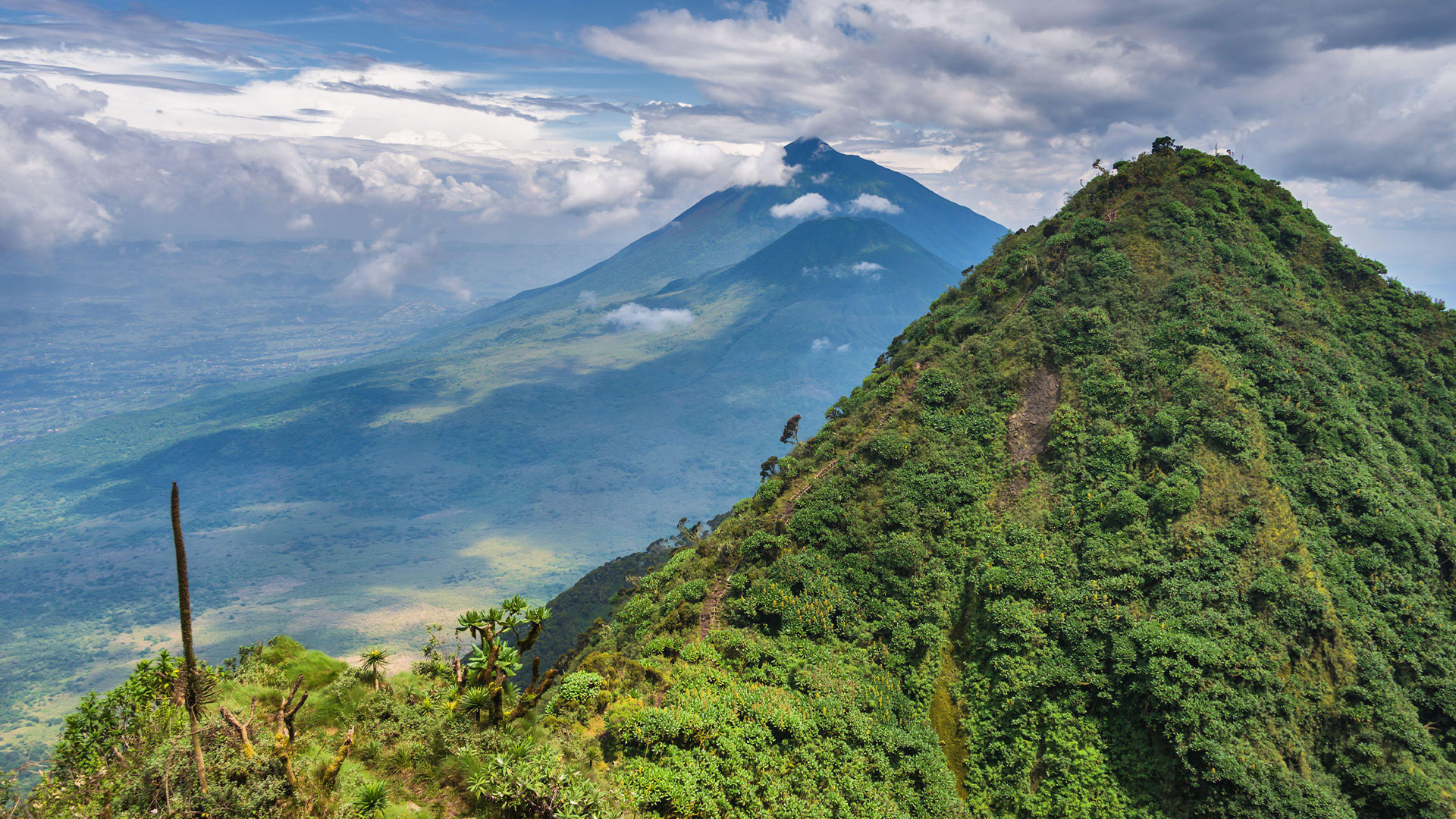
Gorilla trekking in Mgahinga Gorilla National Park offers a distinctive mountain-gorilla experience beneath the forested peaks of the Virunga Mountains in southwestern Uganda. Although Mgahinga is much smaller than Bwindi Impenetrable National Park, it brings together mountain gorillas, golden monkeys, volcanic landscapes, high-altitude hiking, birdwatching and cultural experiences within one compact protected area. Travellers enter a landscape of cultivated highlands, bamboo forest, montane woodland, mist-covered slopes and dramatic volcanic summits shared by Uganda, Rwanda and the Democratic Republic of the Congo.
Mgahinga is particularly attractive to travellers who want more than a single gorilla trek. A visitor can spend one morning searching for the Nyakagezi mountain gorilla family, track endangered golden monkeys on another day, climb one of the Virunga volcanoes, explore forest and birding trails or join a community-led cultural experience associated with the Batwa. The park can also be combined with Lake Mutanda, Kisoro, the Rushaga and Nkuringo sectors of Bwindi or a cross-border safari beginning in Kigali.
Unlike Bwindi, which has four separate gorilla trekking sectors, Mgahinga operates from one main tourism area around the Ntebeko Visitor Centre. This makes its organisation easier to understand, although the number of available gorilla permits and nearby lodges is smaller. Uganda Wildlife Authority currently describes Mgahinga as Uganda’s smallest national park, covering approximately 33.7 square kilometres and rising from about 2,227 metres to 4,127 metres above sea level. The park has one habituated transboundary mountain gorilla group available for regulated tourism.
Location of Mgahinga Gorilla National Park
Mgahinga Gorilla National Park is located in Kisoro District in the far southwestern corner of Uganda. It lies close to the country’s borders with Rwanda and the Democratic Republic of the Congo and protects the Ugandan slopes of three prominent Virunga volcanoes. Kisoro is the nearest major town and serves as the region’s principal transport, accommodation and supply centre.
The park is reached from Kisoro by a mountainous road leading to the Ntebeko Visitor Centre and park entrance. Uganda Wildlife Authority places Ntebeko approximately 14 kilometres from Kisoro and describes the final road as rough, with steep and rocky sections. A four-wheel-drive vehicle is therefore advisable, particularly during wet weather when the unpaved road can become muddy or slippery.
Mgahinga’s small size should not be confused with a limited landscape. The park rises sharply through several ecological zones, beginning with regenerated vegetation and montane forest before reaching bamboo, heath and high-altitude vegetation. These changing habitats support mountain gorillas, golden monkeys, forest birds and a variety of less frequently observed mammals. UWA records wildlife such as buffaloes, elephants, giant forest hogs and leopards, although these animals are difficult to see within the dense vegetation.
The park forms part of the wider Virunga Conservation Area. It adjoins Volcanoes National Park in Rwanda and Virunga National Park in the Democratic Republic of the Congo, creating a continuous highland ecosystem that is not limited by national borders. The protected areas collectively conserve important mountain-gorilla habitat, bamboo forest, watersheds and rare Albertine Rift wildlife.
The Virunga Mountains of Mgahinga
The Virunga Mountains are a chain of volcanic peaks extending through Uganda, Rwanda and the Democratic Republic of the Congo. Mgahinga protects the slopes of three extinct volcanoes: Mount Muhabura, which is also commonly written as Mount Muhavura; Mount Gahinga; and Mount Sabyinyo. These mountains dominate the landscape around Kisoro and provide a dramatic background to gorilla trekking, golden monkey tracking and community life.
Mount Muhabura is Mgahinga’s highest point at approximately 4,127 metres above sea level. Its name is commonly interpreted as “the guide” because its high, symmetrical cone was historically visible from long distances and helped travellers navigate through the region. The upper mountain contains a small crater lake and provides wide views across the Virunga chain when weather conditions are clear.
Mount Gahinga rises to approximately 3,474 metres. Its name refers to the small piles of volcanic stones traditionally cleared from agricultural land by local farmers. The word later gave Mgahinga Gorilla National Park its name. Mount Gahinga has broad bamboo-covered slopes and a swampy crater near its summit.
Mount Sabyinyo has a jagged line of peaks whose appearance inspired a name meaning “old man’s teeth.” Its rugged ridges and deep ravines create a more technical and physically challenging climb than the gentler lower slopes of Mount Gahinga. The mountain stands near the meeting point of Uganda, Rwanda and the Democratic Republic of the Congo. Official sources differ slightly on its measured elevation, so it is safest to describe it as approximately 3,650 metres high.
These volcanoes influence almost every aspect of the Mgahinga experience. They shape the local climate, create high-altitude habitats and form the watersheds that support surrounding communities. They also explain the region’s rich volcanic soils, terraced farms and rolling green landscape. Visitors travelling from Kigali, Kabale or Kisoro see the peaks long before reaching the park entrance.
Cloud and mist frequently cover the summits, especially during the wetter periods. A traveller should therefore not expect uninterrupted volcano views throughout the day. Clear mornings may reveal all three peaks, while changing weather can hide them within minutes. This unpredictability contributes to the park’s mountain atmosphere.
The Nyakagezi Gorilla Family
The Nyak agezi gorilla family is the habituated mountain gorilla group most closely associated with Mgahinga Gorilla National Park. Uganda Wildlife Authority describes Mgahinga as having one habituated transboundary group available for tourism. The word “transboundary” reflects the wider Virunga habitat shared across Uganda, Rwanda and the Democratic Republic of the Congo, although the group has been reliably tracked from Mgahinga for many years.
Nyakagezi has developed a reputation for having a notable presence of mature male gorillas. However, fixed online descriptions of the number of silverbacks, females, juveniles or infants quickly become outdated. Gorilla families change naturally through births, deaths, maturing juveniles, transfers, leadership challenges and movements between groups. The exact composition should therefore be verified through current Uganda Wildlife Authority records rather than treated as permanent information.
The family occupies the forested and bamboo-covered slopes within the Mgahinga section of the Virunga ecosystem. Its movements depend on food availability, nesting locations, seasonal vegetation and interactions between family members. The gorillas are not kept near the park entrance and do not follow a route designed for visitors. Trackers must search for fresh evidence such as nests, footprints, dung, feeding remains and broken vegetation.
Nyakagezi is habituated, meaning its members have gradually become accustomed to the controlled presence of researchers, trackers and small authorised visitor groups. Habituation does not make the gorillas tame. They remain wild animals capable of moving freely, changing direction and responding naturally to their environment. Visitors must maintain the required behaviour and follow ranger instructions throughout the encounter.
Mgahinga’s single tourism family gives the experience a more concentrated character than trekking in Bwindi. There are fewer daily permits, fewer trekking groups and less flexibility for large parties. Travellers hoping to visit Mgahinga should therefore confirm permit availability before committing to accommodation, flights or cross-border arrangements.
The limited number of permits can also be part of Mgahinga’s appeal. The briefing area may feel quieter than the larger trailheads of Bwindi, and visitors often appreciate the sense of entering a small mountain park rather than a widely distributed tourism area. Nevertheless, a smaller operation does not guarantee that visitors will be alone in the forest, nor does it change the official group-size and viewing rules.
The Gorilla Trekking Experience in Mgahinga
The gorilla trekking day begins at the Ntebeko Visitor Centre, which serves as the starting point for gorilla trekking, golden monkey tracking, nature walks and volcano hikes. Visitors arrive early for registration and briefing, during which Uganda Wildlife Authority staff explain the trekking procedure, health requirements, forest behaviour and rules for observing the gorillas.
The park’s published visitor information states that gorilla trekking generally begins at about 8:00 a.m. and often lasts between three and five hours. However, this should be treated as a planning estimate rather than a guaranteed duration. The gorillas’ location changes daily, and a trek may be shorter or longer depending on where the family nested, how far it moved and the condition of the trails.
After the briefing, the group enters the park with ranger guides, trackers and support staff. The initial route may cross open ground or regenerated vegetation before climbing into thicker forest and bamboo. The vegetation and terrain depend on the gorillas’ position. Some treks remain on the lower slopes, while others require more sustained climbing.
The bamboo zone is one of the distinctive features of gorilla trekking in Mgahinga. Tall bamboo stems create a different atmosphere from the tangled broadleaf forest of Bwindi. Light filters through the stems, leaves cover the ground and the gorillas may feed on young bamboo shoots when they are available. Other sections include montane forest, shrubs and old volcanic ground.
Trackers search for evidence from the family’s previous movements. They may identify flattened nesting vegetation, recently eaten plants, footprints or freshly broken branches. Ranger teams communicate with trackers who may have entered the forest earlier, improving the chances of locating the group efficiently.
The terrain remains unpredictable. Mgahinga has steep slopes, mud, roots, rocks and dense vegetation. Its high elevation may also affect visitors who are not accustomed to mountain conditions. Travellers should wear waterproof hiking boots, long trousers, a long-sleeved shirt and a rain jacket. Gardening gloves can protect the hands when holding vegetation for balance.
Hiring a porter is recommended. A porter carries drinking water, rain clothing, packed food and camera equipment while also helping the visitor across slippery or steep sections. Porter employment gives direct financial benefit to families living around the protected area.
Once Nyakagezi is located, the ranger prepares visitors for the observation period. Bags and walking sticks may be left at a safe point with the porters while the group approaches more closely under ranger guidance. Standard gorilla tracking allows a maximum of one hour with the habituated family. Visitors must remain calm, avoid flash photography, keep their voices low and follow instructions when gorillas move nearby.
The encounter may include gorillas feeding on leaves, breaking bamboo, grooming, resting or interacting with younger family members. A silverback may remain watchful while other gorillas spread through the vegetation. Some individuals may be clearly visible, while others may be partly hidden by bamboo and shrubs.
The quality of the experience should not be judged only by the number of photographs obtained. Forest light can be difficult, animals may move frequently and vegetation may block a perfect view. The value of the encounter lies in observing natural behaviour within an active mountain ecosystem.
After the viewing period, visitors move away and begin the return walk to the visitor centre. The return route may feel easier because it is downhill, or it may require a demanding climb depending on where the family was located. Travellers should keep some energy in reserve rather than assuming the hardest part ends when the gorillas are found.
Mgahinga is open for gorilla trekking throughout the year. Rain can occur during any month, but the park brochure identifies December to February and May to August as generally drier periods, with March to April and September to November receiving more rain. Mist and damp conditions are common in the wet seasons.
Golden Monkey Trekking in Mgahinga
 Mgahinga Gorilla National Park is Uganda’s principal destination for seeing the endangered golden monkey. This colourful primate is associated with the bamboo forests of the Virunga Mountains and is recognised by its dark limbs, expressive face and distinctive orange-gold colouring along the back and sides. Uganda Wildlife Authority identifies Mgahinga as the only national park in Uganda where the species occurs.
Golden monkey trekking normally begins from Ntebeko after a ranger briefing. Visitors then enter the forest to search for a habituated troop, commonly moving through bamboo zones where the monkeys feed, rest and travel. The experience is usually faster and more energetic than gorilla trekking because golden monkeys move actively between branches and bamboo stems.
The monkeys may remain high above the ground, making photography difficult, or descend into lower vegetation where visitors can observe their faces and coat colours more clearly. Their movements can be quick and unpredictable, so photographers benefit from a fast shutter speed and equipment capable of working in changing forest light.
Regular golden monkey tracking provides up to one hour of observation after the troop is located. UWA also describes a golden monkey habituation experience that allows visitors to spend a longer day in the field alongside researchers. The longer experience includes searching, following the troop and observing the work involved in monitoring and habituation rather than simply remaining in one place with the monkeys.
Golden monkey trekking is often considered less physically demanding than a mountain-gorilla trek, but it still involves high-altitude forest, muddy trails and uneven ground. The monkeys can travel quickly, requiring visitors to keep moving. Waterproof footwear, rain protection and porter support can still be useful.
Combining mountain gorillas and golden monkeys creates one of the strongest reasons to stay at least three nights around Mgahinga. Travellers can arrive on the first day, trek gorillas on the second, track golden monkeys on the third and continue to their next destination on the fourth. This programme avoids trying to place two forest activities into the same day.
Golden monkey trekking is especially valuable for primate enthusiasts who want to observe two very different species. Mountain gorillas are large, primarily ground-based apes whose movements may be slow and deliberate. Golden monkeys are smaller, faster and more difficult to photograph as they jump through bamboo and forest branches.
Volcano Hiking in Mgahinga
Mgahinga is one of Uganda’s most rewarding destinations for travellers who want to combine wildlife with mountain hiking. Its three Virunga volcanoes can be climbed as full-day activities, although they vary considerably in elevation, terrain and physical difficulty. UWA states that all three summits can be climbed in a day and that the routes can provide views into Rwanda, the Democratic Republic of the Congo, the Albertine Rift and towards Bwindi.
Volcano climbs begin early and should not be treated as casual walks. Hikers need suitable boots, rain protection, warm clothing, drinking water, food and good physical fitness. Weather changes rapidly at high altitude, and cloud may cover the summit even when the lower slopes are clear.
Hiking Mount Gahinga
Mount Gahinga is the lowest of Mgahinga’s three volcanoes at approximately 3,474 metres. Its slopes include bamboo forest and other highland vegetation before reaching a broad, swamp-filled crater near the top. UWA describes the crater as approximately 180 metres wide.
The Gahinga climb is often selected by travellers who want a major mountain activity but do not feel ready for the sustained ascent of Muhabura or the exposed ladders of Sabyinyo. It is still a demanding high-altitude hike, particularly when trails are wet.
The bamboo forest creates opportunities to hear birds and notice signs of primates and larger mammals, although wildlife sightings cannot be promised. The route’s scenery and changing vegetation are as important as the summit itself.
Hiking Mount Sabyinyo
Mount Sabyinyo is recognised by its jagged, tooth-like peaks. The hike involves steep ridges, ravines and fixed ladders placed along difficult sections. UWA describes parts of the climb as steep and exposed, making it most suitable for confident, physically fit hikers who are comfortable with heights.
The route passes through forest and high-altitude vegetation before reaching the upper ridges. The summit area is associated with the point where Uganda, Rwanda and the Democratic Republic of the Congo meet, creating one of the hike’s best-known features.
Rain, mud and strong wind can make the climb considerably harder. Travellers should discuss their experience and fitness honestly with the guide before starting. Sabyinyo is not the best activity for visitors with a serious fear of heights, weak knees or limited balance.
Hiking Mount Muhabura
Mount Muhabura is the park’s highest and most physically demanding volcano at approximately 4,127 metres. The climb involves a long, sustained ascent through montane forest, bamboo, heather and high-altitude vegetation. Near the summit, hikers may encounter giant lobelias, groundsels and a small crater lake.
The mountain’s height makes acclimatisation and endurance important. Travellers who have recently arrived from low altitude may find the climb more difficult than expected. A steady pace, sufficient water and warm summit clothing are essential.
On a clear day, the summit can provide wide views across the Virunga Mountains, Kisoro’s highlands and neighbouring countries. Cloud frequently reduces visibility, but reaching the summit remains a significant achievement even when distant views are limited.
Visitors should not schedule a strenuous volcano climb immediately before their gorilla trek unless they are experienced and confident in their recovery. A rest day, light community activity or golden monkey trek may create a better sequence.
Batwa Cultural Experiences Around Mgahinga
The forests now protected within Mgahinga Gorilla National Park have deep cultural importance for the Batwa, whose ancestors lived as forest-dependent hunter-gatherers. Batwa communities used forest plants for food and medicine, hunted small animals, collected honey and developed detailed knowledge of the mountain environment. The creation and strict protection of the national park brought major changes to their access, settlement and livelihoods.
The Batwa Trail was developed to allow Batwa guides to introduce visitors to elements of their historical forest knowledge. UWA describes guided walks on the lower mountain slopes during which participants learn about traditional plant use, hunting methods, shelters and survival skills. One of the recognised highlights is Garama Cave, a volcanic lava tube historically associated with the Batwa leadership. Full-day and shorter versions of the experience may be available.
A cultural visit should not portray the Batwa as people frozen in the past. Batwa communities are contemporary communities with modern needs, ambitions and challenges. Their history should be explained respectfully, including the effect that conservation-related displacement had on housing, land access and livelihoods.
Travellers should select experiences that are genuinely community-led and provide clear financial benefits to participating guides, performers and households. Permission should be obtained before photographing individuals, homes or children. Visitors should avoid treating cultural demonstrations as staged entertainment without understanding the wider history.
There are also community projects outside the formal Batwa Trail. The Gahinga Batwa Village, created near Mount Gahinga Lodge, provides a permanent home and community facilities for Batwa residents. Volcanoes Safaris reports that the village was established through its partnership trust after community members had been displaced when the national park was gazetted.
Cultural experiences can be combined with gorilla trekking, but they should be allocated enough time. A hurried visit immediately after a long trek may feel superficial. A separate afternoon or morning allows travellers to listen, ask respectful questions and understand the relationship between conservation and neighbouring communities.
Accommodation Around Mgahinga and Kisoro
Accommodation for gorilla trekking in Mgahinga is available near the Ntebeko entrance, in Kisoro town and around nearby lakes such as Mutanda and Mulehe. UWA confirms that both upmarket and budget accommodation can be found near the park, with additional options in Kisoro and around Lake Mutanda.
Staying close to the park entrance is the most convenient arrangement for gorilla trekking, golden monkey tracking and volcano hiking. Early-morning activities begin from Ntebeko, so a nearby lodge reduces the risk of delays and allows visitors to avoid a long transfer before entering the forest.
Mount Gahinga Lodge is one of the main luxury options close to the park. It is positioned near the Mgahinga entrance in the foothills of the Virunga Mountains and is designed as a base for gorilla trekking, golden monkeys, volcano hiking and cultural experiences. The lodge can be reached by following the road from Kisoro towards Mgahinga, with the property situated shortly before the park entrance.
Amajambere Iwacu Community Camp provides a more affordable and community-based option at Ntebeko Gate. The camp offers bandas, dormitory accommodation and camping, and its development is connected with communities displaced during the establishment of the park. Staying there can provide convenient access to early park activities while supporting community initiatives.
Kisoro town offers practical hotels and guesthouses for budget and mid-range travellers. These properties can be useful for visitors arriving late, taking an early domestic flight or combining Mgahinga with southern Bwindi. However, travellers staying in town must allow time for the roughly 14-kilometre morning transfer to Ntebeko.
Accommodation near Lake Mulehe offers a scenic alternative. Lake Mulehe Safari Lodge states that it is about 10 kilometres from Kisoro, approximately 20 kilometres from Mgahinga and around 13 kilometres from Kisoro Airstrip. Its location allows travellers to combine primate activities with lake views, birdwatching and a quieter highland environment.
Lake Mutanda is another attractive base, particularly for travellers combining Mgahinga with Rushaga or Nkuringo in southern Bwindi. The lake provides views towards the Virunga volcanoes and opportunities for canoeing, birdwatching, photography and relaxation. The UWA park brochure places Lake Mutanda approximately 15 kilometres north of Mgahinga, although the exact transfer to a particular lodge depends on its position around the shoreline.
The cheapest lodge is not always the best-value choice. Travellers should consider the condition of the access road, transfer cost, meal plan, electricity, hot water, room type and the time required to reach Ntebeko. A low room price can become inconvenient when the lodge is far from the morning briefing point.
Visitors should ideally spend at least two nights near Mgahinga for a single gorilla trek: one night before and one night afterwards. Three or four nights are better for travellers adding golden monkeys, cultural experiences or a volcano hike.
Access to Mgahinga From Kigali
Mgahinga Gorilla National Park is conveniently accessible from Kigali, making it suitable for travellers whose international flights arrive in Rwanda. The usual route travels north from Kigali through Rwanda’s highlands towards Musanze and the Cyanika border, after which visitors complete immigration procedures and continue into Kisoro District.
Cyanika is an officially recognised border post in Uganda’s Kisoro region. Travellers must carry valid passports and any visas or entry documents required for their nationality. Visa-prone travellers should complete Uganda’s online application process before reaching the border rather than assuming that a visa will automatically be issued on arrival.
The drive from Kigali to accommodation near Mgahinga commonly takes approximately four hours, although immigration procedures, traffic, weather and stops can make the journey longer. A current lodge planning guide also estimates about four hours from Kigali to the Mount Gahinga area.
After crossing at Cyanika, travellers continue through Kisoro and take the final mountain road towards Ntebeko. The route is geographically shorter than travelling from Entebbe or Kampala, making Kigali useful for two-day, three-day and four-day Mgahinga gorilla safaris.
A two-day programme may include a morning departure from Kigali, an afternoon arrival near Mgahinga, gorilla trekking the following morning and a return to Kigali afterwards. This itinerary is possible but fast. A three-day programme provides a more comfortable pace, while four days allow golden monkey tracking or a cultural experience to be added.
Travellers should not plan to land in Kigali and trek gorillas in Mgahinga on the same morning. Gorilla activities begin early, border delays are possible and the permit is valid for a fixed date. Visitors should arrive near the park at least one day before trekking.
Mgahinga can also form part of a longer open-jaw itinerary. A traveller may arrive in Kigali, trek gorillas in Mgahinga, continue to Rushaga or Nkuringo and then travel through Queen Elizabeth and Kibale before finishing in Entebbe. The journey can also operate in reverse.
Access to Mgahinga From Entebbe
Travellers beginning in Uganda can reach Mgahinga by road or domestic flight from Entebbe. The road journey travels through central and western Uganda towards Mbarara, Kabale and Kisoro before continuing to the park.
Uganda Wildlife Authority estimates the road journey from Kampala to Kisoro at about nine hours under suitable conditions. Starting from Entebbe adds airport-area and city-transfer time, so the complete journey should be treated as a full travel day. Traffic, roadworks, meal stops and weather can extend the journey.
The long road route has several advantages. Travellers see Uganda’s changing countryside, agricultural landscapes and southwestern highlands. The journey can also be divided with a night around Lake Mburo, Mbarara, Kabale or Lake Bunyonyi.
A longer safari may approach Mgahinga through Uganda’s western tourism circuit. Visitors can travel from Entebbe to Lake Mburo, continue to Queen Elizabeth National Park, visit Bwindi and finish at Mgahinga before leaving through Kigali. This route avoids treating the long drive as a single transfer.
Domestic flights provide a faster alternative. UWA states that scheduled and charter flights operate from Entebbe International Airport or Kajjansi Airstrip to Kisoro Airstrip, with the flight taking approximately one hour and ten minutes. Visitors then continue by road from Kisoro to their lodge or the park area.
Flights to Kisoro can be affected by weather because the airstrip lies within a mountainous area. Morning schedules, baggage restrictions and transfer arrangements should be confirmed before travel. Travellers carrying heavy camera equipment may need to request additional luggage allowance.
Flying is particularly suitable for luxury travellers, senior visitors and people with limited safari time. It reduces a long road journey but does not remove the need for the final transfer between Kisoro Airstrip, the lodge and Ntebeko.
Travellers Who Should Choose Mgahinga
Mgahinga is especially suitable for travellers who want a quieter and more concentrated gorilla destination. Its single briefing area and smaller number of daily visitors create a different atmosphere from Bwindi’s four-sector system.
It is a strong choice for travellers arriving through Kigali. The Cyanika route provides practical access to Kisoro and Mgahinga, allowing the park to be included in a short Uganda gorilla safari without the full road journey from Entebbe.
Mgahinga is ideal for primate enthusiasts who want to combine mountain gorillas with golden monkeys. Few destinations allow visitors to see both endangered primates within the same compact park. A three- or four-night stay can create a focused Virunga primate experience.
Hikers should also consider Mgahinga. The presence of Mount Gahinga, Mount Sabyinyo and Mount Muhabura allows visitors to combine wildlife with challenging volcano climbs. Active travellers can design a programme containing gorilla trekking, golden monkeys and one major mountain hike.
Photographers may appreciate the contrast between dark mountain gorillas, orange-coloured golden monkeys, bamboo vegetation and volcanic landscapes. However, they must prepare for low forest light, fast-moving monkeys, mist and unpredictable visibility.
Repeat gorilla trekkers who have already visited Bwindi may find Mgahinga particularly rewarding. The Virunga habitat, bamboo forest and volcanic setting create a noticeably different experience from Bwindi’s dense ridges and valleys.
Couples and honeymooners can combine the trek with scenic accommodation around Lake Mulehe, Lake Mutanda or the park’s foothills. The landscape is well suited to travellers who want quiet evenings and dramatic mountain views rather than a busy tourism centre.
Solo travellers can join the official gorilla trekking group while using private transport and guiding for the remainder of the safari. Mgahinga’s compact geography also makes it relatively easy to combine several activities without repeatedly changing lodges.
Families can consider Mgahinga when all gorilla-trekking participants meet the official minimum age requirement. Younger children will need alternative supervised activities during the trek. Lake activities, community walks and nature experiences can provide greater variety for a family itinerary.
Senior travellers may also choose Mgahinga, but the high-altitude environment and steep terrain should be considered honestly. Porter support, suitable accommodation and enough recovery time are important. The location of Nyakagezi changes daily, so a short or easy trek cannot be guaranteed.
Large groups may find Mgahinga less flexible because only one habituated tourism family is regularly available. Bwindi may provide better permit availability for a large party, while Mgahinga works especially well for couples, solo travellers and smaller groups.
Visitors interested mainly in luxury-lodge variety may also find Bwindi offers more choices. Mgahinga has excellent accommodation, but the selection is smaller and concentrated around the park, Kisoro and nearby lakes.
For travellers who value mountain scenery, primate diversity, cultural context and outdoor adventure, gorilla trekking in Mgahinga Gorilla National Park provides one of Uganda’s most complete small-park experiences. Its combination of the Nyakagezi gorilla family, endangered golden monkeys, three Virunga volcanoes, Batwa cultural history and easy access from Kigali makes it a distinctive alternative to Bwindi and an important destination in its own right.

Bwindi Versus Mgahinga Gorilla Trekking
Choosing between Bwindi and Mgahinga gorilla trekking is one of the most important decisions when planning gorilla trekking safaris in Uganda. Both parks protect mountain gorillas, both offer professionally managed trekking experiences, and both allow visitors to spend a controlled period observing a habituated gorilla family in its natural habitat. However, the two destinations differ considerably in size, landscape, trekking organisation, accommodation variety, additional activities, permit availability and connections with other safari destinations.
Bwindi Impenetrable National Park is Uganda’s larger and more established gorilla trekking destination. It contains four separate trekking sectors—Buhoma, Ruhija, Rushaga and Nkuringo—which provide a wider selection of trailheads, accommodation and safari routes. Mgahinga Gorilla National Park is a much smaller destination in the Virunga Mountains, where gorilla trekking is organised through the Ntebeko or Muhavura visitor area. Uganda Wildlife Authority officially recognises the four Bwindi sectors and the Mgahinga entry point as Uganda’s designated gorilla trekking locations.
The best destination is therefore not automatically the park with the greatest number of gorilla families or the widest accommodation range. A traveller should consider where the safari begins, the destinations included before and after the trek, preferred scenery, physical ability, accommodation expectations and interest in activities such as golden monkey trekking, birdwatching, volcano hiking or gorilla habituation.
Quick Comparison of Bwindi and Mgahinga Gorilla Trekking
Bwindi Impenetrable National Park and Mgahinga Gorilla National Park both offer remarkable gorilla trekking experiences in southwestern Uganda, but they differ in size, landscape, accessibility, accommodation and additional activities. The comparison below can help travellers decide which destination is better suited to their interests, travel route and preferred trekking experience.
| Comparison Factor | Bwindi Impenetrable National Park | Mgahinga Gorilla National Park |
|---|---|---|
| Gorilla trekking organisation | Four main trekking sectors: Buhoma, Ruhija, Rushaga and Nkuringo. | One main trekking area, with activities beginning from the Ntebeko Visitor Centre near the Muhavura slopes. |
| Permit availability | Generally wider because gorilla trekking is distributed across several sectors and multiple habituated gorilla families. | More limited because the park has one principal habituated gorilla family used for tourism. |
| Landscape | Ancient rainforest characterised by steep ridges, deep valleys, streams, waterfalls and dense vegetation. | Bamboo forest, montane vegetation and dramatic volcanic slopes within the Virunga Mountains. |
| Trekking difficulty | Varies greatly according to the trekking sector, gorilla location, weather conditions, trail condition and terrain. | Varies according to the gorillas’ location, while the park’s altitude and volcanic slopes can make some routes demanding. |
| Accommodation | Uganda’s largest selection of gorilla trekking accommodation, including budget, mid-range and luxury properties. | A smaller selection near the park, Kisoro, Lake Mulehe and Lake Mutanda, with options across different budgets. |
| Gorilla habituation | Available in selected parts of southern Bwindi, subject to current gorilla habituation permit allocation. | Mgahinga is not the main destination for Uganda’s gorilla habituation experience. |
| Additional activities | Birdwatching, waterfall walks, forest trails, community visits, cultural activities and excursions to nearby lakes. | Golden monkey trekking, volcano hiking, Batwa cultural experiences, birdwatching and guided nature walks. |
| Best wildlife connection | Queen Elizabeth National Park, particularly through the Buhoma and Ishasha route. | Commonly combined with southern Bwindi, Lake Mutanda, Lake Mulehe and other regional primate experiences. |
| Access from Kigali | Convenient for Rushaga and Nkuringo through the Cyanika border, while journeys to Ruhija and Buhoma are generally longer. | Particularly convenient through the Cyanika border and Kisoro route. |
| Access from Entebbe | Accessible by road or domestic flights to Kihihi and Kisoro, depending on the selected trekking sector. | Accessible by road through Kabale and Kisoro or by domestic flight to Kisoro. |
| Best-suited travellers | First-time gorilla trekkers, groups, birdwatchers, luxury travellers and visitors who need greater itinerary flexibility. | Repeat trekkers, hikers, primate enthusiasts and travellers attracted to volcanoes and dramatic mountain scenery. |
| General atmosphere | Larger, more varied and distributed across several independent gorilla trekking and tourism areas. | Smaller, quieter and more concentrated within one compact mountain park. |
The table provides a general guide rather than a guarantee of trekking conditions. Mountain gorillas move freely, and the difficulty and duration of each trek depend on the animals’ location, forest conditions and the route followed on that particular day.
Number of Gorilla Trekking Sectors
The greatest structural difference between Bwindi and Mgahinga is the number of trekking locations available.
Bwindi is divided into four principal gorilla trekking sectors: Buhoma, Ruhija, Rushaga and Nkuringo. Each sector has its own Uganda Wildlife Authority visitor centre, permit allocation, accommodation and access roads. A permit booked for one sector cannot simply be used from another briefing point because visitors must report to the designated location shown in their reservation.
This four-sector system gives Bwindi considerable flexibility. Travellers arriving from Queen Elizabeth National Park can use Buhoma, while those approaching through Kabale or Lake Bunyonyi may consider Ruhija. Visitors beginning in Kigali or Kisoro commonly use Rushaga or Nkuringo. Groups requiring several permits also normally have a better chance of finding suitable availability somewhere within Bwindi, although early booking remains essential.
Mgahinga has one main gorilla trekking area associated with the Ntebeko or Muhavura visitor centre and the Nyakagezi gorilla family. Uganda Wildlife Authority describes the park as having one habituated transboundary group available for tourism. The smaller trekking operation means fewer permits are normally available on any particular date.
This limitation can also be an advantage. Mgahinga may feel quieter and less geographically complicated because visitors do not need to choose between four widely separated sectors. Once the permit and lodge are confirmed, most activities begin from the same general park area.
Travellers organising a large family party, photography group or private group will normally find Bwindi more flexible. Couples, solo travellers and small groups may find Mgahinga’s smaller trekking operation especially appealing.
Accessibility
Both parks are located in southwestern Uganda, but their accessibility depends heavily on the starting point and complete safari route.
Bwindi can be approached from several directions because its four sectors are positioned around different sides of the forest. Buhoma is reached through Kihihi, Butogota or the Ishasha region of Queen Elizabeth National Park. Ruhija is normally reached through Kabale or Lake Bunyonyi. Rushaga and Nkuringo are commonly approached through Kisoro, Kabale or Rwanda.
This variety allows Bwindi to fit into many Uganda safari circuits. However, it can also create confusion. Travellers must know their assigned sector before choosing a lodge or road route. A property advertised as being in Bwindi may still be several hours from the correct trekking centre.
Mgahinga is simpler geographically. Kisoro is the main nearby town, and the park entrance lies along the mountain road leading from the town towards Ntebeko. Uganda Wildlife Authority identifies Kisoro as the nearest major access centre and recommends four-wheel-drive transport for the final road journey.
Travellers approaching from Kigali usually find Mgahinga and the southern Bwindi sectors more convenient than Buhoma. Visitors travelling from Queen Elizabeth National Park normally find Buhoma more practical than Mgahinga because the Ishasha–Buhoma route provides a natural connection between the savannah and forest destinations.
Accessibility should therefore be assessed according to the safari direction:
Choose Buhoma when approaching from Ishasha or Kihihi.
Consider Ruhija when travelling through Kabale or Lake Bunyonyi.
Consider Rushaga or Nkuringo when beginning from Kigali or Kisoro.
Consider Mgahinga when travelling through Kisoro or crossing from Rwanda through the Cyanika region.
Landscape and Scenery
Bwindi and Mgahinga provide very different visual environments.
Bwindi is an ancient Afromontane forest where lower and higher-altitude vegetation zones meet. The landscape contains steep forested ridges, deep valleys, streams, rivers, vines, ferns and thick undergrowth. Uganda Wildlife Authority describes the park as a land of ridges and valleys, while its management documents identify it as an important part of the Albertine Rift ecosystem.
The forest often feels enclosed. Visitors may walk beneath a dense canopy with limited long-distance views. Mist settles over the hills, streams flow through narrow valleys and the sounds of birds and primates travel through vegetation that can hide wildlife only a short distance away.
Bwindi is best for travellers attracted to the atmosphere of an ancient tropical rainforest. Its scenery is rich, green and intimate rather than dominated by wide open mountain views.
Mgahinga has a more dramatic volcanic setting. The park protects the Ugandan slopes of Mount Muhabura, Mount Gahinga and Mount Sabyinyo, which form part of the wider Virunga Mountains shared by Uganda, Rwanda and the Democratic Republic of the Congo.
The landscape includes bamboo forest, montane vegetation, regenerated woodland, volcanic ground and high-altitude slopes. When the weather is clear, the volcanoes rise above the surrounding farmland and villages, creating some of southwestern Uganda’s most impressive scenery.
Mgahinga is normally the better choice for travellers who prioritise volcanic landscapes and mountain views. Bwindi is generally more suitable for visitors who want the atmosphere of a dense, biologically rich rainforest.
Weather can affect both experiences. Clouds and mist may hide the Virunga peaks in Mgahinga, while rain and forest cover may limit views in Bwindi. The landscapes should therefore be appreciated as changing natural environments rather than fixed photographic backgrounds.
Trekking Difficulty
Neither Bwindi nor Mgahinga can guarantee an easy gorilla trek.
Uganda Wildlife Authority advises that gorilla trekking may take approximately two to seven hours and requires a reasonable level of fitness. The duration depends on the location of the assigned gorilla family, terrain and conditions on the trekking day.
Bwindi’s terrain includes steep hills, deep valleys, muddy paths, tangled vegetation, roots, streams and uneven forest floors. The physical demands can differ between the four sectors, but the assigned gorilla family’s location remains the most important factor.
Nkuringo is commonly considered demanding because visitors may descend steeply from the high ridge before climbing back after the encounter. Ruhija also contains high-altitude ridges and valleys. Buhoma may occasionally provide more gradual routes, but it can still involve long and difficult trekking. Rushaga contains varied terrain with steep climbs, streams and dense southern forest.
It would therefore be misleading to describe Buhoma as easy and Nkuringo as always difficult. Gorilla movements change daily. A family in Buhoma may move deep into the forest while a Nkuringo family remains relatively close to the trailhead.
Mgahinga’s terrain includes high-altitude forest, bamboo zones and the lower volcanic slopes. The park rises from approximately 2,227 metres to 4,127 metres above sea level, so altitude may be more noticeable for travellers who have recently arrived from lower elevations.
The Nyakagezi family may sometimes remain in relatively accessible bamboo areas, but it can also move farther or higher into the park. Mud, rocks, roots and volcanic slopes can make the trek physically demanding.
Travellers should choose either destination with the understanding that difficulty cannot be predicted perfectly. Porter support, proper footwear, walking sticks and basic fitness preparation are recommended in both parks.
For travellers with mobility limitations, the decision should be based on current park arrangements, porter assistance, accommodation location and honest communication during the morning briefing rather than on general claims that one park is always easier.
Accommodation Options
Bwindi offers a much wider accommodation range than Mgahinga because tourism is distributed across four sectors.
Buhoma has the most established selection, including community accommodation, budget camps, comfortable mid-range lodges and premium forest properties. Ruhija provides a smaller collection of quiet forest lodges and camps. Rushaga has a growing range of budget, mid-range and luxury accommodation, while Nkuringo offers scenic lodges positioned on elevated ridges overlooking the forest and surrounding highlands.
This variety makes Bwindi especially suitable for travellers with specific accommodation requirements. Luxury visitors can select high-end forest lodges, families can search for larger rooms or cottages, and budget travellers can choose simpler properties near the appropriate briefing point.
The main accommodation rule is that the lodge must match the permit sector. A visitor with a Buhoma permit should normally stay in Buhoma, while a Rushaga permit should be matched with accommodation in or close to Rushaga. Travelling between distant sectors early in the morning creates unnecessary risk.
Mgahinga has fewer accommodation options, but visitors can stay close to the park entrance, in Kisoro, beside Lake Mulehe or around Lake Mutanda. The selection includes basic community accommodation, town hotels, comfortable lakeside lodges and a small number of luxury options.
Staying near Ntebeko is most convenient for early gorilla trekking, golden monkey tracking and volcano hiking. Kisoro offers more practical budget and town-based accommodation but requires an early transfer to the park. Lakeside properties provide better scenery and relaxation, although transfer distances must be checked carefully.
Bwindi is normally the stronger choice for travellers who want the widest possible accommodation selection. Mgahinga is suitable for visitors who are comfortable choosing from a smaller collection of mountain, town or lakeside properties.
Additional Activities
Both parks offer activities beyond mountain gorilla trekking, but the experiences are different.
Bwindi is particularly strong for forest walks, birdwatching and community activities. Visitors can explore waterfall trails, riverside paths, forest-edge walks and routes through different vegetation zones. Ruhija is especially valuable for birdwatchers seeking Albertine Rift species, while Buhoma provides established waterfall and community walks.
Travellers can also combine Bwindi with Lake Bunyonyi or Lake Mutanda for canoeing, boat trips and relaxation. Community experiences around the different sectors may include farming demonstrations, crafts, local food, music, storytelling and respectfully organised Batwa or Bakiga cultural activities.
Mgahinga offers a more concentrated range of mountain and primate activities. The park is Uganda’s principal destination for golden monkey trekking, and Uganda Wildlife Authority identifies it as the country’s only national park protecting this endangered primate.
Golden monkey trekking is one of the strongest reasons to choose Mgahinga. Visitors can spend one day trekking the Nyakagezi gorilla family and another following golden monkeys through the bamboo forest. The two experiences are noticeably different because golden monkeys move quickly through branches and bamboo while gorillas are larger and often spend more time on or near the ground.
Mgahinga also provides volcano hiking on Mount Gahinga, Mount Sabyinyo and Mount Muhabura. All three mountains can be attempted as full-day hikes, although their routes and difficulty differ. The park brochure also identifies the Batwa Trail, nature walks and birdwatching as important activities.
Travellers interested mainly in forest ecology and birding may prefer Bwindi. Those interested in golden monkeys, volcanic scenery and challenging mountain hikes may prefer Mgahinga.
Gorilla Habituation Experience
Bwindi is the destination to choose when Uganda’s gorilla habituation experience is a major travel priority.
The habituation experience allows visitors to accompany researchers and habituators working with gorillas that are gradually becoming accustomed to controlled human presence. It differs from standard trekking in duration, permit cost, group arrangements and the behaviour visitors may observe. Uganda Wildlife Authority officially defines the activity as participation alongside researchers and habituation teams in the forest.
The experience is associated primarily with selected parts of southern Bwindi, particularly the Rushaga area, although exact family locations and entry arrangements must be confirmed when booking. Availability is limited and can change according to the stage of habituation and park-management decisions.
Mgahinga is not normally promoted as Uganda’s main gorilla habituation destination. Gorilla tourism there focuses on standard trekking with the habituated Nyakagezi family.
Travellers who want a longer, research-oriented gorilla experience should therefore prioritise Bwindi. Visitors satisfied with the standard one-hour observation period can choose either park.
It is important not to describe habituation as several guaranteed hours sitting beside gorillas. The complete experience includes searching, following the animals and observing the work of researchers and trackers. The gorillas may move frequently, and forest conditions can be physically demanding.
Connections With Other Safari Destinations
Bwindi is generally easier to include within a complete Uganda wildlife circuit because its sectors connect with several major destinations.
Buhoma provides the strongest connection with Queen Elizabeth National Park. The Ishasha region lies approximately 64 kilometres from Bwindi, although the journey is mainly on unpaved roads and requires suitable transport.
A common itinerary travels from Queen Elizabeth National Park through Ishasha to Buhoma, allowing visitors to move from savannah wildlife viewing to gorilla trekking. The journey can continue from Bwindi to Lake Bunyonyi, Lake Mutanda, Mgahinga or Kigali.
Ruhija connects well with Kabale and Lake Bunyonyi. Rushaga and Nkuringo connect naturally with Kisoro, Lake Mutanda and Mgahinga Gorilla National Park. This makes Bwindi highly flexible for routes that combine gorillas with chimpanzees, game drives, boat cruises, birdwatching and cultural experiences.
Mgahinga connects most naturally with Kisoro, Lake Mutanda, Lake Mulehe and southern Bwindi. Travellers can trek gorillas in Mgahinga and then continue to Rushaga or Nkuringo for another gorilla experience. They can also combine Mgahinga with golden monkeys before travelling north towards Queen Elizabeth or Kibale.
Mgahinga is less directly connected with Uganda’s major savannah parks than Buhoma. Reaching Queen Elizabeth National Park requires travelling through Kisoro and the surrounding highlands before continuing north. This is manageable within a longer itinerary but less convenient for a short gorilla-and-wildlife safari.
Bwindi is therefore usually better for travellers combining gorillas with Queen Elizabeth National Park, Kibale or a broad western Uganda circuit. Mgahinga is especially suitable for a focused Virunga itinerary combining gorillas, golden monkeys, mountains, lakes and southern Bwindi.
Access From Kigali
Both Mgahinga and southern Bwindi are accessible from Kigali, but Mgahinga normally provides the most direct geographical connection.
Travellers heading to Mgahinga usually drive through northern Rwanda towards the Cyanika border region, enter Uganda and continue through Kisoro to their lodge or the park area. Because Mgahinga lies close to Kisoro and the Rwandan border, it works well for short gorilla safaris beginning and ending in Kigali.
Rushaga and Nkuringo are also practical from Kigali. After crossing into southwestern Uganda, travellers continue through Kisoro, Kabale or the appropriate mountain roads towards southern Bwindi. The exact route depends on the confirmed permit sector and lodge.
Ruhija can be reached from Kigali, but the journey is generally longer than travelling to Rushaga, Nkuringo or Mgahinga. Buhoma is the least convenient of the main gorilla areas for a short Kigali-based safari because it lies on the northern side of Bwindi.
Travellers should always arrive near the trekking destination one day before the gorilla permit date. Border procedures, weather, traffic and road conditions can extend the journey. Attempting to cross from Kigali and reach the morning briefing on the same day creates a serious risk of missing the trek.
For a short two-day or three-day safari from Kigali, Mgahinga, Rushaga and Nkuringo are normally the strongest options. Mgahinga is especially attractive when golden monkey trekking or Virunga scenery is also important.
Access From Entebbe
Bwindi and Mgahinga can both be reached from Entebbe by road or domestic flight.
The road journey requires a full travel day. Travellers drive through central and western Uganda before continuing towards Kabale, Kisoro or the appropriate Bwindi sector. The route can be divided with an overnight stop around Lake Mburo, Mbarara, Kabale or Lake Bunyonyi.
Bwindi has two principal flight-access options. Scheduled and charter flights from Entebbe serve Kihihi Airstrip for the northern side of the park and Kisoro Airstrip for Rushaga and Nkuringo. Uganda Wildlife Authority estimates these flights at approximately one hour and ten minutes, followed by a road transfer to the lodge.
Kihihi is most useful for Buhoma and some northern Bwindi itineraries. Kisoro is the main air access point for southern Bwindi.
Mgahinga is served by flights to Kisoro Airstrip. UWA states that scheduled and charter flights operate from Entebbe or Kajjansi and take approximately one hour and ten minutes. Travellers then continue by road to Kisoro, their lodge or Ntebeko.
The road journey from Kampala to Kisoro is estimated by UWA at approximately nine hours under suitable conditions, while beginning in Entebbe may add additional transfer time.
Bwindi generally provides greater flexibility from Entebbe because travellers can use Kihihi or Kisoro depending on the trekking sector. Mgahinga is straightforward by air through Kisoro but has only one regional air-access option.
Which Is Better for First-Time Gorilla Trekkers?
Bwindi is usually the better choice for first-time gorilla trekkers because it offers more permit options, four different sectors and the widest selection of accommodation. It is easier to adapt a Bwindi safari around a traveller’s preferred budget, arrival point and onward destination.
The park is also well suited to visitors combining mountain gorillas with Queen Elizabeth National Park, Kibale, Lake Bunyonyi or other attractions in western Uganda.
Mgahinga can still be an excellent first gorilla destination, particularly for travellers arriving through Kigali or visitors who want a quieter mountain setting. A first-time trekker interested in golden monkeys and Virunga scenery may prefer Mgahinga despite its more limited permit availability.
Which Is Better for Repeat Gorilla Trekkers?
Mgahinga is especially attractive to travellers who have already trekked in Bwindi. Its bamboo forest, volcanic setting and Nyakagezi family provide a noticeably different environment from Bwindi’s dense rainforest ridges.
Repeat visitors can combine a Mgahinga gorilla trek with golden monkey tracking or a volcano hike, creating a more varied mountain adventure.
Travellers returning specifically for the gorilla habituation experience should choose Bwindi because Mgahinga is not Uganda’s main habituation destination.
Which Is Better for Photographers?
Both parks offer excellent photographic opportunities, but they create different backgrounds and challenges.
Bwindi provides dense rainforest, vines, tree ferns and layered green vegetation. Photographers may appreciate the variety created by four trekking sectors and the possibility of completing more than one trek. However, the forest can be dark and obstructed, requiring equipment that performs well at higher ISO settings.
Mgahinga provides bamboo, volcanic vegetation and occasional wider views. Golden monkey trekking also adds a second specialised photography experience. The monkeys are fast-moving, while the gorillas may be surrounded by bamboo rather than the broadleaf vegetation common in Bwindi.
Photographers seeking additional observation time should consider the habituation experience in Bwindi. Those seeking a broader collection of primate and volcanic images may prefer Mgahinga.
Which Is Better for Birdwatchers?
Bwindi is generally the stronger choice for dedicated birdwatchers. The park is recognised for its Albertine Rift biodiversity, and the Ruhija area is especially important for forest birding. Trails such as the Mubwindi Swamp route attract travellers searching for rare and localised species.
Mgahinga also provides valuable Albertine Rift birdwatching, particularly around the bamboo forest, Sabyinyo Gorge and montane habitats. It can be included in a larger birding itinerary connecting Bwindi, Echuya Forest and the Virunga highlands.
Serious birdwatchers may choose Bwindi as the main base and add Mgahinga for additional high-altitude species and golden monkeys.
Which Is Better for Hikers?
Mgahinga is the clear choice for travellers who want major mountain hiking in addition to gorilla trekking. Mount Gahinga, Mount Sabyinyo and Mount Muhabura provide full-day climbing opportunities through changing vegetation zones.
Bwindi provides forest walks, waterfall trails and long cross-forest routes, but it does not offer the same volcanic summit experience.
Active travellers can spend several days in Mgahinga combining gorilla trekking, golden monkeys and a volcano climb. The activities should be spaced carefully to allow physical recovery.
Which Is Better for Luxury Travellers?
Bwindi offers the widest luxury accommodation selection. Several high-end properties are located around Buhoma, Rushaga and Nkuringo, providing different room categories, forest views, dining styles and service levels.
Luxury travellers can also fly into Kihihi or Kisoro, reducing the long road journey from Entebbe. This flexibility makes Bwindi especially suitable for high-end itineraries.
Mgahinga has fewer luxury properties, but its smaller selection includes scenic mountain and lakeside options. Travellers who value privacy, volcanic views and a quieter atmosphere may prefer Mgahinga despite having fewer lodge choices.
Luxury improves the comfort surrounding the trek but does not change the natural trekking conditions. Visitors in both parks must still prepare for mud, rain, uneven ground and unpredictable gorilla movements.
Which Is Better for Budget Travellers?
Both parks can accommodate budget travellers.
Bwindi has a larger number of budget camps, guesthouses and community properties across the four sectors. This creates more choice, but visitors must ensure that the selected property is close to the correct trekking centre.
Kisoro provides affordable accommodation for visitors trekking in Mgahinga. Community accommodation is also available closer to the park. Travellers staying in town must include the early road transfer to Ntebeko in their planning.
The gorilla permit remains the largest fixed cost regardless of accommodation category. Budget travellers should therefore focus on reducing accommodation and transport costs without compromising permit authenticity, vehicle reliability or proximity to the briefing point.
Which Is Better for Short Safaris From Kigali?
Mgahinga is usually the most convenient option for a short safari from Kigali because of its position near Kisoro and the Cyanika border region.
Rushaga and Nkuringo are also suitable and may provide greater permit availability or a wider accommodation selection. The final choice should depend on confirmed permits, lodge location and the activities included.
Buhoma is normally less practical for a very short Kigali itinerary because reaching the northern side of Bwindi requires additional road travel.
Which Is Better for a Complete Uganda Safari?
Bwindi is generally the better option for a longer Uganda safari containing chimpanzees, wildlife and boat activities.
A route can connect Kibale National Park, Queen Elizabeth National Park and Bwindi before ending in Kigali or returning towards Entebbe. Buhoma is especially convenient from Ishasha, while the other sectors can be incorporated according to the direction of travel.
Mgahinga can still be included in a complete Uganda circuit, particularly when the traveller wants golden monkeys, volcano hiking or a second gorilla trek. It normally works best near the beginning or end of the safari rather than as the only gorilla destination in a broad western Uganda route.
Final Decision: Bwindi or Mgahinga?
Choose Bwindi Impenetrable National Park when you want:
The widest gorilla permit availability.
Four trekking sectors from which to choose.
More budget, mid-range and luxury accommodation.
Gorilla habituation.
Strong birdwatching and forest walks.
Easy connections with Queen Elizabeth National Park.
A longer safari combining gorillas, chimpanzees and savannah wildlife.
Greater flexibility for families and private groups.
Choose Mgahinga Gorilla National Park when you want:
A smaller and quieter gorilla destination.
Virunga volcanic scenery.
Golden monkey trekking.
Volcano hiking.
A focused primate and mountain adventure.
Convenient access from Kigali through the Kisoro region.
An experience that differs from Bwindi.
A strong choice for repeat gorilla trekkers, hikers and active travellers.
There is no universal winner in the Bwindi versus Mgahinga gorilla trekking comparison. Bwindi provides greater flexibility, accommodation variety and easier connections with Uganda’s main wildlife circuit. Mgahinga offers a smaller, scenic and activity-rich experience centred on the Virunga Mountains.
For most first-time visitors planning a complete Uganda safari, Bwindi will normally be the more practical choice. For travellers who prioritise volcanic scenery, golden monkeys, hiking and a quieter park environment, Mgahinga may provide the more rewarding experience. Travellers with sufficient time can visit both parks, combining the ancient rainforest of Bwindi with the bamboo forests and volcanic slopes of Mgahinga.
Uganda Gorilla Trekking Permits
A Uganda gorilla trekking permit is an official authorisation that allows one named visitor to participate in a mountain gorilla trekking or gorilla habituation activity on a specific date and from a designated entry point. The permit is issued through the Uganda Wildlife Authority, commonly known as UWA, which manages gorilla tourism in Bwindi Impenetrable National Park and Mgahinga Gorilla National Park. It is not a general entrance ticket that can be used in any part of Bwindi or on any convenient day. It is connected to a particular traveller, activity, trekking date and park entry point.
Every person who intends to trek mountain gorillas must have a valid permit. Travellers cannot arrive at Bwindi or Mgahinga and expect to join a trek without advance confirmation, even when they have already paid for accommodation, transport or a safari package. UWA validates the permit and the visitor’s identification at the designated briefing centre before allowing the traveller to proceed for the morning briefing and trek. Visitors who attempt to track gorillas without an authorised guide, valid documentation and proof of payment are not permitted to participate.
Uganda gorilla permits are among the most important parts of planning gorilla trekking safaris in Uganda because their availability determines the trekking date, park, sector, accommodation location and transport route. The permit should therefore normally be secured before non-refundable lodge bookings, domestic flights and complicated safari arrangements are completed.
What Is a Uganda Gorilla Permit?
A Uganda gorilla permit is a controlled wildlife-tourism ticket issued for either standard gorilla trekking or the gorilla habituation experience. It gives the named permit holder permission to enter the gorilla habitat under the supervision of Uganda Wildlife Authority ranger guides and trackers.
For standard gorilla trekking, visitors begin after the morning briefing and search for a fully habituated gorilla family. Once the family is located, the standard viewing period is a maximum of one hour. Gorilla trekking in Uganda is organised in Bwindi Impenetrable National Park and Mgahinga Gorilla National Park, and UWA advises that the complete activity may take approximately two to seven hours depending on the gorillas’ location, terrain and forest conditions.
The gorilla habituation experience is a different activity. It allows visitors to accompany researchers, trackers and habituators working with a gorilla family that is gradually becoming accustomed to controlled human presence. It begins earlier than standard trekking and provides a longer maximum observation period once the gorillas are encountered. Gorilla habituation is offered in selected parts of Bwindi and is not the standard tourism activity in Mgahinga.
A permit does not give the visitor ownership of an entire gorilla group or a private trek. Standard permit holders are normally placed with other authorised visitors according to the permitted group size and park procedures. Private safari transport and accommodation can be organised separately, but the actual gorilla encounter remains a regulated UWA activity.
Why Uganda Gorilla Permits Are Required
Gorilla permits are required primarily to control the number of people entering the mountain gorillas’ habitat. Mountain gorillas are endangered wild primates that live in sensitive forest ecosystems. Uncontrolled visitor access could increase stress, disturb feeding and social behaviour, damage vegetation and expose the gorillas to human illnesses.
The permit system allows UWA to limit the number of trekkers visiting each habituated gorilla family. Standard gorilla tourism generally allows a maximum of eight visitors per gorilla group, while all participants must follow health, distance, photography and behavioural regulations. Visits to a standard tourism family are limited to one hour after the gorillas are reached.
Permit revenue also contributes to the management and protection of the national parks. Official UWA tariff information states that the gorilla permit rate includes the guide fee, park entrance for the day and a community-development contribution. Permit income supports wider conservation activities such as ranger operations, tourism management, monitoring and community programmes around the protected areas.
The permit system also helps UWA collect accurate visitor information. Names, nationality, residency status and other identification details are connected to the booking so that the correct price category can be verified and visitor records can be maintained. Travellers who book under one category but present documents belonging to another category may be treated as having attempted to obtain a permit fraudulently.
What Does a Uganda Gorilla Permit Include?
A standard Uganda gorilla trekking permit normally includes:
Entry into Bwindi Impenetrable National Park or Mgahinga Gorilla National Park for the gorilla activity on the booked date.
The morning registration and ranger briefing.
Services of Uganda Wildlife Authority guides and trackers.
The guided forest search for the assigned habituated gorilla family.
A maximum of one hour observing the gorillas after they are located.
Park entrance fees for the day of the gorilla activity.
A community-development contribution included within the permit tariff.
A gorilla habituation permit includes entry for the specialised habituation activity, UWA field staff and the longer habituation experience. The total field day may be lengthy because it includes searching for the gorillas and following the habituation team. The longer viewing allowance begins once the gorillas are encountered rather than immediately when visitors leave the briefing centre.
The permit does not normally include accommodation, transport to the park, safari vehicle expenses, meals outside the park arrangements, porter services, personal equipment, travel insurance, visas, tips or other activities. These services may be included when the permit forms part of a complete Uganda gorilla trekking safari package, but they are not automatically provided by the permit itself.
The permit is also not an assurance that every visitor will obtain uninterrupted photographs or that the trek will be short. The gorillas move freely, forest vegetation may restrict views and weather can change quickly. The permit provides the authorised opportunity to track and observe the gorillas under official management.
Uganda Gorilla Permit Prices
Uganda gorilla permit prices depend on the activity and the traveller’s nationality or residency category. Rates are quoted in United States dollars for most international categories and in Uganda shillings for East African Community citizens.
Standard Uganda Gorilla Trekking Permit Rates
The standard gorilla tracking tariff is:
Uganda Gorilla Trekking Permit Prices
The cost of a standard gorilla trekking permit in Uganda depends on the visitor’s nationality and residency category. Each permit is issued per person for a specific trekking date and allows the visitor to participate in one standard gorilla trekking experience.
| Visitor Category | Standard Gorilla Trekking Permit |
|---|---|
| Foreign Non-Resident | USD 800 per person |
| Foreign Resident | USD 700 per person |
| Rest of Africa Citizen | USD 500 per person |
| East African Community Citizen | UGX 300,000 per person |
The February 2026 UWA tariff notice confirms the same standard rates from 1 January 2027. It also introduced discounted low-season tracking rates for foreign non-residents and foreign residents during April, May and November.
Uganda Low-Season Gorilla Permit Rates
For travel during April, May and November, UWA introduced the following discounted rates:
Uganda Low-Season Gorilla Permit Prices
Low-season gorilla permits offer eligible travellers a reduced permit price during selected travel periods. The amount payable depends on the visitor’s residency category, as shown in the table below.
| Visitor Category | Low-Season Gorilla Permit |
|---|---|
| Foreign Non-Resident | USD 600 per person |
| Foreign Resident | USD 500 per person |
On smartphones and small tablets, swipe horizontally across the table to view all columns.
UWA’s published low-season notice states that these discounted permits took immediate effect and cannot be rescheduled. The notice did not publish separate low-season discounts for Rest of Africa or East African Community categories, so travellers in those categories should confirm the applicable amount on the official UWA invoice.
The discounted price does not mean that visitors receive a shorter trek or an inferior gorilla family. The same official trekking procedures apply. The principal difference is the reduced permit price during the stated low-season months and the prohibition on rescheduling the discounted permit.
Gorilla Habituation Permit Rates
The previously published Uganda gorilla habituation rates were:
Uganda Gorilla Habituation Permit Prices for 2026
The cost of a gorilla habituation permit for 2026 bookings depends on the traveller’s citizenship or residency category. The gorilla habituation experience allows visitors to spend more time observing a gorilla family that is undergoing the habituation process.
| Visitor Category | Gorilla Habituation Permit for 2026 Bookings |
|---|---|
| Foreign Non-Resident | USD 1,500 per person |
| Foreign Resident | USD 1,000 per person |
| Rest of Africa Citizen | USD 1,000 per person |
| East African Community Citizen | UGX 750,000 per person |
On a smartphone or small tablet, swipe horizontally across the table to view all columns.
UWA has announced revised habituation tariffs effective 1 January 2027:
Uganda Gorilla Habituation Permit Prices from 1 January 2027
Uganda gorilla habituation permit prices will vary according to the traveller’s citizenship or residency category from 1 January 2027. The table below shows the applicable permit price for each visitor category.
| Visitor Category | Gorilla Habituation Permit from 1 January 2027 |
|---|---|
| Foreign Non-Resident | USD 1,800 per person |
| Foreign Resident | USD 1,600 per person |
| Rest of Africa Citizen | USD 1,000 per person |
| East African Community Citizen | UGX 750,000 per person |
On smartphones and small tablets, swipe horizontally across the table to view all columns.
The January 2027 adjustment raises the foreign non-resident and foreign-resident habituation rates while keeping the announced Rest of Africa and East African Community prices unchanged.
Because UWA may amend tariffs and issue promotional notices, travellers should treat the official proforma invoice prepared for their exact date as the final price confirmation. The published UWA rates page currently displays the existing tariff material together with the February 2026 changes, making direct confirmation especially important for any travel date that falls between tariff periods.
Uganda Gorilla Permit Visitor Categories
Uganda Wildlife Authority divides visitors into four principal pricing categories.
East African Community Citizens
This category applies to citizens of East African Community member states and officially registered refugees in Uganda. Visitors must present an accepted national identity card, passport or qualifying refugee identification document.
The UWA guidelines list Uganda, Kenya, Tanzania, Rwanda, Burundi, the Democratic Republic of the Congo, South Sudan and Somalia among the East African Community countries covered by this category.
A person does not qualify for the East African rate merely because they currently live or work in one of these countries. Citizenship or another officially accepted EAC status must be proven with valid documentation.
Rest of Africa Citizens
The Rest of Africa category applies to citizens of African countries that are not members of the East African Community. A valid passport is required to prove nationality.
This category is based on citizenship rather than where the visitor currently lives. For example, an African citizen living outside Africa may still qualify for the Rest of Africa rate when presenting a valid passport from an eligible African country.
Foreign Residents
The foreign-resident category applies to foreign citizens legally residing in an East African Community member state. They must present valid evidence such as a residence permit, work permit, student pass, dependent pass or another accepted residence document together with a passport.
Simply holding a long tourist visa or spending several months in Uganda does not automatically make a visitor a foreign resident. The residency documentation must be valid and accepted by UWA.
Foreign Non-Residents
Foreign non-residents are visitors from outside the East African Community who do not qualify as East African citizens, Rest of Africa citizens or legal foreign residents in an EAC member state.
A valid passport is required. Gorilla permits for foreign non-residents must be purchased through a tour and travel operator licensed by the Uganda Tourism Board.
Types of Uganda Gorilla Permits
Travellers may encounter two different meanings when the term “permit category” is used.
The first meaning refers to the activity category:
Standard gorilla trekking permit.
Gorilla habituation experience permit.
The second meaning refers to how UWA classifies the ticket administratively:
Normal permits purchased at the prevailing tariff.
Promotional or discounted permits issued under a special campaign.
Complimentary permits issued for approved official or promotional purposes.
Commission permits issued to qualifying tour operators or associations under UWA arrangements.
Ordinary travellers normally use standard fully paid permits or officially announced promotional permits. Complimentary and commission permits are not general public discounts.
Promotional and complimentary permits cannot normally be rescheduled. The 2026 low-season gorilla permits are also specifically non-reschedulable.
Where Uganda Gorilla Permits Are Valid
Uganda gorilla permits are booked according to the date and designated entry point.
The recognised entry points are:
Buhoma Visitor Information Centre.
Ruhija Visitor Information Centre.
Rushaga Visitor Information Centre.
Nkuringo Visitor Information Centre.
Ntebeko or Muhavura Visitor Information Centre for Mgahinga and the Nyakagezi gorilla family.
The four Bwindi locations are commonly called gorilla trekking sectors. Mgahinga has one main gorilla tourism entry area rather than four separate sectors.
A traveller normally books a permit for a sector or entry point, not for a guaranteed named gorilla family. Specific family allocation takes place on the trekking day according to UWA procedures, family location, operational conditions and the available visitor groups.
How to Check Uganda Gorilla Permit Availability
Permit availability should be checked before finalising the rest of the safari. The request should contain the preferred date, number of travellers, activity and desired entry point.
Foreign non-residents should ask a Uganda Tourism Board-licensed tour operator to check availability through the UWA booking system. Foreign residents and East African Community citizens who qualify for direct booking may contact the Uganda Wildlife Authority reservations office through its approved channels.
A proper availability request should include at least one or two alternative dates. It may also include alternative sectors, particularly when the traveller’s priority is to obtain permits rather than trek from one specific location.
For example, a traveller may request:
First choice: Rushaga on 15 August.
Second choice: Nkuringo on 15 August.
Third choice: Rushaga or Nkuringo on 16 August.
When the preferred date or sector is unavailable, the reservations team can advise on alternative dates or entry points with remaining spaces. The booking system displays availability by date and location, and an operator cannot complete the booking when the selected entry point has no remaining spaces.
Availability should not be assumed merely because a lodge still has rooms. Accommodation and gorilla permits are controlled through separate systems. A lodge may be available when all gorilla permits for the nearby briefing point have already sold out.
How to Book Uganda Gorilla Permits
The booking procedure depends partly on the visitor category.
Booking for Foreign Non-Residents
Foreign non-residents must purchase gorilla permits through a tour operator licensed by the Uganda Tourism Board. Before paying, travellers should verify that the company is properly licensed and should avoid sending permit payments to an unverified individual or unlicensed intermediary.
The normal process is:
The traveller sends the operator the preferred date, number of participants and preferred park or Bwindi sector.
The operator checks live availability through the UWA reservations system.
The operator advises whether the preferred permits are available and may suggest alternatives.
The traveller provides the required personal and passport information.
The operator requests an official booking and invoice.
Full permit payment is made so the permits can be secured.
The operator receives the UWA receipt and booking confirmation.
Visitor details are updated and the permit documentation is prepared before the trekking date.
Booking for Foreign Residents and East African Citizens
Qualifying foreign residents and East African citizens may purchase permits directly through UWA for themselves and eligible resident family members. Payments must be made through official UWA channels and must be connected to a valid invoice.
Foreign residents should be prepared to provide both their passport and valid residency documents. East African citizens must present accepted proof of citizenship.
Information Required to Book a Gorilla Permit
The exact booking information requested may depend on the system and visitor category, but travellers should normally prepare:
Full name exactly as it appears in the passport or accepted identity document.
Passport number or national identity number.
Nationality.
Date of birth.
Visitor category.
Copy of the passport biodata page.
Valid residence or work permit when claiming the foreign-resident rate.
Preferred trekking date.
Alternative dates.
Selected park and Bwindi sector or Mgahinga entry point.
Standard trekking or gorilla habituation.
Number of travellers.
Email address and contact information.
UWA requires visitor biodata to be added to the permit before the tracking date when it was not captured during the initial reservation. At the park, the documents presented by the visitor are checked against the information in UWA’s booking records.
Names and passport details should be checked carefully before final confirmation. Spelling mistakes, incorrect nationality or an inaccurate visitor category can create delays during permit validation.
Uganda Gorilla Permit Payment Process
Uganda Wildlife Authority requires gorilla permit payments to be made in full. It does not accept a partial deposit against an official gorilla permit.
A safari company may offer its own deposit arrangement for the complete tour, but the portion needed to secure the gorilla permits must still be sufficient for the operator to make the required full payment to UWA. The operator cannot secure a fully paid permit by sending only a small percentage of its value.
UWA previously allowed operators to hold permits for seven days without payment. That unpaid reservation window was suspended with effect from 1 March 2026. Permits are now secured only when full payment is made at the time of booking. Unpaid enquiries or provisional requests do not guarantee availability.
This change makes quick decision-making more important. When availability is confirmed, another operator may purchase the same spaces before payment is completed.
Official payment methods may include:
Approved online card or mobile-money payment options.
Point-of-sale card payments at designated UWA locations in Kampala.
Bank deposit or transfer to an official UWA account based on an issued invoice.
Approved mobile-money merchant payment channels.
Foreign non-resident travellers normally pay their licensed tour operator, which then completes the official UWA transaction. Travellers should receive a company invoice or payment request clearly indicating that the gorilla permit is included.
Money should never be deposited into an account merely because someone claims to represent UWA. The UWA advisory instructs clients to obtain a proforma invoice before paying and warns against transfers to unauthorised people or individual mobile numbers.
Bank charges and transfer fees must be considered because UWA requires the full invoiced amount to reach its account. A payment that arrives short of the invoiced amount may delay permit issuance.
How a Gorilla Permit Is Confirmed
A permit should not be considered secured simply because an availability request has been sent or because an operator has verbally said that spaces exist.
Confirmation normally involves:
An official UWA booking or invoice.
Full payment.
A system-generated receipt.
A booking identification number or permit record.
Visitor details connected to the reservation.
Confirmation of the trekking date and designated entry point.
After successful payment, UWA issues a system-generated receipt to the registered email. Permit or ticket information may then be collected from the appropriate office or printed from the system, depending on the procedure being used at the time.
Travellers booking through a safari operator should ask for written confirmation containing:
Name of each traveller.
Trekking date.
Activity.
Park.
Bwindi sector or Mgahinga entry point.
Number of permits.
Amount paid.
The traveller should check that the date and sector match the safari itinerary and lodge location.
On the trekking morning, visitors report to the designated reception point for permit validation and briefing. Their documents are checked against the UWA booking system before they are allowed to proceed.
Uganda Gorilla Permit Cancellation Rules
Uganda gorilla permits are not freely refundable. A cancellation request must be submitted in writing, and approval rests with the UWA Executive Director under the published guidelines.
For ordinary cancellations, the refund schedule is:
Uganda Gorilla Permit Cancellation and Refund Guidelines
The maximum refund available after cancelling a Uganda gorilla trekking permit depends on how early the cancellation is made before the scheduled trekking date. The table below provides a quick explanation of the refund percentages under the applicable Uganda Wildlife Authority guidelines.
| Time Before the Trekking Date | Maximum Refund Under UWA Guidelines |
|---|---|
| Within 14 Days | No refund |
| 15–45 Days | 25% of the amount paid |
| 46–60 Days | 50% of the amount paid |
| 61 Days or More | 75% of the amount paid |
On smartphones and small tablets, swipe horizontally across the table to view all columns.
The refund is reduced by applicable bank charges, government taxes and other incidental costs already incurred by UWA. The date on which UWA receives the cancellation request is used when calculating the applicable refund.
Travellers should not assume that purchasing a permit many months in advance guarantees a full refund when plans change. Even a cancellation more than 61 days before the trek is normally eligible for up to 75%, not 100%, under the general cancellation schedule.
Cancellation Because of Illness
A visitor showing signs of an infectious illness before trekking may be prevented from visiting the gorillas because human diseases can be transmitted to great apes.
When a visitor is already at the park but is declared medically unfit to trek, UWA may authorise cancellation and a refund of 50% of the permit value, less taxes and bank charges. The illness must be supported by a medical report, and the visitor bears the cost of assessment and treatment.
This medical provision is not a general cancellation option for someone who becomes ill at home several weeks before travel. It applies specifically under the conditions described in the UWA guidelines.
Failure to See the Gorillas
Gorilla sightings are highly reliable, but the animals remain wild and sightings cannot be presented as an absolute guarantee.
When visitors complete a full day of tracking but fail to see the gorillas, UWA may authorise another attempt the following day. When no space is available or the traveller’s itinerary does not allow an additional day, UWA may approve a refund of 60% of the permit value, less incidental costs, after the failure has been officially confirmed by the responsible park warden.
A visitor who voluntarily stops trekking because of tiredness, weather or personal preference should not assume that the same refund will apply. The inability to reach or locate the gorillas must be assessed and certified under park procedures.
Uganda Gorilla Permit Rescheduling Rules
A reschedule means changing the original tracking date or approved tracking location while retaining the same activity.
Under the general UWA guidelines:
A permit may be rescheduled a maximum of two times.
The first reschedule may be completed without a surcharge when requested at least 14 days before the activity and when suitable availability exists.
A second reschedule attracts a surcharge of 25% of the permit cost.
A request received fewer than 14 days before the trekking date attracts a 25% surcharge and remains subject to availability.
When a permit is rescheduled to a period with a higher tariff, the visitor must pay the price difference.
If a permit has already been rescheduled, it is not eligible for a later refund.
Rescheduling must remain within the same conservation area and the same activity.
No reschedule is accepted beyond the second change.
When a permit is rescheduled twice, the new tracking date must not extend beyond 12 months from the initially booked tracking date.
Promotional and complimentary permits cannot normally be rescheduled. The discounted low-season permits for April, May and November are also specifically excluded from rescheduling.
All reschedules depend on availability. Paying a surcharge does not create a trekking space on a sold-out date.
Can a Gorilla Permit Be Transferred to Another Person?
UWA permits are connected to visitor biodata and identification records. The published guidelines require the traveller’s documents to be checked against the booking-system information before trekking.
Travellers should therefore not assume that they can sell, exchange or privately transfer a permit to another person. Any proposed name change or replacement traveller must be handled through the licensed operator and UWA before the trekking date and remains subject to official approval and the correct visitor category.
A permit purchased at a foreign-resident or East African rate cannot simply be transferred to a foreign non-resident without the required category and tariff adjustments. Providing false visitor information can be treated as attempted fraud.
Why Uganda Gorilla Permits Should Be Booked Early
Uganda gorilla permits are limited because only a controlled number of visitors may see each habituated gorilla family each day.
Bwindi has more permits because trekking is distributed among Buhoma, Ruhija, Rushaga and Nkuringo. Mgahinga has a much smaller daily allocation because gorilla tourism is focused on the Nyakagezi family. UWA currently describes Mgahinga as issuing approximately eight gorilla permits per day.
Early booking is particularly important for:
June, July, August and September.
December and early January.
Easter and other international holiday periods.
Travellers requiring several permits on the same date.
Visitors wanting gorilla habituation.
Travellers requesting one specific Bwindi sector.
Luxury travellers needing a particular lodge and room category.
Short safaris that cannot move to alternative dates.
The removal of the seven-day unpaid reservation window also makes early payment more important. An operator may see available permits in the system, but the spaces remain available to other confirmed buyers until full payment is completed.
Travellers with flexible dates have a better chance of finding permits. Providing two or three alternative dates and being open to more than one Bwindi sector can make the booking process easier.
Importance of Booking the Correct Gorilla Trekking Sector
Booking the correct trekking sector is essential because Bwindi’s four trailheads are separated by mountainous roads and long driving times.
A traveller with a Buhoma permit must report to Buhoma. A Ruhija permit requires reporting to Ruhija. Rushaga and Nkuringo permits are also connected to their respective briefing centres. Mgahinga visitors report to the Ntebeko or Muhavura entry area. UWA books permits by date and designated entry point, while the named gorilla family is assigned on the trekking day.
The permit sector determines:
Where the traveller should stay.
Which access road should be used.
Whether Kihihi or Kisoro is the appropriate domestic airstrip.
Whether the safari connects naturally with Queen Elizabeth National Park, Lake Bunyonyi, Lake Mutanda, Kisoro or Kigali.
How early the traveller must leave the lodge.
Which additional activities can be included conveniently.
A common planning mistake is booking a lodge in one part of Bwindi and later obtaining a permit for another sector. A property may say that it is “near Bwindi” while still being several hours from the correct briefing centre. This can require a very early departure on difficult roads and may risk missing registration.
The safest order is:
Select preferred travel dates.
Check gorilla permit availability.
Confirm the park and sector.
Pay for the permit.
Reserve accommodation near the confirmed briefing centre.
Arrange the correct transport route.
Travellers should also check the sector printed on the confirmation immediately after payment. Errors are easier to address during the planning stage than on the morning of the trek.
Practical Advice Before Paying for Uganda Gorilla Permits
Before making payment, travellers should confirm all of the following:
The operator is licensed by the Uganda Tourism Board.
The permit date matches the international flight and safari itinerary.
The activity is standard trekking or habituation as intended.
The visitor category is correct.
The full name matches the passport.
The selected Bwindi sector is suitable for the lodge.
The payment request clearly identifies the permit.
Cancellation and rescheduling conditions have been explained.
Low-season permits are understood to be non-reschedulable.
The traveller is at least 15 years old on the trekking date.
The traveller has appropriate travel insurance.
A permit is one of the largest non-refundable expenses in a Uganda gorilla safari. Careful checking before payment protects both the traveller and the operator.
Final Advice About Uganda Gorilla Trekking Permits
Uganda gorilla trekking permits should be treated as the foundation of the entire safari. They determine when and where the traveller will trek, which lodge should be booked and how the transport route should be organised. A complete itinerary should not be built around an assumed gorilla date and then have the permit checked afterwards.
Foreign non-residents should book through a Uganda Tourism Board-licensed tour operator, while eligible East African citizens and foreign residents may use the approved direct UWA process. Full payment is required to secure the permits because the former seven-day unpaid reservation window has been suspended.
Permit prices, promotional rates and booking procedures can be amended. Travellers should therefore confirm the exact tariff, sector and conditions shown on the official invoice for their intended travel date. Once the permit has been secured, accommodation and transport can be arranged around the confirmed entry point, creating a reliable foundation for a successful gorilla trekking safari in Uganda.
What Happens During Gorilla Trekking in Uganda?
Gorilla trekking in Uganda is a carefully managed, full-day forest experience that begins before sunrise and may continue until the afternoon or early evening. The exact schedule differs according to the trekking sector, lodge location, weather, terrain and movements of the assigned gorilla family. However, the day generally follows the same sequence: an early breakfast, transfer to the park briefing centre, permit validation, ranger briefing, assignment to a gorilla family, hiring a porter, entering the forest, following the gorillas’ trail, spending one hour with the family and returning to the park headquarters before travelling back to the lodge.
Uganda Wildlife Authority states that standard gorilla tracking begins at approximately 8:00 a.m. and continues until visitors return to the briefing location for debriefing. The entire activity commonly takes between two and seven hours, although some treks can end earlier or continue for longer when the gorillas have moved deep into difficult terrain. The permitted viewing period begins when visitors reach the gorillas and is limited to a maximum of one hour during standard trekking.
The gorilla trekking day should never be treated as an activity with a guaranteed finishing time. Travellers should avoid arranging a domestic flight, border crossing, long transfer or another fixed activity immediately after the trek. Mountain gorillas move freely through Bwindi Impenetrable National Park and Mgahinga Gorilla National Park, and no guide can determine their exact location several days in advance. The unpredictability of the search is part of what makes the experience a genuine wildlife encounter rather than a staged visit.
Early Breakfast at the Lodge
The day normally begins with an early wake-up and breakfast at the lodge. Depending on the distance between the accommodation and the briefing centre, travellers may eat between approximately 5:30 a.m. and 6:30 a.m. Lodges serving gorilla trekkers are generally accustomed to early departures and normally arrange breakfast before the usual restaurant opening time.
Breakfast should be filling but not excessively heavy. Travellers may choose eggs, toast, fruit, porridge, cereal, coffee, tea or another meal that provides enough energy for several hours of walking. The trek may involve steep climbs, muddy paths and prolonged movement through dense forest, so leaving the lodge without eating is not recommended.
Visitors should drink enough water during breakfast but should also remember that toilets are not available throughout the forest. The ranger briefing normally explains what to do when a visitor needs to use the toilet during the trek. Uganda Wildlife Authority requires human waste to be buried approximately 30 centimetres deep and away from the main trail under the guidance of the ranger team.
The lodge will usually prepare a packed lunch or provide snacks when these are included in the accommodation or safari package. A packed lunch may contain sandwiches, fruit, biscuits, juice and water. Even when a trek is expected to be short, visitors should carry food because the location of the gorillas may change overnight.
Food can be eaten at a suitable resting location selected by the ranger, but visitors are not allowed to eat or drink while observing the gorillas. Food remains should never be left in the forest. Uganda Wildlife Authority prohibits eating, drinking and smoking during the gorilla encounter because of health, safety and conservation concerns.
Before leaving the lodge, travellers should make a final equipment check. Essential items normally include a passport or accepted identification document, permit confirmation where requested, drinking water, packed food, rain jacket, camera, spare batteries, long trousers, gardening gloves and waterproof hiking boots. Camera equipment, documents and phones should be protected inside waterproof bags because rain can fall unexpectedly even during Uganda’s drier months.
Visitors should wear their trekking clothes before departing rather than planning to change at the park headquarters. Long trousers can be tucked into long socks or gaiters to reduce contact with insects and plants. A lightweight long-sleeved shirt protects the arms from scratches, while a warm layer may be useful during the cool morning briefing.
Transfer to the Park Headquarters or Briefing Centre
After breakfast, the driver-guide transfers the travellers from the lodge to the correct Uganda Wildlife Authority briefing centre. This is why accommodation must be matched carefully with the sector indicated on the gorilla permit.
In Bwindi Impenetrable National Park, visitors report to the appropriate trekking centre in Buhoma, Ruhija, Rushaga or Nkuringo. In Mgahinga Gorilla National Park, gorilla trekking is organised through the main visitor area around Ntebeko or Muhavura. Uganda Wildlife Authority validates permits according to the designated date and tracking location, and visitors cannot simply report to another sector because it is closer to their lodge.
The morning drive may take only a few minutes when the lodge is close to the briefing point. Travellers staying farther away may need to leave considerably earlier. Roads around Bwindi and Mgahinga can be winding, steep and unpaved, and rain may slow down the journey.
Visitors should arrive with enough time for registration and preparation before the ranger briefing. Standard gorilla tracking officially operates from approximately 8:00 a.m., but travellers commonly arrive at the headquarters earlier so that permit checks, group organisation and porter arrangements can be completed.
Late arrival can create serious problems. The ranger teams and other trekkers cannot always remain at the headquarters waiting for one visitor, particularly when trackers have already begun communicating information about the gorillas’ movements. Travellers should therefore stay near the correct briefing centre and follow the departure time recommended by their guide.
The drive to the headquarters is also the final opportunity to inform the driver-guide about any forgotten equipment, health problem or physical concern. A traveller who develops flu, a cold, fever, diarrhoea or another potentially infectious illness should report it honestly. Mountain gorillas can catch human respiratory infections, and Uganda Wildlife Authority rules state that visitors with colds or other infectious illnesses should not trek.
Registration and Permit Validation
On arrival at the park headquarters, visitors register with Uganda Wildlife Authority staff. The registration process confirms that every participant has a valid permit for that date, activity and location.
Travellers may be required to present a passport, national identity document or residency document that matches the information supplied during booking. UWA’s official management guidelines state that documents are cross-checked against the visitor records held in the booking system. Only after successful validation may the visitor proceed to the ranger briefing and tracking activity.
The staff may confirm the traveller’s name, nationality, permit category and trekking sector. This is especially important for visitors using East African Community, Rest of Africa or foreign-resident permit categories because the relevant status must be supported by valid identification.
Visitors should keep electronic and printed copies of their permit confirmation available, even when the safari operator has completed the booking. The driver-guide may also carry the company’s permit documentation, but every traveller should know the confirmed trekking sector and date before leaving the lodge.
Registration is not the time to request a completely different national park or distant Bwindi sector. Changes depend on official availability and should have been completed before the trekking date. A visitor with a Rushaga permit, for example, should have stayed close enough to report to Rushaga rather than arriving at Buhoma and expecting the permit to be transferred.
During registration, travellers may also be asked about their physical condition, age or health. This information can help the ranger team organise the trekking groups, although it does not create a guarantee of an easy route. The gorillas’ location changes daily, and the family assigned to an apparently less demanding group may still move farther into the forest.
The Ranger Briefing

After registration, all trekkers gather for the ranger briefing. This is one of the most important parts of the morning because it explains how visitors must behave in the forest and during the gorilla encounter.
The ranger normally introduces the park, the tracking process and the conservation importance of mountain gorillas. Visitors learn that the gorillas are wild animals even though the families used for tourism have been habituated to controlled human presence. Habituation reduces fear of authorised visitors but does not turn the animals into pets or make their behaviour completely predictable.
The briefing normally covers the permitted viewing period, group size, minimum age, health precautions, recommended distance, photography rules and the importance of following the guide. Uganda Wildlife Authority currently limits ordinary gorilla observation to one hour, prohibits flash photography and allows a maximum of eight visitors with a standard tourism gorilla family.
Visitors are instructed to keep their voices low in the forest. Quiet walking improves the possibility of noticing birds, monkeys and other forest wildlife. It also reduces unnecessary disturbance when the trekking group approaches the gorillas.
The ranger explains that visitors should not run when a gorilla moves nearby. Running may create confusion or appear threatening. Instead, travellers should remain calm, avoid direct confrontational behaviour and follow the guide’s instructions.
Visitors are advised not to touch the gorillas, even when a young animal approaches out of curiosity. The distance rule is intended to reduce disease transmission and disturbance. Uganda Wildlife Authority’s published rules require visitors to maintain approximately seven metres from the gorillas whenever circumstances allow.
The forest does not always allow the distance to be maintained perfectly. A gorilla may suddenly move through the trekking group or sit close to a visitor. In that situation, the visitor should not attempt to touch the animal or step away suddenly without guidance. The ranger will explain how to remain still, lower the body if necessary and allow the gorilla to pass.
The briefing also covers coughing and sneezing. Visitors who need to cough or sneeze must turn away from the gorillas and cover their nose and mouth. The rule exists because gorillas can contract respiratory infections from humans.
Travellers should listen carefully even when they have trekked gorillas before. Forest conditions, group arrangements and operational instructions may differ between sectors and dates. The ranger leading the trek has the authority to manage the group and may shorten or stop an encounter when visitor behaviour threatens the animals or the safety of the group.
Assignment to a Gorilla Family
After the general briefing, visitors are divided into smaller trekking groups and assigned to an available habituated gorilla family. Standard groups normally contain no more than eight permitted visitors, excluding the ranger guides, trackers, porters and other authorised staff.
The traveller normally books a gorilla permit for a particular park and entry point rather than selecting a guaranteed named family. The final family allocation is handled at the briefing centre according to park operations, visitor numbers and the known or estimated location of the gorillas.
The rangers may consider the age, general fitness and mobility of visitors when organising groups. Travellers with physical concerns should explain them politely and honestly. A visitor who has difficulty with steep slopes, a recent injury or limited endurance should not remain silent and later struggle unnecessarily in the forest.
However, even when rangers try to allocate a closer family to visitors who need assistance, no trek can be guaranteed as easy. The gorillas may have moved several kilometres since trackers last recorded their position. They can also change direction while visitors are walking towards them.
Some gorilla families may be located near a park boundary, while others may be deep inside the forest or on steep slopes. The same family can produce a short trek one day and a long trek the next. The assignment should therefore be viewed as an operational decision rather than a promise about trekking duration.
The ranger may introduce the name and known history of the assigned gorilla family. This can include the dominant silverback, notable adult females, recent births or changes in group leadership. Because gorilla families change naturally, the exact group composition should always be treated as current information rather than a permanent description.
Hiring a Porter
After the family assignment, visitors normally have an opportunity to hire a porter. A porter carries the traveller’s backpack, drinking water, packed lunch, rain gear and camera equipment. The porter also provides physical support on steep, slippery and uneven terrain.
Hiring a porter is recommended for almost every visitor, not only older or unfit travellers. A person who feels strong at the beginning of the trek may become tired after several hours of climbing, crouching and walking through mud. Carrying a bag can also affect balance on steep slopes.
A porter can offer a steady hand when the visitor crosses a stream, climbs over a fallen tree or descends a muddy path. The porter knows how to move through local terrain and can help the traveller choose safe places to step.
Porters generally remain a short distance away when visitors make the final approach to the gorillas. They look after bags, walking sticks and packed food while the permitted visitors continue with the ranger. This arrangement reduces unnecessary equipment and disturbance during the one-hour observation period.
Hiring a porter also creates a direct local economic benefit. Many porters come from communities surrounding Bwindi and Mgahinga, and the work provides income linked to gorilla conservation and tourism. The payment supports an individual or household while giving the visitor practical assistance.
Travellers should agree on the official or locally organised porter fee before leaving the briefing area and may provide a tip afterwards when satisfied with the service. The ranger, driver-guide or porter coordinator can explain the current procedure.
A visitor carrying expensive camera equipment should discuss how they want it handled. Some photographers prefer the porter to carry the main backpack while they retain one camera and lens. Equipment should be protected from rain and accidental impact.
Beginning the Forest Walk

The trek may begin directly from the park headquarters, or the visitors may first drive to a separate trailhead closer to the area where their assigned family was last located. The exact starting point depends on the trekking sector, gorilla movements and park operations.
Before entering the forest, the ranger normally introduces the other members of the field team. These may include an armed ranger responsible for security, a lead guide, trackers and community porters. UWA requires gorilla clients to be accompanied by authorised guides and trackers; independent tracking is not allowed.
The walk may begin through farmland, tea plantations, community land or regenerating vegetation before reaching the protected forest boundary. This transition helps visitors understand that the gorilla habitat is surrounded by densely populated rural landscapes.
Once inside the forest, the terrain may change quickly. Paths can become narrow, shaded and muddy. The group may cross streams, step over large roots and fallen trees, climb steep ridges or descend into valleys.
The pace is controlled by the ranger and the needs of the group. Visitors should not move ahead of the guide or fall far behind. When someone needs rest, water or assistance, they should communicate rather than trying to hide their difficulty.
The forest walk is an important part of the experience rather than merely an obstacle before reaching the gorillas. Bwindi and Mgahinga support birds, butterflies, smaller primates, unusual plants and many other forms of wildlife. Some animals may be heard without being seen because the vegetation is dense.
Rangers may pause to explain medicinal plants, animal tracks, insects, forest ecology or signs of other wildlife. Visitors may hear monkeys calling, see colourful forest birds or notice evidence of elephants and forest antelopes, although sightings of additional animals cannot be guaranteed.
How Trackers Locate the Gorillas
Mountain gorillas do not remain in one permanent place. They travel through their home range in search of food, suitable resting areas and safe nesting locations. Finding them requires detailed knowledge of their recent movements.
Experienced trackers normally begin working before the tourist group enters the forest. They may travel to the previous day’s known location or the family’s night nests and then follow the fresh trail.
Gorillas construct nests for resting at night, and these nests provide an important starting point. Trackers examine the direction in which the family moved after leaving the nesting site.
They look for broken branches, bent vegetation, footprints, dung, feeding remains and recently stripped plants. Freshness helps them estimate how long ago the gorillas passed through an area.
Gorillas may leave stems with visible bite marks or stripped bark where they have been feeding. Large silverbacks may create clear paths through vegetation, while smaller gorillas can move without leaving equally obvious signs.
Trackers also listen for vocalisations and movement. Low grunts, branch breaking and vegetation shaking may indicate that the group is nearby. However, similar noises can be produced by other animals or falling branches, so the signs must be interpreted together.
The ranger accompanying the visitors may communicate with trackers through radio or phone where network conditions allow. This information helps the group adjust its direction as the gorillas move.
When the trail leaves an established path, the field team may carefully clear a narrow route through vegetation. This can involve cutting vines or branches while minimising unnecessary damage to the forest.
The tracking process can be slow and physically demanding. Visitors may feel that they are approaching the gorillas only to discover that the family has moved again. Patience is essential because the objective is to find wild animals moving naturally rather than animals positioned for tourism.
Rest Stops and Eating During the Trek
The ranger may arrange short rest stops according to the fitness of the group and the progress of the search. Visitors can drink water, adjust clothing and recover their breathing during these pauses.
A longer stop may be arranged for packed food when the trek continues for several hours. The ranger selects an appropriate place away from the gorillas and advises the group when eating is permitted.
All food packaging, bottles and tissues must be carried out of the forest. Visitors should check the resting area before leaving to ensure that nothing has been dropped.
Food should be stored securely inside the backpack rather than carried openly. The group may encounter monkeys or other wildlife, and feeding animals is not permitted.
Visitors should not consume alcohol before or during trekking. The terrain requires balance and careful judgement, while the gorilla encounter requires calm behaviour and the ability to follow instructions.
Knowing the Gorillas Are Close
As the trackers approach the gorilla family, the atmosphere of the trek changes. The ranger may ask the group to lower their voices and move more carefully.
Fresh feeding remains, warm dung, recently broken vegetation or nearby vocalisations may indicate that the family is only a short distance away. Visitors may suddenly hear heavy movement through the plants before seeing any gorilla.
The ranger normally stops the group at a suitable point before the final approach. Travellers leave their walking sticks, packed food and larger backpacks with the porters because these items are unnecessary during the encounter and could create hazards or attract attention.
Visitors keep their cameras and any small items authorised by the ranger. Loose objects should be secured, and phones should be placed on silent mode.
The ranger may repeat the main rules before moving forward. Visitors are reminded not to use flash, not to eat, not to touch the gorillas and not to move suddenly.
The final approach may involve crouching under vegetation, stepping quietly around trees or moving into a position selected by the ranger. The gorillas may be resting in one open area or spread through thick plants over a wide section of forest.
Finding the Gorilla Family
The first sight of a mountain gorilla can happen suddenly. A visitor may first notice a dark shape behind leaves, a young gorilla climbing a branch or a silverback sitting quietly on the forest floor.
The ranger confirms that the assigned family has been located and manages the group’s position. The official one-hour observation period begins when the visitors reach the gorillas rather than when the trek began at the headquarters.
The family may include a dominant silverback, other mature males, adult females, juveniles and infants. Exact composition changes over time because of births, deaths, transfers and family divisions.
Mountain gorilla behaviour during the encounter cannot be scripted. The family may remain in one place feeding or resting, or it may continue moving through the forest. Visitors may need to follow slowly under the ranger’s direction.
A silverback may appear powerful and intimidating because of his size, but he may spend most of the encounter feeding quietly or monitoring the group. Adult females may care for infants, while juveniles may climb, play or interact with one another.
Some gorillas may be clearly visible, while others remain behind leaves and branches. A visitor should not push vegetation aside aggressively or move away from the ranger in search of a better angle.
The encounter is sometimes completely quiet except for feeding sounds, bird calls and the movement of leaves. At other times, the gorillas may vocalise, beat vegetation or move close to the visitors.
The ranger interprets visible behaviour and advises the visitors when to move, crouch or remain still. Following these instructions protects both the people and the gorillas.
The One Hour With the Gorillas
Standard gorilla trekking in Uganda allows visitors to spend a maximum of one hour with the habituated family after it has been located. The viewing period is restricted to reduce disturbance and repeated exposure to human beings.
The hour often feels much shorter than visitors expect. Much of the time may be spent adjusting positions, waiting for a gorilla to emerge from vegetation and watching behaviour develop slowly.
Visitors should balance photography with direct observation. It is easy to spend the entire encounter looking through a camera screen and later realise that very little time was spent watching the animals naturally.
The gorillas may continue feeding throughout the hour. Mountain gorillas consume leaves, shoots, stems, bark and other plant material, and their movement often reflects the availability of food.
Grooming can reveal important social relationships. Adult gorillas may inspect one another’s hair, rest close together or communicate through subtle sounds and body movements.
Juveniles may play, chase one another or climb small trees. Their behaviour can be energetic, but visitors should not respond by moving closer or trying to attract their attention.
An infant may remain attached to its mother or begin exploring nearby vegetation under her supervision. The mother may turn away from visitors, and the group must respect her position rather than attempting to move around her.
The silverback’s behaviour helps maintain order and protect the family. He may sit at a distance, position himself between the group and visitors or move through the family while feeding.
A gorilla may approach closer than the recommended distance. The visitor should remain still, avoid reaching out and follow the ranger. The fact that a gorilla comes close does not give permission to touch it.
Visitors should keep their voices low. Whispered comments may be allowed, but loud excitement, shouting or calling to the gorillas is inappropriate.
Eating, drinking and smoking are not permitted during the encounter. Visitors who need to cough or sneeze must turn away and cover their face.
When the hour ends, the ranger informs the visitors that it is time to leave. The group moves away calmly rather than standing up suddenly or attempting to take one final close photograph.
Photography During Gorilla Trekking
Photography is permitted during gorilla trekking, but flash photography is prohibited. A sudden flash can disturb the gorillas, and the forest environment requires visitors to rely on natural light and suitable camera settings.
The forest can be dark even in the middle of the day. Thick canopy cover, mist and deep valleys reduce available light. Photographers should understand how to raise ISO, use a wide aperture and maintain a shutter speed suitable for moving animals.
A zoom lens can be useful because visitors must not move closer merely to improve a photograph. An excessively long or heavy lens may become difficult to carry through steep forest, so photographers should balance reach with portability.
A camera capable of performing well in low light is helpful, but expensive equipment is not essential. Modern phones can produce good photographs when the gorillas are in open light and reasonably close.
Visitors should disable the flash before approaching the family rather than discovering it only after the first photograph. Automatic flash settings should also be turned off.
Continuous shooting may help when juveniles are playing or gorillas are moving through vegetation. However, visitors should be considerate about repeated shutter sounds and follow any ranger instructions concerning noise.
Spare batteries are important because cold, damp conditions and frequent image review can reduce battery life. Memory cards should have enough free space before the trek begins.
Camera bags and equipment should be waterproofed. Rain can begin quickly, while wet leaves may transfer water to the camera even when it is not raining.
Visitors should not use drones. Drone operations in protected wildlife areas require official authorisation and can disturb animals. Ordinary gorilla permits do not provide permission for aerial filming.
Photography must never take priority over safety or ranger instructions. Visitors should not step away from the group, climb unstable ground, block another traveller or move suddenly towards a gorilla for a better angle.
When the Gorilla Family Moves
The gorillas may remain settled throughout the observation period, but they may also move continuously. When the family changes position, the ranger decides whether and how visitors should follow.
Following can involve walking through thick vegetation, crouching beneath branches or climbing a short slope. The group must remain together rather than each photographer choosing a separate route.
At times, the silverback may move first and the rest of the family may follow. In other situations, adult females and juveniles spread through the vegetation while the silverback remains behind.
Visitors should pay attention to the ranger rather than focusing only on the nearest gorilla. Another animal may be moving behind or beside the group.
The distance rule applies whenever possible, but the forest is not a controlled viewing platform. A gorilla can emerge unexpectedly from vegetation and pass close to a visitor.
If a gorilla makes a display, beats vegetation or vocalises strongly, visitors must remain calm. The ranger understands the behaviour and provides instructions. Running, screaming or making sudden movements can worsen the situation.
Habituated gorillas are accustomed to controlled visits, but they remain wild. Respectful behaviour throughout the hour is essential.
Leaving the Gorillas
At the end of the permitted hour, the ranger guides visitors away from the family. The group should leave quietly without surrounding the gorillas or blocking their direction of movement.
Visitors normally walk back to the location where the porters are waiting. They collect their backpacks, food, water and walking sticks before beginning the return journey.
This may be the first convenient time to discuss the encounter, review photographs or celebrate. Even then, voices should remain controlled until the group has moved a suitable distance away.
The ranger may identify a resting place where visitors can eat, drink and recover before continuing. The return walk can still require substantial effort.
Many trekkers assume that locating the gorillas is the hardest part of the day. However, the return may include a long uphill climb, particularly when the family was found deep in a valley.
Visitors should maintain a steady pace and continue using porter support. Tiredness can increase the risk of slipping, especially on wet descents or uneven roots.
Returning Through the Forest
The return route may follow the same path used during the search or take a more direct direction towards the trailhead. The ranger chooses the route according to terrain, weather and the group’s condition.
A return that appears short on a map may still take time because of steep slopes and dense vegetation. Visitors should avoid repeatedly asking for an exact arrival time because the guide may not be able to provide one.
The forest may look different in the afternoon. Mist may have lifted, bird activity may have changed and sunlight may reach areas that were dark during the morning.
The group may pause for additional interpretation of plants, birds or forest signs. However, the main priority is normally to return safely before conditions become difficult.
During heavy rain, trails can change rapidly. Water may flow across paths, roots become slippery and mud can make climbing tiring. Waterproof footwear and a walking stick remain valuable until the visitor has completely left the forest.
All rubbish must be carried out. Travellers should check that food wrappers, tissues and plastic bottles remain inside their bags.
Returning to the Briefing Point

After leaving the forest, visitors return to the briefing point or another collection location arranged by the park team. In some sectors, the driver-guide may meet the group at a trailhead different from the headquarters.
The ranger normally completes a short debriefing. Uganda Wildlife Authority defines the tracking activity as continuing from the morning start until visitors return to the briefing location for debriefing.
The debriefing may include a summary of the trek, comments about the gorilla family and an opportunity for visitors to ask questions. It also allows the ranger to confirm that the entire group has returned safely.
Travellers can thank the ranger, trackers and porters at this stage. Tips are voluntary but commonly given when visitors are satisfied with the support received. The safari guide can advise on an appropriate and organised method so that tips are distributed fairly.
Visitors should not feel pressured to hand money directly to every person encountered. A clear group arrangement through the ranger, porter coordinator or guide can avoid confusion.
The driver-guide normally has water available in the vehicle and may help travellers remove muddy gaiters or boots before departure. Some lodges also provide boot cleaning and laundry support after the trek.
Receiving a Gorilla Trekking Certificate
At many gorilla trekking centres, visitors are presented with a commemorative gorilla trekking certificate after successfully completing the experience. The certificate commonly records the visitor’s participation and may include the park, trekking date or gorilla family.
The presentation is often used as a celebratory conclusion to the day. Travellers may take group photographs with the ranger team or hold their certificates near the briefing centre.
However, the certificate should be described as a customary commemorative item rather than the main legal proof of trekking. The official permit, booking record and identification are what authorise participation. Certificate procedures and availability may vary between trekking centres and dates, so travellers should not treat presentation of a certificate as a guaranteed contractual inclusion of the permit.
The certificate has sentimental rather than financial value. It provides a physical reminder of the forest walk, the gorilla family and the conservation experience.
Visitors should place the certificate inside a waterproof folder or flat section of their luggage because rain and vehicle movement can easily damage it.
Returning to the Lodge
After completing the debriefing and any certificate presentation, travellers return to their lodge. The time of arrival may range from late morning to late afternoon depending on the duration of the trek.
A short trek may leave enough time for lunch and a relaxed afternoon at the lodge. A longer trek may mean returning tired, muddy and hungry near the end of the day.
Most visitors prefer to shower, change clothes and rest before participating in another activity. Lodges near Bwindi and Mgahinga are familiar with muddy trekking equipment and may offer boot cleaning or help dry wet clothing.
Travellers should drink water and eat a proper meal after the trek. Even in cool forest weather, several hours of climbing and walking can cause dehydration.
Muscles may feel tired, particularly in the thighs, knees and calves. Gentle stretching, a warm shower and sufficient rest can make the following day more comfortable.
Visitors completing another gorilla trek, golden monkey trek or volcano hike should prepare their clothes and equipment again before going to bed. Wet boots may require extra drying time.
A short community walk or lakeside activity may be possible after an early return, but travellers should not force an additional programme when they are exhausted. The gorilla trek should remain the central experience of the day.
Those transferring to another destination should ideally remain at the lodge overnight and travel the following morning. Leaving immediately for a long road journey can be uncomfortable and may reduce the opportunity to reflect on the experience.
A Typical Gorilla Trekking Day at a Glance
A typical day may begin with breakfast between 5:30 a.m. and 6:30 a.m., followed by transfer to the correct briefing centre. Registration and ranger briefing normally take place before the official tracking start at about 8:00 a.m.
The forest search may take a few hours or most of the day. After the assigned gorilla family is found, standard permit holders receive a maximum of one hour with the gorillas.
Visitors then walk back to the trailhead, return to the briefing location for debriefing and may receive a commemorative trekking certificate. The driver-guide transfers them back to the lodge for lunch, rest or dinner depending on the finishing time.
This schedule should remain flexible. The gorillas’ movements, rain, trail conditions and visitor fitness determine the actual timing.
Practical Advice for a Comfortable Trekking Day
Travellers should sleep early on the night before the trek and avoid excessive alcohol. The activity requires concentration, balance and physical effort.
All trekking equipment should be prepared before going to bed. Searching for gloves, camera batteries or permit documents in the morning can delay departure.
The traveller should wear broken-in hiking boots rather than new shoes. Blisters can make even a moderate trek uncomfortable.
A rain jacket should be carried regardless of the season. Bwindi and Mgahinga are humid mountain forests where showers can develop unexpectedly.
At least one or two litres of drinking water may be appropriate depending on personal needs and guide advice. The amount must be balanced against the weight being carried, which is another reason to hire a porter.
Visitors should bring only the camera equipment they can use comfortably. Carrying several heavy lenses through steep terrain may become frustrating.
Travellers with knee, back or mobility concerns should inform the safari organiser before arriving at the park. Porter assistance, walking sticks and other support can then be discussed in advance.
Medication that may be needed during the day should remain in the visitor’s daypack rather than inside luggage left at the lodge.
The traveller should remain honest about illness. Missing a trek can be disappointing, but exposing mountain gorillas to a human infection creates a serious conservation risk.
Why the Full Trekking Day Is Part of the Experience
The most memorable moment of gorilla trekking is usually the hour spent with the gorillas, but the complete day gives that encounter its meaning. The early breakfast, misty drive to the briefing centre, ranger instructions, porter support and slow search through the forest create a gradual journey into the gorillas’ natural world.
Following nests, feeding remains and broken vegetation helps visitors understand that mountain gorillas are free-ranging animals rather than permanent subjects at a viewing point. The physical effort involved in reaching them also creates a deeper appreciation of their forest habitat and the work required to protect it.
The trek introduces visitors to rangers, trackers, porters and communities whose livelihoods and responsibilities are connected with gorilla conservation. Each person contributes to the safety and organisation of the experience.
The return to the briefing point brings a mixture of relief, tiredness and excitement. Photographs, a certificate and stories shared at the lodge preserve the memory, but the most important part is the direct experience of watching mountain gorillas behave naturally in a protected Ugandan forest.
For this reason, travellers should approach gorilla trekking in Uganda as a complete day of exploration rather than only a one-hour wildlife sighting. Preparing properly, listening to the ranger, hiring a porter and allowing enough time before and after the trek all contribute to a safer, more respectful and more rewarding experience.
Gorilla Trekking Rules and Regulations
Gorilla trekking rules and regulations in Uganda are designed to protect mountain gorillas, safeguard visitors and preserve the forests of Bwindi Impenetrable National Park and Mgahinga Gorilla National Park. Mountain gorillas are habituated to carefully controlled human visits, but they remain wild animals living in sensitive natural habitats. Every visitor must therefore attend the morning ranger briefing, remain with the authorised trekking group and follow Uganda Wildlife Authority instructions from the beginning of the forest walk until the group returns for debriefing.
The rules are not optional suggestions. A visitor who ignores the ranger, uses flash photography, approaches the gorillas carelessly or behaves in a way that threatens the animals may be moved away from the family or have the encounter ended. Conditions may also require the ranger to provide additional instructions that are not listed on a general travel page. The ranger accompanying the group has the final authority because they can assess the gorillas’ behaviour, terrain and visitor safety in real time.
Quick Summary of Uganda Gorilla Trekking Rules
Quick Summary of Uganda Gorilla Trekking Rules
Uganda gorilla trekking rules are designed to protect mountain gorillas, reduce the risk of disease transmission and keep visitors safe inside the forest. Every trekker must follow the instructions provided by Uganda Wildlife Authority rangers throughout the experience.
| Rule | Requirement |
|---|---|
| Minimum Trekking Age | Visitors must be at least 15 years old. |
| Health Requirement | Do not participate in gorilla trekking when suffering from a cold, flu or another infectious illness. |
| Recommended Distance | Maintain a distance of at least 7 metres from the gorillas whenever possible. |
| Standard Observation Time | Visitors may normally spend a maximum of one hour with a habituated gorilla family. |
| Habituation Observation Time | Gorilla habituation visitors may spend a maximum of four hours with the gorillas after they are encountered. |
| Visitors per Standard Gorilla Family | A maximum of eight visitors may trek one standard habituated gorilla family each day. |
| Flash Photography | Flash photography is not permitted because it may disturb or frighten the gorillas. |
| Food and Drinks Near Gorillas | Eating and drinking are not permitted during the gorilla encounter. |
| Smoking Near Gorillas | Smoking is not permitted during the gorilla encounter. |
| Noise | Keep voices low, avoid shouting and move calmly while observing the gorillas. |
| Touching Gorillas | Visitors must not touch the gorillas, even when a gorilla approaches closely. |
| Following Gorillas Independently | Visitors must not leave the group or follow gorillas without a ranger. |
| Human Waste | Human waste must be buried approximately 30 centimetres deep under the direction of a ranger. |
| Litter | Carry all bottles, tissues, food wrappers and other waste out of the forest. |
| Ranger Instructions | All ranger instructions must be followed before, during and after the gorilla encounter. |
On smartphones and small tablets, swipe horizontally across the table to view both columns.
Uganda Wildlife Authority’s published rules establish a minimum age of 15, a maximum of eight ordinary visitors per gorilla group, a seven-metre viewing distance, a one-hour standard visit, no flash photography and strict precautions against trekking while suffering from an infectious illness.
Minimum Age for Gorilla Trekking in Uganda
The minimum age for gorilla trekking in Uganda is 15 years. A child who is younger than 15 on the trekking date is not normally permitted to participate, even when the child is physically fit, accustomed to hiking or travelling with parents. The rule applies to gorilla trekking in both Bwindi Impenetrable National Park and Mgahinga Gorilla National Park.
The age restriction exists for several reasons. Gorilla trekking may involve long hours of walking through steep, muddy and uneven terrain. Younger children may struggle with fatigue, remain quiet for long periods or follow instructions during an unexpected gorilla movement. A frightened child could shout, run or make sudden movements that disturb the gorillas and complicate the ranger’s management of the encounter.
Children are also more likely to carry common respiratory infections acquired through school and daily contact with other children. Because mountain gorillas can catch human illnesses, controlling the age and health of visitors forms part of the wider disease-prevention system.
Families should check every participant’s age before paying for permits. A child who will turn 15 shortly after the planned trek should not be booked on the assumption that an exception will automatically be made. The age recorded on the passport or accepted identification document may be checked against permit information at registration.
Families travelling with children under 15 can still visit Bwindi or Mgahinga. The adults and eligible teenagers can trek while younger children remain with a responsible adult, lodge caregiver or previously arranged guide. Depending on the location and the child’s age, alternative activities may include nature walks outside restricted gorilla areas, craft activities, village experiences or time at the lodge.
Health Requirements Before Gorilla Trekking
Visitors should not trek mountain gorillas when they have a cold, influenza-like symptoms or another potentially infectious illness. Uganda Wildlife Authority specifically instructs visitors not to visit the gorillas when suffering from a cold or other infectious disease.
This rule primarily protects the gorillas rather than the visitor. Mountain gorillas are genetically and biologically close enough to humans to be vulnerable to some human respiratory infections. An illness that appears mild in a traveller could spread within a gorilla family, where close social contact between adults, juveniles and infants may make transmission difficult to contain.
A traveller should report symptoms honestly to the safari guide and park staff. Relevant symptoms may include persistent coughing, fever, a heavy cold, breathing difficulties, diarrhoea, vomiting or another condition that may place the gorillas or other trekkers at risk. The final decision about participation belongs to the responsible park authorities.
Visitors should not hide symptoms because a permit is expensive or difficult to replace. Taking medicine to suppress a cough does not necessarily remove the infection or its transmission risk. The disappointment of missing a trek is serious, but exposing an endangered gorilla family to illness can have much wider consequences.
Travellers should reduce their chance of becoming sick before the trek by practising good hand hygiene, resting properly, staying hydrated and avoiding close contact with visibly ill people where practical. Those arriving after a long international flight should also allow enough recovery time before the trek.
Uganda Wildlife Authority may introduce additional precautions when there is a significant disease outbreak or another public-health concern. These could include face coverings, added screening or temporary adjustments to visitor procedures. Travellers should follow the instructions given at the park even when those measures differ from older online travel articles. UWA has previously emphasised strict distancing and health controls as safeguards against disease transmission between humans and gorillas.
Attend the Registration and Ranger Briefing
Every visitor must report to the designated entry point for permit validation, orientation and briefing before entering the forest. In Bwindi, the entry point will be Buhoma, Ruhija, Rushaga or Nkuringo. Mgahinga visitors report through the designated Ntebeko or Muhavura visitor area.
The briefing is compulsory even for visitors who have trekked gorillas before. The ranger explains the rules, current forest conditions, expected group behaviour and what visitors should do when the gorillas are located. The briefing may also address weather, difficult terrain, porter assistance and the estimated location of the assigned gorilla family.
Visitors must remain with their authorised ranger and trekking group. Entering the gorilla habitat independently, using an undesignated entry point or tracking without an authentic permit is prohibited. UWA’s management guidelines state that gorilla tracking takes place under authorised entry arrangements and with UWA guides.
A visitor should ask questions during the briefing when anything is unclear. It is better to understand the appropriate response before entering the forest than to guess when a silverback moves, a gorilla approaches or the group encounters difficult terrain.
Maximum Number of Visitors per Gorilla Family
A standard gorilla trekking group normally contains a maximum of eight visitors assigned to one habituated gorilla family. The ranger guides, trackers, porters and other authorised field staff are not counted as ordinary permit-holding tourists.
Limiting visitor numbers reduces crowding, noise and repeated exposure of the gorillas to people. It also allows the ranger to manage the group more effectively during movement through the forest and throughout the observation period.
Visitors may reserve a private safari vehicle and private lodge services, but this does not automatically make the gorilla trek private. A traveller may be joined by other permit holders at the morning briefing unless a special arrangement has been officially authorised.
Members of the trekking group should respect one another during the encounter. Visitors should avoid standing continuously in front of others, blocking every photography angle or moving away from the group to obtain an unobstructed view. The ranger may reposition people as the gorillas move.
Required Distance From the Gorillas
Visitors should remain at least seven metres, or approximately 21 feet, from the gorillas whenever the terrain and the animals’ movements allow. The distance helps reduce disease transmission and prevents visitors from crowding or surrounding the family.
The ranger will normally position the group at a suitable viewing point. Visitors should not move closer because a gorilla is partly hidden, looking away or appears calm. Habituation means the family accepts carefully managed human presence; it does not mean visitors may enter the gorillas’ personal space.
Dense vegetation can make distance difficult to judge. Travellers should follow the ranger rather than trying to measure it themselves. Rangers understand the terrain, the family’s behaviour and the safest positions from which visitors can observe.
The gorillas may sometimes move closer than seven metres. A juvenile may approach out of curiosity, an adult may pass along an established route, or the entire family may change position unexpectedly. The visitor should not attempt to maintain the distance by running, jumping away or pushing through other trekkers. The correct response is to remain calm and follow the ranger’s immediate instructions.
The seven-metre rule should also not be used as permission to approach exactly that distance when the gorillas are farther away. When a clear and respectful view is available from a greater distance, visitors should remain where the ranger places them.
Never Touch a Mountain Gorilla
Visitors must not touch the gorillas, including infants or juveniles that approach voluntarily. Touching creates a disease-transmission risk and may interfere with normal behaviour.
Young gorillas can appear curious and playful, but visitors should not interpret this as an invitation to interact. A juvenile remains part of a family protected by adults and the dominant silverback. Trying to reach out, imitate play or block the animal’s movement can create a dangerous misunderstanding.
Travellers should keep their hands close to their bodies when a gorilla passes nearby. They should also avoid placing loose equipment, food or personal items where a gorilla might reach them.
A close approach can be one of the most exciting moments of the trek, but remaining still and allowing the gorilla to make its own decision is part of responsible wildlife viewing.
What to Do When a Gorilla Approaches
When a gorilla approaches, visitors should remain calm, avoid sudden movements and listen carefully to the ranger. They should not run, scream, stand abruptly or attempt to touch the animal.
The ranger may instruct visitors to remain still, lower their bodies, avoid blocking the gorilla’s path or move slowly in a particular direction. The exact response depends on the gorilla’s position, behaviour and the surrounding terrain. A general travel article cannot replace the judgement of the ranger who is standing with the group.
Visitors should avoid direct, prolonged staring when the ranger indicates that it could appear confrontational. They should keep their voices low and allow the gorilla enough room to pass.
If a silverback makes a display, beats vegetation, vocalises or moves quickly, visitors should not assume that an attack is about to occur. Displays can be a form of communication or a warning. The ranger understands the behaviour and will guide the group.
Running is particularly inappropriate. It can create panic among other visitors, increase the chance of falling on steep terrain and cause the gorilla to respond to unexpected movement.
The safest principle is simple: do not improvise. Remain with the group and do exactly what the ranger says.
Follow Ranger Instructions at All Times
The ranger’s instructions take priority over the visitor’s desire for a photograph, better viewing position or longer encounter. Rangers are responsible for visitor safety, animal welfare and enforcement of park rules.
Visitors should stop when the ranger says stop, move when instructed and remain within the authorised group. They should not follow a gorilla independently when it disappears behind vegetation or take a separate path to reach another family member.
A visitor who feels tired, unwell or frightened should tell the ranger. Remaining silent may make the situation harder to manage later, particularly on steep slopes or deep inside the forest.
The ranger may shorten or end an encounter when the gorillas show signs of disturbance, when visitors fail to follow instructions or when another safety concern develops. The one-hour limit is a maximum permitted period, not an unconditional right to remain for exactly 60 minutes regardless of circumstances.
Visitors should also follow the trackers’ instructions. Trackers understand the family’s recent movements and may warn visitors about unstable ground, thick vegetation or an approaching gorilla that is not yet visible.
Keep Voices Low and Avoid Loud Noise
Visitors should remain as quiet as possible while walking through the forest and observing the gorillas. Quiet movement reduces disturbance and increases the possibility of noticing birds, monkeys and other wildlife along the trail.
Near the gorillas, conversations should be kept to a whisper or very low voice. Shouting, calling to the animals, clapping, singing and making loud sounds to attract their attention are inappropriate.
Visitors should not imitate gorilla vocalisations. A traveller does not necessarily understand the meaning of the sound being copied, and an attempted imitation could be interpreted differently by the family.
Phones should be placed on silent mode before the final approach. Alarm sounds, message notifications, music and video playback can disturb the encounter.
Visitors should also avoid celebrating loudly immediately after leaving the family. The group should move a suitable distance away before speaking normally.
Keeping quiet is not only about rules. It improves the quality of the encounter. Visitors can hear gorillas chewing vegetation, moving leaves, breathing, communicating softly and interacting with one another.
Flash Photography Is Prohibited
Flash photography is not permitted during gorilla trekking. Visitors must disable the flash before approaching the family, including any automatic flash setting that may activate in low forest light.
Bwindi and Mgahinga forests can be dark, especially beneath thick canopy or during cloudy weather. A camera may automatically decide that flash is required, so photographers should adjust the setting in advance rather than waiting until the first gorilla appears.
Travellers can manage low light by increasing the ISO, opening the aperture, reducing unnecessary camera movement and using an appropriate shutter speed. However, no photograph is worth violating the rules or disturbing the gorillas.
External flashes and bright continuous video lights should not be used. Visitors should also avoid shining torches or phone lights towards the animals.
Repeatedly moving closer because the available light is poor is equally inappropriate. Photographers must work from the positions selected by the ranger and accept the natural conditions of the forest.
Responsible Photography Around Gorillas
Visitors should prepare their cameras before reaching the family. Batteries should be charged, memory cards should have sufficient space and unnecessary sounds should be disabled.
Photographers should avoid stepping away from the authorised group, climbing unstable slopes or pushing through vegetation for a clear angle. A blocked image is sometimes part of photographing wildlife in a dense natural forest.
Long lenses can provide useful reach without approaching too closely, but excessively heavy equipment may be difficult to manage during a long trek. Camera bags are normally left with the porters during the final approach, while visitors carry the camera equipment approved by the ranger.
Visitors should not use food, noises or gestures to attract a gorilla’s attention. Natural behaviour is more valuable than an artificial reaction created for a photograph.
Drones are not included within an ordinary gorilla permit and should not be flown over the gorillas or protected forest without formal authorisation. Drone noise and movement can disturb wildlife and other visitors.
No Eating, Drinking or Smoking Near the Gorillas
Eating, drinking and smoking are prohibited during the gorilla encounter. Uganda Wildlife Authority includes these restrictions within its published gorilla-tracking rules.
Food can create several problems. Crumbs and packaging may be dropped, smells may attract wildlife, and food may contain substances that are unsuitable for animals. Eating also involves repeated hand-to-mouth contact, which can increase hygiene concerns.
Visitors should eat packed food only at a location approved by the ranger and before making the final approach to the gorillas. When trackers indicate that the family is close, food, drinks and larger bags are usually left with the porters at a safe point.
Travellers should not offer food to gorillas or any other wildlife. Feeding can change natural behaviour, create dependence and expose animals to human disease.
Water should be consumed during authorised rest stops rather than during the one-hour observation period. Visitors who have a medical condition requiring urgent access to water or food should inform the ranger before the trek begins.
Smoking and vaping should not take place near the gorillas or while moving with the authorised trekking group. Smoke, fire risk, litter and strong smells are inconsistent with responsible forest behaviour.
How to Behave When Coughing or Sneezing
A visitor who needs to cough or sneeze near the gorillas should turn away from them and cover the nose and mouth. Uganda Wildlife Authority includes this requirement because mountain gorillas can catch human coughs, colds and related respiratory infections.
The visitor should use the inside of the elbow or a clean tissue rather than coughing into uncovered hands. Used tissues must be placed securely inside a bag and carried out of the forest.
Coughing repeatedly may indicate that the visitor should not have entered the forest. Anyone who develops persistent symptoms overnight should tell the guide before leaving the lodge rather than waiting until the gorillas have been reached.
Visitors should not remove a face covering when the ranger has instructed them to wear one. Health procedures can be adjusted according to current conservation or public-health circumstances.
Turning away and covering the face is an emergency precaution, not a substitute for the requirement to avoid trekking with an infectious illness.
Time Allowed With the Gorillas
Standard gorilla trekking allows visitors to spend a maximum of one hour with the habituated gorilla family after the animals have been located. The observation period begins when visitors reach the gorillas, not when they leave the briefing centre or enter the forest.
The entire activity can last much longer than one hour because it includes the briefing, forest search, gorilla encounter and return journey. Uganda Wildlife Authority advises that an ordinary trek may take approximately two to seven hours, depending on terrain and the location of the family.
The ranger keeps track of the observation period. Visitors should not argue for extra time because the gorillas were hidden, photography conditions were poor or part of the group arrived slightly later. The limit is a conservation measure rather than a photography guarantee.
The one-hour period may also be shortened when the gorillas become restless, when a health concern arises, when a visitor repeatedly breaks the rules or when the ranger determines that remaining longer would be unsafe.
The gorilla habituation experience has a maximum observation period of four hours after the gorillas are encountered. It is a separate activity with a different permit and field arrangement. Travellers holding a standard trekking permit cannot extend their encounter to four hours by paying an informal fee at the park.
The four-hour habituation allowance should not be confused with the total time in the forest. Participants may spend considerable time searching for and following the gorillas before the viewing period begins.
Waste Disposal and Litter
Visitors must carry all rubbish out of the forest. Water bottles, food wrappers, tissues, wet wipes, batteries, camera accessories and other items should be stored securely in the daypack.
Dropping even biodegradable food waste is inappropriate. Fruit peel, crumbs and other food remains can introduce unfamiliar substances, attract animals and change natural feeding behaviour.
Visitors should check resting places before moving on. Small pieces of plastic and tissue are easy to overlook in wet vegetation.
Nothing should be intentionally left as a marker or souvenir. Visitors should not attach ribbons to trees, carve names into bark or place objects near gorilla nests.
The general park rules prohibit littering and damaging vegetation within Uganda’s protected areas.
A reusable water bottle and limited packaging can reduce the amount of waste carried into the forest. Packed food should be placed in containers or bags that can be closed securely after eating.
Human Waste in the Forest
A trek can last several hours, so a visitor may need to use the toilet while inside the forest. The traveller should quietly tell the ranger rather than leaving the group alone.
Uganda Wildlife Authority’s rules state that human waste should be buried approximately 30 centimetres, or 12 inches, deep. The ranger or field team will direct the visitor to an appropriate location away from the main trail and gorilla activity.
Toilet paper should be buried according to ranger instructions or carried out when requested. Wet wipes and sanitary products should not be buried because many contain plastic fibres and do not break down properly.
Visitors should use hand sanitiser afterwards but should avoid leaving bottles, tissues or packaging in the forest.
Human waste must be managed carefully because it can carry pathogens and contaminate soil or water. The rule protects wildlife, trackers and future visitors.
Respect the Forest and Its Vegetation
Visitors should regard the forest as the gorillas’ home rather than a recreation area created for tourists. Plants, insects, streams, nesting sites and fallen wood all form part of the ecosystem.
Travellers should not pick flowers, collect leaves, remove bark or take plants as souvenirs. Uganda Wildlife Authority’s general park rules prohibit picking flowers and destroying vegetation.
Some contact with plants is unavoidable when trackers guide visitors through dense vegetation. However, visitors should avoid unnecessary cutting, pulling or trampling. Trackers may clear a narrow route when required, but tourists should not begin cutting their own paths.
Visitors should remain on the route chosen by the ranger. Leaving the trail can damage vegetation, separate the visitor from the group and create additional safety risks.
Water sources should not be polluted with soap, food or other substances. Visitors should also avoid disturbing nests, insects and smaller animals encountered along the route.
Natural objects should remain where they are found. Gorilla feeding remains, nests, feathers, stones and plants may appear suitable as souvenirs, but removing them changes the forest and may violate protected-area regulations.
Do Not Chase or Surround the Gorillas
Visitors should never chase a gorilla that moves away. When a family changes position, the ranger decides whether the group should follow and which route should be used.
Tourists should not spread around the gorillas to obtain photographs from different sides. Surrounding the family can block escape routes and place visitors between mothers, infants or the dominant silverback.
The group should remain together behind or beside the ranger. A visitor who notices another gorilla away from the main family should alert the ranger rather than moving towards it alone.
Gorillas should always have control over their movement. When they choose to leave, visitors must accept that decision and follow the ranger’s guidance.
Do Not Imitate or Provoke Gorilla Behaviour
Visitors should not imitate gorilla sounds, beat their chests, shake vegetation or perform gestures intended to produce a reaction. Such behaviour may be misunderstood and can disturb both the gorillas and other trekkers.
A silverback’s chest beating is part of gorilla communication, not an invitation for tourists to copy him. Visitors do not know how their posture, eye contact or sound may be interpreted.
People should also avoid throwing objects, pointing walking sticks towards the gorillas or blocking an animal for a photograph.
The best encounter is based on observation. Travellers should watch how the family feeds, rests, communicates and moves without trying to influence the behaviour.
Keep Personal Belongings Secure
Loose belongings should be secured before approaching the gorillas. Food, walking sticks and large backpacks are usually left with the porters at a safe distance.
Visitors should avoid placing phones, sunglasses, hats or camera accessories on the ground. A curious juvenile might approach an unfamiliar object, creating a situation that could have been prevented.
Brightly swinging straps and loose clothing can catch on vegetation or attract attention. Camera straps should be secure, and unnecessary items should remain in the backpack.
Medication that may be needed urgently should be discussed with the ranger. Everything else should remain organised so the visitor can move calmly when the gorillas change position.
Respect Other Visitors
Every permit holder has paid for and prepared for the encounter. Visitors should therefore avoid blocking views continuously, standing directly in front of seated travellers or moving aggressively to secure a photograph.
The ranger may ask taller visitors to stand behind others or rotate positions. Cooperating helps everyone enjoy the limited observation period.
Talking should remain minimal, and visitors should not provide competing instructions when the ranger is directing the group.
People should avoid recording strangers closely without permission. The focus of the encounter should remain on the gorillas and forest rather than creating unwanted images of other visitors.
What Happens When a Rule Is Broken?
The ranger may warn a visitor who moves too close, speaks loudly or ignores instructions. When the behaviour continues or creates an immediate risk, the visitor may be moved away from the gorillas.
The encounter may be shortened or ended when the group’s conduct disturbs the family or when the ranger determines that safety has been compromised. The permit does not give a visitor permission to ignore park regulations.
Serious violations, such as entering through an undesignated area, tracking without an authentic permit or entering without authorised guides, can lead to arrest and prosecution under UWA’s published management rules.
Visitors should not expect a refund when their experience is shortened because they deliberately refused to follow instructions.
Why Gorilla Trekking Rules Matter
The rules exist because mountain gorilla tourism places humans inside a sensitive wildlife habitat. Without visitor limits, health controls, regulated viewing time and trained rangers, tourism could disturb the animals it is intended to help protect.
Maintaining distance reduces the likelihood of disease transmission. Limiting the encounter to one hour reduces prolonged daily disturbance. Restricting each standard group to eight visitors prevents crowding. Prohibiting flash, loud noise and food protects natural behaviour and keeps the encounter controlled.
The rules also protect visitors. Remaining with the ranger, staying calm when gorillas move and avoiding sudden behaviour reduce risks in an environment containing steep slopes, thick vegetation and powerful wild animals.
Responsible behaviour improves the quality of the experience. A quiet, organised group is more likely to observe relaxed feeding, grooming, infant care and social interaction than a noisy group competing for photographs.
Following the regulations demonstrates respect for Uganda’s conservation work, the ranger and tracker teams, neighbouring communities and future travellers who hope to see mountain gorillas in the wild.
Final Advice on Gorilla Trekking Rules and Regulations
Before beginning the trek, visitors should remember the central requirements: participants must be at least 15 years old, must not trek with an infectious illness and must attend the official briefing. They should remain with the ranger, maintain approximately seven metres from the gorillas whenever possible, avoid flash photography and keep their voices low.
During the encounter, visitors must not touch, feed, chase or surround the gorillas. Eating, drinking and smoking are not allowed near the family. Anyone who needs to cough or sneeze should turn away and cover the nose and mouth. When a gorilla approaches, visitors should remain calm, avoid running and follow the ranger’s immediate instructions.
Standard trekking provides a maximum of one hour with the gorillas, while the separately permitted habituation experience allows a maximum of four hours after the family is reached. All rubbish must be carried out, human waste must be buried correctly under ranger direction and the forest must not be damaged.
Observing these gorilla trekking rules and regulations allows travellers to enjoy a remarkable wildlife experience while reducing their impact on the gorillas and their habitat. The encounter becomes more meaningful when visitors understand that entering the forest is a privilege accompanied by a responsibility to protect the animals they have travelled so far to see.
Knowing what to pack for gorilla trekking in Uganda can make the difference between an enjoyable forest adventure and an uncomfortable day struggling with wet clothes, slippery trails or unsuitable footwear. Gorilla trekking takes place in the mountainous forests of Bwindi Impenetrable National Park and Mgahinga Gorilla National Park, where visitors may walk for several hours through mud, dense vegetation, steep slopes, roots, streams and changing weather. Uganda Wildlife Authority advises that a standard trek may last approximately two to seven hours, depending on the gorillas’ location and the conditions encountered along the route.
The objective is not to carry a large or heavy collection of safari equipment. Travellers should instead pack practical clothing and essential items that protect them from rain, insects, scratches, mud and changing temperatures while remaining comfortable enough for extended walking. Everything required during the trek should fit inside a small daypack that can be carried by the visitor or, preferably, by a locally hired porter.
Bwindi is characterised by steep ridges, deep valleys and dense forest, while Mgahinga rises from approximately 2,227 metres to 4,127 metres and is frequently cool, misty and humid. These conditions explain why waterproof footwear, layered clothing, rain protection and secure storage for cameras and documents are more important than fashionable safari clothing.
Quick Gorilla Trekking Packing Checklist
What to Pack for Gorilla Trekking in Uganda
Packing the correct clothing, footwear and personal equipment can make gorilla trekking safer and more comfortable. The forest may be wet, muddy, steep and humid, while the duration of the trek can range from a few hours to most of the day. The table below explains the essential items to pack and why each one is needed.
| Item | Why It Is Needed |
|---|---|
| Waterproof Hiking Boots | Provide grip, ankle support and protection from mud, water, slippery roots and uneven forest trails. |
| Long Trousers | Protect the legs from thick vegetation, insects, mud, nettles, thorns and scratches. |
| Long-Sleeved Shirt | Protects the arms from plants, insects, scratches and direct sunlight before entering the forest. |
| Gardening Gloves | Protect the hands when holding branches, vines and other vegetation for balance on steep or slippery ground. |
| Rain Jacket | Keeps the upper body dry during sudden forest rain and helps protect clothing and personal equipment. |
| Gaiters | Prevent mud, water, insects, loose soil and small pieces of vegetation from entering the boots. |
| Daypack | Carries drinking water, food, rainwear, medication, camera equipment and other personal essentials. |
| Drinking Water | Prevents dehydration during a long and physically demanding trek through humid or mountainous terrain. |
| Snacks or Packed Lunch | Provides energy when the trek continues for several hours or extends beyond the expected return time. |
| Insect Repellent | Reduces bites from mosquitoes and other insects found around the forest and nearby accommodation areas. |
| Sunscreen | Protects exposed skin before entering the shaded forest and during time spent in open areas. |
| Hat | Provides protection from sunlight, light rain and moisture falling from forest vegetation. |
| Camera | Records the gorilla encounter and forest experience. Flash must be switched off before photographing the gorillas. |
| Spare Batteries | Prevent the loss of camera or phone power during a long day in areas where charging is unavailable. |
| Walking Stick | Improves balance and stability when walking across steep, muddy, rocky or uneven terrain. |
| Personal Medication | Ensures that essential prescribed or emergency medicine remains available throughout the trek. |
| Passport | May be required for identification and to confirm that the traveller’s details match the gorilla permit booking. |
| Gorilla Permit Documents | Help confirm the trekking date, national park, trekking sector, visitor details and assigned entry point. |
On smartphones and small tablets, swipe horizontally across the table to view both columns.
Waterproof Hiking Boots
Waterproof hiking boots are the most important item of footwear for gorilla trekking in Uganda. The trails in Bwindi and Mgahinga can be muddy, slippery and uneven even during months normally described as dry. Rain may fall during the night, leaving the forest floor wet before the morning trek begins, while streams, damp vegetation and soft ground can keep trails muddy throughout the year.
A suitable trekking boot should have a strong sole with deep grip, good ankle support and enough space for comfortable hiking socks. Ankle support is especially valuable when descending steep slopes, stepping over roots or walking across loose ground. Lightweight trainers and ordinary city shoes may become soaked quickly and generally provide insufficient grip on mud.
The boots should be water-resistant or waterproof rather than simply made from thick material. A boot that keeps out water helps prevent wet socks, cold feet, blisters and discomfort during a long trek. However, the footwear should still allow reasonable ventilation because the visitor may become warm during steep climbs.
Travellers should never wear new hiking boots for the first time on the gorilla trekking day. New footwear can create blisters, pressure points and painful rubbing. The boots should be worn during several walks before travelling to Uganda so that they are properly broken in.
After the trek, boots may be covered in mud. Many lodges near Bwindi and Mgahinga can assist with boot cleaning, but travellers should still carry an additional pair of comfortable shoes for use at the lodge. Wet trekking boots should be allowed to dry naturally rather than being placed too close to an open fire, which can damage some materials.
Long Trousers
Long trousers protect the legs from stinging plants, thorns, insects, mud and scratches. Gorilla trackers sometimes leave an established trail and follow the gorillas through thick undergrowth, making exposed legs unsuitable for the activity.
The best trekking trousers are lightweight, breathable, quick-drying and flexible enough for climbing and bending. Hiking trousers, safari trousers or durable outdoor trousers are generally more practical than heavy denim jeans. Jeans absorb water, become heavy when wet and may take a long time to dry in a humid mountain environment.
Trousers should not be excessively loose because wide fabric can catch on branches, vines and thorns. They should also not be so tight that they restrict movement when climbing steep slopes or stepping over fallen trees.
Many trekkers tuck the lower part of their trousers into long socks or wear gaiters over the trousers. This arrangement reduces the chance of insects, mud and plant material entering through the trouser opening.
Neutral colours such as green, brown, grey, beige and dark blue are practical because they do not show mud as quickly as white or very light colours. Bright colours are not normally prohibited, but neutral outdoor clothing is generally less distracting and easier to maintain during a forest safari.
A second pair of trousers should remain at the lodge. After the trek, visitors are often wet, muddy and ready to change immediately rather than waiting for their trekking clothes to be cleaned.
Long-Sleeved Shirts
A lightweight long-sleeved shirt protects the arms from scratches, insects, stinging vegetation and direct sunlight. The forest may be cool at the beginning of the trek, but visitors usually become warmer as they walk uphill. The shirt should therefore provide protection without being excessively thick.
Breathable and quick-drying materials are preferable to heavy cotton. Cotton can absorb sweat and rain, remaining damp for a long period. Technical hiking fabrics usually dry faster and allow greater freedom of movement.
The sleeves should remain down while walking through dense vegetation. Rolling them up may feel cooler, but it exposes the arms to branches, insects and plants. A collar can also provide additional protection around the neck.
Travellers can wear a light base layer underneath the shirt during cold mornings, especially when trekking from high-altitude areas such as Ruhija, Nkuringo or Mgahinga. The extra layer can be removed and placed in the daypack as the body becomes warmer.
A long-sleeved shirt does not need to be expensive safari clothing. It simply needs to fit comfortably, dry reasonably quickly and provide effective coverage.
Gardening Gloves
Strong gardening gloves are highly useful during gorilla trekking. Visitors frequently use their hands for balance when climbing, descending or moving around vegetation. Without gloves, the hands may come into contact with rough bark, thorns, stinging plants, wet branches and muddy ground.
Gardening gloves are normally more practical than thin fashion gloves because they provide better grip and stronger protection. The palms should be durable, while the fingers should remain flexible enough to hold a walking stick, camera or water bottle.
The gloves should fit properly. Oversized gloves can slide off or make it difficult to handle equipment, while very tight gloves may become uncomfortable during a long trek.
Water-resistant gloves are helpful, but they do not need to be completely waterproof. Breathability and grip are more important than heavy insulation. Thick winter gloves can become hot and may make camera handling difficult.
Visitors should remove or clean muddy gloves before handling the camera. Carrying a small reusable bag for dirty gloves can prevent mud from spreading inside the daypack after the trek.
Rain Jacket
A lightweight waterproof rain jacket should be carried regardless of the month of travel. Bwindi and Mgahinga are mountain forests where rainfall, mist and damp vegetation can occur even outside the main rainy seasons. UWA notes that wet periods can leave forest trails and access roads in poor condition, while Mgahinga’s high-altitude environment is frequently misty and humid.
The jacket should be genuinely waterproof rather than merely wind-resistant. A hood is important because using an umbrella while walking through thick vegetation is impractical and can interfere with balance.
A breathable rain jacket is preferable because trekkers generate body heat during climbs. A heavy plastic poncho may keep out rain but can become hot and uncomfortable. However, a good-quality poncho can still be useful when it is large enough to cover both the visitor and the daypack.
The jacket should be easy to reach. Packing it at the bottom of the bag means the traveller may already be wet before it is retrieved. It can be stored near the top of the daypack or in an outside pocket.
Rain trousers are optional but useful during the wetter months. They provide additional protection during heavy rain, although some travellers find them too warm during steep walking.
Gaiters
Gaiters are protective coverings worn over the lower trousers and the top of the hiking boots. They help prevent mud, water, small stones, plant material and insects from entering the footwear.
They are particularly useful when trails are deeply muddy or when trackers guide visitors through thick undergrowth. Gaiters can also stop the lower part of the trousers from becoming completely covered in mud.
Waterproof knee-length or mid-calf gaiters provide the strongest protection, but shorter ankle gaiters may be sufficient during drier periods. They should fit closely around the boot without restricting circulation.
Travellers should practise putting them on before the trek. Some gaiters use zips, straps, hooks or Velcro fasteners that can be confusing when used for the first time in the early morning.
Gaiters are not a replacement for waterproof boots. They work together with proper footwear by protecting the opening around the ankle and lower leg.
Small Waterproof Daypack
A small daypack carries all the items needed between leaving the lodge and returning after the trek. A capacity of approximately 15 to 25 litres is usually enough for water, food, rain gear, medication, camera accessories and personal documents.
The bag should be comfortable and have adjustable shoulder straps. A chest strap can improve stability during steep climbs and prevent the pack from moving from side to side.
A waterproof backpack is ideal, but a normal hiking bag can be protected with a rain cover. Important items such as the passport, permit documentation, batteries, phone and medication should still be placed inside sealed waterproof pouches or reusable plastic bags.
The daypack should remain as light as possible. Carrying unnecessary clothing, several heavy camera lenses and large personal items can make the trek more tiring.
Hiring a porter is strongly recommended. The porter can carry the daypack and provide support on difficult ground. Visitors still retain responsibility for ensuring that fragile equipment and documents are packed securely.
Food should be sealed so that smells and crumbs do not escape. When visitors approach the gorillas, larger bags, food and walking sticks are normally left at a safe location with the porters under ranger guidance.
Drinking Water
Visitors should carry enough drinking water for several hours of physical activity. A standard trek may last from approximately two to seven hours, and the duration cannot be predicted precisely because the gorillas move freely.
The appropriate amount depends on personal needs, weather and trekking difficulty, but many visitors carry approximately one to two litres. A reusable water bottle or hydration bladder can reduce disposable plastic waste.
Drinking should take place during appropriate resting points. Eating and drinking are not permitted during the close gorilla observation period, so visitors should follow the ranger’s instructions once the family is near.
The water bottle should be secure and easy to reach. A loose bottle placed in an open side pocket may fall out on a steep slope.
Travellers should begin the day well hydrated rather than attempting to drink a large amount immediately before entering the forest. They should also continue drinking after returning to the lodge, because cool weather can hide how much fluid has been lost through physical effort.
Snacks and Packed Lunch
A trek may end before lunchtime, but it may also continue into the afternoon. Travellers should therefore carry snacks or a packed lunch even when the gorilla family was reportedly close to the trailhead on the previous day.
Most lodges can prepare a packed meal when requested in advance. It may include sandwiches, fruit, biscuits, boiled eggs, juice or other simple foods that can be carried safely.
Energy bars, nuts, dried fruit and biscuits are practical because they are light and do not require preparation. Chocolate can melt or become messy, while foods with strong smells may be unsuitable.
Visitors may eat only at a location approved by the ranger and away from the gorillas. Food should never be consumed during the one-hour encounter.
All wrappers, fruit peels, bottles and other waste must be carried out of the forest. Even biodegradable food should not be left behind because it can alter animal behaviour or introduce unfamiliar substances into the ecosystem.
Insect Repellent
Insect repellent helps reduce bites from mosquitoes and other insects encountered around lodges, villages and forest-edge areas. The cool high-altitude conditions of Bwindi and Mgahinga may reduce mosquito activity compared with lower and warmer parts of Uganda, but travellers should not assume that insects are absent.
The repellent should be applied to exposed skin and, when the product instructions allow, to clothing. Particular attention can be given to the neck, wrists and ankles.
A long-sleeved shirt, long trousers and gaiters provide the first level of protection. Repellent supplements the clothing rather than replacing it.
Travellers should follow the product instructions and avoid applying strong repellent directly to the eyes, mouth or camera equipment. Hands should be cleaned before eating or touching the face.
Visitors following a wider Uganda safari should also seek current medical advice regarding malaria prevention and other travel-health measures. Insect repellent is one part of protection and should not be treated as a substitute for professional medical guidance.
Sunscreen
Sunscreen remains useful even though much of the trek takes place beneath forest cover. Visitors may spend time in open areas at the briefing centre, walk through farmland near the park boundary or remain exposed during road transfers and rest stops.
High-altitude sunlight can be strong, and cloud cover does not completely remove ultraviolet exposure. Sunscreen should therefore be applied to the face, neck, ears and other exposed areas before leaving the lodge.
A broad-spectrum, water-resistant sunscreen is practical because the visitor may sweat or encounter rain. It can be reapplied during a rest stop when necessary.
The sunscreen should be stored inside a sealed bag to prevent leakage onto camera equipment and documents.
Travellers with sensitive skin should bring a product they have used before rather than purchasing an unfamiliar brand immediately before trekking.
Hat
A lightweight hat provides protection from sunlight before entering the forest and can help keep rain, dripping vegetation and small pieces of plant material away from the face.
A wide-brimmed hat gives more sun and neck protection, while a soft cap may be easier to store in the daypack. The hat should fit securely because branches and wind can remove loose headwear.
A waterproof brim is useful during light rain, although the rain jacket’s hood remains more effective during heavy showers.
Very large or rigid hats can become inconvenient in dense vegetation. The visitor should select something practical that does not block vision or interfere with the ranger’s instructions.
During colder mornings, a light beanie may be useful, especially in Mgahinga or higher parts of Bwindi. It can be removed once walking begins.
Camera
A camera allows visitors to record one of the most memorable wildlife experiences in Africa. However, photography should never interfere with ranger instructions, visitor safety or the gorillas’ natural behaviour.
The forest can be dark because of thick canopy, cloud and vegetation. A camera that performs reasonably well in low light is useful. Travellers should understand the basic controls before the trek, including ISO, shutter speed and aperture.
A moderate zoom lens can provide flexibility without requiring the photographer to move closer. Extremely large lenses may become heavy and difficult to manage during a steep trek.
Flash photography is prohibited during gorilla encounters. The flash and automatic flash settings should be disabled before the family is approached. UWA’s gorilla-tracking guidelines regulate the observation period and visitor behaviour, so photography must always remain secondary to ranger direction.
Phones can also produce good images when lighting is favourable. They should be set to silent mode, and the user should avoid playing recorded sound or using a bright light.
The camera should be protected with a waterproof cover or sealed bag. A small cleaning cloth is useful for removing moisture from the lens.
Spare Batteries and Memory Cards
Spare batteries are important because a gorilla trekking day can continue for several hours. Cold, damp conditions, repeated image review and video recording can drain batteries more quickly than expected.
All batteries should be fully charged before leaving the lodge. Electricity may be solar-powered or available only during selected hours at some remote properties, so charging should not be left until early morning.
Spare batteries should be stored in a waterproof pouch. They should be separated from loose metal objects that could damage the contacts.
Travellers should also carry an empty or partly empty memory card with sufficient capacity. Discovering that the card is full during the gorilla encounter wastes valuable time.
A portable power bank can support phones, but it adds weight and may not charge specialised camera batteries. Equipment should be tested before travel.
Walking Stick
A walking stick improves balance on mud, steep slopes, stream crossings and uneven forest ground. It can reduce pressure on the knees during descents and provide extra support when climbing.
Wooden walking sticks are commonly available at lodges, briefing centres or trailheads. Some visitors prefer to carry adjustable trekking poles, but these should be easy to manage in dense vegetation.
The stick should be placed firmly before the visitor transfers weight onto it. It should not be used to pull aggressively on plants or disturb the forest.
When the gorilla family is approached, visitors may be instructed to leave walking sticks with the porters. A stick can appear threatening if pointed towards a gorilla and may become difficult to manage in a close viewing area.
A walking stick remains helpful even for experienced hikers because forest mud and hidden roots can make familiar movements unpredictable.
Personal Medication
Essential personal medication must be carried in the daypack rather than left at the lodge. The trek may continue for several hours, and returning quickly to collect medicine may not be possible.
Medication may include inhalers, allergy treatment, diabetes supplies, pain medication or any prescription that must be taken during the day. It should remain in its original labelled packaging where practical.
Visitors with a medical condition should discuss it with their doctor before travelling and inform the safari organiser of any support they may require. The ranger should also be told when a condition could affect the visitor during the trek.
Medication should be protected from water and packed in an easily accessible section of the bag. The traveller should not rely on the guide, porter or another visitor carrying the same medicine.
A small personal first-aid kit may include blister treatment, adhesive bandages and antiseptic wipes. It should remain compact and should not replace appropriate travel insurance or professional medical preparation.
Visitors experiencing an infectious illness should not hide their symptoms and proceed with the trek merely because medication reduces the discomfort. Mountain gorillas are vulnerable to some human infections, making honest health reporting essential. UWA’s management guidelines govern visitor health and participation in the trekking activity.
Passport or Official Identification
Travellers should carry the passport or official identification used when booking the gorilla permit. Uganda Wildlife Authority may check the visitor’s information during registration to confirm identity, nationality and the permit category.
Foreign residents claiming a resident rate may also need the valid residence permit, work permit or another accepted supporting document. East African citizens should carry the identification used to establish their eligibility.
The passport should be protected inside a waterproof pouch. It should not be placed loosely inside a jacket pocket or an open section of the backpack.
A photocopy and secure electronic copy can provide additional protection, but visitors should carry the original document when instructed by the operator or UWA.
Travellers crossing between Rwanda and Uganda must also have the passport and required immigration documents readily available during border procedures. These should be checked separately from the gorilla permit requirements.
Gorilla Permit Documents
Travellers should carry written or electronic proof of their confirmed gorilla booking. The operator may also hold the official permit information, but every visitor should know the confirmed trekking date, activity and entry point.
In Bwindi, the confirmation should clearly show whether the visitor is trekking from Buhoma, Ruhija, Rushaga or Nkuringo. Mgahinga visitors should confirm the designated park entry area.
A permit for one Bwindi sector should not be treated as valid from another visitor centre. The sector determines where the traveller registers, where the lodge should be located and which route the driver-guide must use.
Permit documentation should be stored with the passport in a waterproof pouch. A screenshot saved to the phone is useful when internet access is unavailable, while a printed copy provides additional security.
Visitors should review the names, passport details, date and entry point before travelling to the park. Correcting an error several weeks in advance is easier than trying to resolve it during registration.
UWA’s current guidance requires valid permit arrangements and authorised entry through the proper trekking location. Permit details should therefore be treated as essential travel documentation rather than an optional safari voucher.
Additional Useful Items
Although they are not always essential, several small items can make the trek more comfortable. Long hiking socks protect the feet and allow the trousers to be tucked in securely. A dry bag or waterproof phone pouch protects electronics. A small towel can be used to dry hands or camera equipment, while hand sanitiser is useful before eating.
A reusable bag can hold muddy gaiters and gloves after the trek. Lip balm can help in cool, windy highland conditions. Sunglasses may be useful during the road transfer and around open park headquarters, although they may not be needed beneath the forest canopy.
Travellers should avoid carrying unnecessary valuables. Jewellery, large wallets, heavy guidebooks and multiple electronic devices can remain locked at the lodge.
A porter can carry the daypack, but the visitor should still pack carefully. A lighter bag is easier for the porter to manage and reduces environmental impact along the trail.
What to Wear on the Trekking Morning
A practical trekking outfit consists of waterproof hiking boots, comfortable hiking socks, long trousers, a long-sleeved shirt and a lightweight rain jacket. Gaiters should be fitted over the boots and lower trousers, while gardening gloves can remain in a pocket until the group enters thick vegetation.
The visitor can begin with a light fleece or warm layer during the morning briefing. This can be removed and placed in the daypack once walking begins.
The passport, permit documentation, medication, water, food and camera should be packed before leaving the lodge. The rain jacket should remain near the top of the bag.
Sunscreen and insect repellent can be applied before departure. The hat should be carried even when the morning appears cloudy because conditions can change.
Items to Leave at the Lodge
Heavy suitcases, unnecessary valuables, formal clothing and large electronic devices should remain securely at the lodge. Only equipment needed during the forest activity should be taken to the briefing centre.
Several camera bodies and lenses may appear useful during preparation but can become difficult to carry in steep terrain. Photographers should select the most practical combination before leaving.
An umbrella is usually less useful than a rain jacket because dense vegetation and narrow trails make it difficult to open and carry safely.
Shorts, sandals, open shoes and delicate clothing are unsuitable for the trek. Strong perfume should also be avoided because it is unnecessary in a natural wildlife environment and may attract insects.
Final Gorilla Trekking Packing Advice
The best packing strategy is to prepare for mud, rain, thick vegetation and several hours of walking while keeping the daypack light. Waterproof hiking boots, long trousers, a long-sleeved shirt, gardening gloves, gaiters and a rain jacket provide the main physical protection. Water, snacks, medication and a walking stick support the visitor during a potentially long and demanding trek.
A camera, spare batteries and sufficient memory allow the experience to be recorded without relying on flash. The passport and gorilla permit documents ensure that the visitor can complete registration at the correct briefing centre.
Travellers should pack and test their equipment before leaving home. Boots should be broken in, gaiters should fit correctly, camera settings should be understood and batteries should be fully charged. Preparing everything the night before the trek also prevents delays during the early-morning departure.
A carefully planned packing list does not remove the natural challenge of gorilla trekking. It allows the visitor to concentrate on the forest, the trackers’ work and the remarkable moment of finding a mountain gorilla family instead of worrying about wet feet, forgotten medication or damaged camera equipment.
Combining Gorilla Trekking With Other Uganda Safari Experiences
One of the greatest advantages of gorilla trekking safaris in Uganda is the opportunity to combine mountain gorillas with many other wildlife, primate, cultural and scenic experiences within the same country. A Uganda gorilla safari does not have to end after the trek in Bwindi Impenetrable National Park or Mgahinga Gorilla National Park. Travellers can continue to Kibale National Park for chimpanzee trekking, explore Queen Elizabeth National Park on game drives and boat cruises, relax beside Lake Bunyonyi, walk among zebras in Lake Mburo National Park, experience the Nile at Murchison Falls National Park or remain in the southwestern highlands for golden monkey trekking, birdwatching and community activities.
These combinations make gorilla trekking safaris in Uganda suitable for travellers with very different interests. A primate enthusiast can combine mountain gorillas, chimpanzees and golden monkeys. A first-time visitor to Africa can combine gorilla trekking with traditional savannah game drives. Couples can add a relaxing lakeside stay, while birdwatchers can connect Bwindi’s Albertine Rift forests with wetlands, savannahs and river systems elsewhere in Uganda. Travellers interested in people and conservation can also add community-led cultural activities around Bwindi and Mgahinga.
The best combination depends on the traveller’s available time, arrival airport, preferred pace and final departure point. Short gorilla trekking safaris in Uganda can include one nearby destination, while longer journeys can connect several national parks through western Uganda. The itinerary should be paced realistically because some destinations are separated by long road transfers and both gorilla and chimpanzee trekking can be physically demanding.
Best Uganda Gorilla Safari Combinations at a Glance
These durations are practical planning recommendations rather than fixed package lengths. The exact number of days should reflect the trekking sector, road route, lodge location and activities selected.
Gorilla Trekking and Chimpanzee Trekking in Uganda
Combining gorilla trekking and chimpanzee trekking creates one of the most complete primate experiences available in Africa. Mountain gorillas and chimpanzees are both great apes, but their behaviour, habitats, social structures and trekking experiences are noticeably different. Gorilla trekking usually involves following a family through the mountainous forests of Bwindi or Mgahinga, while chimpanzee trekking often involves listening for calls and following a more active community through the trees and forest floor.
Kibale National Park is the leading destination for adding chimpanzees to gorilla trekking safaris in Uganda. The park is renowned for its primate diversity and offers guided chimpanzee tracking from Kanyanchu Visitor Centre. UWA currently describes daily tracking sessions at 8:00 a.m., 11:00 a.m. and 2:00 p.m., with treks generally lasting two to five hours and one hour allowed with the chimpanzees after they are located. Advance booking is required.
A gorilla and chimpanzee safari allows travellers to compare the quieter, close-knit family life of mountain gorillas with the energetic and vocal behaviour of chimpanzees. Gorillas may spend long periods feeding, grooming and resting close to the ground. Chimpanzees can move quickly through the canopy, call loudly across the forest and separate into smaller parties before regrouping. The two encounters complement one another rather than feeling repetitive.
A practical route commonly begins in Entebbe and continues to Kibale National Park before travelling through Queen Elizabeth National Park towards Bwindi. The itinerary can also operate in reverse, beginning with gorilla trekking and continuing north to Queen Elizabeth and Kibale. Visitors entering Uganda through Kigali can trek in southern Bwindi or Mgahinga before travelling northwards through Queen Elizabeth to Kibale and eventually ending in Entebbe.
Travellers should normally allow at least five to seven days for this combination. A five-day programme may include one chimpanzee trek and one gorilla trek with relatively direct transfers. Six or seven days create a more comfortable Uganda gorilla trekking safari, allowing time for Bigodi Wetland, Queen Elizabeth National Park, scenic stops or an additional night near the forests.
Kibale also offers a chimpanzee habituation experience for visitors who want a longer and more research-focused day. Gorilla habituation is available in selected areas of Bwindi, so a specialised primate safari can include both gorilla and chimpanzee habituation, subject to current permit availability. UWA’s management guidelines identify habituated chimpanzee tourism locations in Kibale National Park and the Queen Elizabeth Conservation Area.
The physical demands should be considered when combining the two activities. Gorilla trekking can involve steep slopes, mud and several hours of walking. Chimpanzee tracking may require faster movement as the animals travel through the forest. It is sensible to include a transfer day, wildlife activity or relaxed afternoon between the two treks rather than scheduling demanding forest walks on consecutive days without recovery.
Gorilla trekking and chimpanzee trekking is one of the strongest combinations for travellers whose main interest is primates. It is also highly suitable for wildlife photographers, conservation-minded visitors, couples and first-time travellers who want gorilla trekking safaris in Uganda to show the country’s wider forest diversity.
Gorilla Trekking and Queen Elizabeth National Park
Combining gorilla trekking with Queen Elizabeth National Park provides an excellent balance between intimate forest encounters and traditional African wildlife viewing. Travellers can spend one day walking through Bwindi’s rainforest and another exploring open savannah by vehicle or cruising along the Kazinga Channel.
Queen Elizabeth National Park contains savannahs, wetlands, lakes, forests and volcanic landscapes. UWA highlights elephants, buffaloes, hippos, Uganda kobs, lions, leopards, crocodiles and numerous bird species among the park’s wildlife. The Kazinga Channel connects Lake George and Lake Edward and attracts hippos, buffaloes, elephants and waterbirds to its shores.
The most convenient connection is between the Ishasha region of Queen Elizabeth National Park and Buhoma in northern Bwindi. Visitors can search for wildlife in Ishasha before continuing by road to Buhoma for an overnight stay and gorilla trek. The route can also be completed in reverse, beginning with gorilla trekking in Buhoma and continuing to Ishasha and the central Queen Elizabeth area.
Ishasha is widely known for the possibility of seeing lions resting in fig trees. However, tree-climbing lion sightings should never be guaranteed because the animals move naturally and may remain hidden in tall grass or other parts of their range. UWA identifies Ishasha as the principal part of Queen Elizabeth National Park associated with tree-climbing lions.
The central part of Queen Elizabeth National Park offers game drives around Kasenyi and boat cruises on the Kazinga Channel. The boat cruise provides a different wildlife-viewing perspective because animals can be observed near the water while visitors remain on the vessel. It also offers strong opportunities for photographing hippos, crocodiles, elephants, buffaloes and waterbirds.
A four-day itinerary can combine one gorilla trek with a brief Queen Elizabeth experience, but five or six days are more comfortable. A longer programme provides time for Ishasha, a central-sector game drive, a Kazinga Channel cruise and at least two nights near the gorilla park.
This is one of the best combinations for travellers who want gorilla trekking safaris in Uganda to include lions, elephants, buffaloes and hippos. It works particularly well for first-time African safari visitors who do not want to choose between mountain gorillas and a traditional wildlife safari.
Buhoma is generally the easiest Bwindi sector for this route, but other sectors can also be connected with Queen Elizabeth National Park. Ruhija, Rushaga and Nkuringo involve longer mountain-road transfers, so the itinerary should be planned around realistic driving times rather than distance alone.
Gorilla trekking and Queen Elizabeth National Park is suitable for couples, families with gorilla-eligible teenagers, photographers, solo travellers and private groups. It also forms the central part of many longer gorilla trekking safaris in Uganda that continue to Kibale for chimpanzees.
Gorilla Trekking and Lake Bunyonyi
Lake Bunyonyi provides one of the most relaxing additions to gorilla trekking safaris in Uganda. The lake is surrounded by steep cultivated hills and numerous islands near Kabale in southwestern Uganda. Its calm scenery creates a sharp contrast with the physical effort and dense forest environment of a gorilla trek.
Visitors commonly travel to Lake Bunyonyi after trekking in Ruhija, Rushaga or Nkuringo. The exact transfer depends on the trekking sector and accommodation location, but the lake is particularly convenient for itineraries passing through Kabale. Mgahinga’s official visitor material also identifies Lake Bunyonyi as a scenic place to break a journey through southwestern Uganda.
The lake works well as a recovery destination. Travellers can sleep later, enjoy a slow breakfast and spend time looking across the water after an early and physically demanding trekking day. Activities may include canoeing, guided boat trips, birdwatching, community walks and visits to selected islands.
A three-day gorilla trekking safari may include Kigali or Entebbe transfers, one gorilla trek and one short Lake Bunyonyi visit. Four or five days allow a more rewarding stay, particularly when visitors want a full day beside the lake rather than using it only as an overnight stop.
Lake Bunyonyi is especially suitable for couples and honeymooners. Lakeside or island accommodation can add quiet evenings, private views and a slower pace to a Uganda gorilla safari. Senior travellers may also value the opportunity to rest before continuing to another destination.
Families can enjoy the lake when younger children are unable to participate in gorilla trekking. Parents and eligible teenagers can complete the trek while other family members enjoy prearranged lakeside activities with responsible supervision.
Visitors should not automatically assume that all parts of Lake Bunyonyi are suitable for unrestricted swimming. Conditions, water depth, weather, boat traffic and local advice should be considered. Travellers should follow the instructions of the lodge and local guides.
This combination is ideal when the traveller does not want to add another major national park. Gorilla trekking and Lake Bunyonyi creates a compact safari focused on mountain scenery, forest adventure and relaxation. It is one of the easiest ways to make shorter gorilla trekking safaris in Uganda feel less rushed.
Gorilla Trekking and Lake Mburo National Park
Lake Mburo National Park is a useful addition for travellers driving between Entebbe or Kampala and southwestern Uganda. Its location between Kampala and Mbarara allows it to serve as a natural overnight stop before or after visiting Bwindi or Mgahinga.
UWA describes Lake Mburo as Uganda’s smallest savannah national park and notes that it contains a mixture of savannah, woodland, lakes, rocky outcrops and wetlands. Wildlife includes zebras, impalas, elands, buffaloes, waterbucks, topis, warthogs, hippos and crocodiles. The park is also home to more than 300 recorded bird species.
The absence of large numbers of dangerous predators in frequently visited areas allows Lake Mburo to provide activities that are less common in Uganda’s other savannah parks. Depending on current park arrangements, visitors can enjoy guided nature walks, game drives, cycling, boat cruises and horseback riding through concessions adjoining the park.
A walking safari gives travellers an opportunity to observe zebras, impalas and other wildlife from ground level while accompanied by an authorised guide. This experience contrasts with both gorilla trekking and vehicle-based game viewing. Although both activities take place on foot, Lake Mburo’s open savannah feels completely different from Bwindi’s dense forest.
The park is particularly useful at the beginning of gorilla trekking safaris in Uganda. Travellers can leave Entebbe or Kampala, spend a night near Lake Mburo and then continue to Bwindi or Mgahinga the following day. This divides the long road journey and introduces Uganda’s wildlife before the gorilla trek.
Lake Mburo also works well at the end of the safari. After gorilla trekking and travelling north from Bwindi, visitors can stop for a final game drive or nature walk before returning to Entebbe. This avoids completing the entire southwestern transfer in one day.
Four to six days are practical for combining one gorilla trek with Lake Mburo. A shorter itinerary may feel rushed because the journey between Entebbe and the gorilla parks still requires substantial road time.
This combination is best for travellers who want a short wildlife addition without travelling as far north as Queen Elizabeth or Murchison Falls. It is also suitable for active travellers interested in walking, cycling or horse-based wildlife experiences.
Gorilla trekking and Lake Mburo is less suitable for visitors whose main priority is seeing large concentrations of lions, elephants or giraffes. Queen Elizabeth or Murchison Falls offers a broader big-game experience. Lake Mburo’s strength lies in its accessibility, zebras, impalas, attractive landscapes and varied activities.
Gorilla Trekking and Murchison Falls National Park
Combining gorilla trekking with Murchison Falls National Park creates one of the most complete gorilla trekking safaris in Uganda. The itinerary links the country’s southwestern mountain forests with the savannahs, river systems and dramatic waterfalls of the northwestern region.
Murchison Falls is Uganda’s largest national park. Its central feature is the Victoria Nile forcing its way through a narrow gorge before plunging into the river below. The park contains savannah, woodland, riverine habitat and wetlands supporting elephants, giraffes, buffaloes, antelopes, lions, hippos, crocodiles and a rich variety of birds.
The boat journey towards Murchison Falls is one of the park’s principal activities. Visitors travel along the Nile while observing hippos, crocodiles, elephants, buffaloes and birds near the riverbanks. UWA’s park guide also identifies boat journeys towards the Nile Delta as important for birdwatching, including the possibility of searching for shoebills.
Game drives are commonly conducted on the northern savannahs, where visitors may look for giraffes, elephants, buffaloes, Uganda kobs, lions and other wildlife. The Top of the Falls viewpoint provides an opportunity to see and hear the Nile moving through the gorge from land.
This combination requires more time because Murchison Falls and the gorilla parks lie in different regions. Travellers should normally allow at least eight days, while ten to twelve days provide a much better pace. A complete itinerary may include Murchison Falls, Kibale National Park, Queen Elizabeth National Park and Bwindi before ending in Kigali or Entebbe.
Ziwa Rhino Sanctuary can also be included on the route between Kampala and Murchison Falls. UWA’s visitor material identifies Ziwa as Uganda’s rhino sanctuary and an important stop near the Kampala–Gulu road.
Adding Ziwa can create an itinerary containing rhinos, lions, elephants, buffaloes, hippos, giraffes, chimpanzees and mountain gorillas. However, wildlife sightings remain natural and cannot be guaranteed.
Gorilla trekking and Murchison Falls is ideal for first-time visitors who want a broad overview of Uganda. It is also suitable for photographers, families, couples and travellers who have enough time for a properly paced road safari.
Attempting to combine Murchison Falls and Bwindi in a very short itinerary creates long transfers and limited activity time. Travellers with fewer than seven days should normally consider Queen Elizabeth or Lake Mburo instead.
Gorilla Trekking and Golden Monkey Trekking

Combining gorilla trekking with golden monkey trekking is one of the best primate-focused additions to gorilla trekking safaris in Uganda. Both experiences are available in Mgahinga Gorilla National Park, allowing travellers to remain in the same region and use one lodge for several activities.
Golden monkeys live in the Virunga Mountains and are strongly associated with bamboo habitat. UWA describes them as endangered primates found in Uganda’s Mgahinga Gorilla National Park, where habituated troops are available for ordinary tracking and semi-habituated troops may be visited through experiential tourism.
Golden monkey trekking differs noticeably from mountain gorilla trekking. Gorillas are much larger and may remain close to the ground while feeding, resting or grooming. Golden monkeys move rapidly through bamboo and forest vegetation, frequently jumping between stems and branches.
The golden monkey encounter can be energetic and challenging for photographers. Visitors may need to follow the troop as it moves, adjust quickly to changing light and wait for individual monkeys to appear clearly between bamboo stems.
Regular golden monkey tracking normally provides one hour with the habituated troop after it is located. Mgahinga also offers a longer experiential or habituation activity for travellers interested in research and conservation work. UWA’s Mgahinga material identifies golden monkey tracking, experiential tourism, volcano climbing and the Batwa Trail among the park’s principal activities.
A practical programme includes arrival on the first day, gorilla trekking on the second day, golden monkey trekking on the third day and departure on the fourth. Travellers beginning in Kigali can reach the Kisoro and Mgahinga region through the Cyanika route, while those beginning in Entebbe may fly to Kisoro or include Mgahinga within a longer road itinerary.
The two activities should normally be arranged on separate days. Although golden monkey trekking may be less demanding than some gorilla treks, both involve mountain forest, uneven ground and early starts.
Gorilla trekking and golden monkey trekking is particularly suitable for primate enthusiasts, photographers, repeat gorilla trekkers and travellers who enjoy active experiences. It is also a strong option for visitors who want shorter gorilla trekking safaris in Uganda without adding long transfers to another national park.
The combination can be extended with a volcano hike, Lake Mutanda stay or a second gorilla trek in Rushaga or Nkuringo. This creates a complete Virunga and southern Bwindi itinerary centred on primates, mountains and lakes.
Gorilla Trekking and Cultural Experiences
Cultural experiences can add depth to gorilla trekking safaris in Uganda by helping travellers understand the people, livelihoods and histories surrounding the protected forests. Bwindi and Mgahinga are bordered by densely settled communities whose lives have been influenced by conservation, agriculture and tourism.
Around Bwindi, community activities may introduce visitors to Bakiga farming traditions, local food preparation, crafts, music, dance and community-development projects. UWA’s Bwindi material identifies community walks through nearby villages as opportunities to learn about the Batwa and Bakiga people living beside the forest.
Mgahinga offers Batwa-guided experiences connected with the community’s historical relationship with the Virunga forests. The Batwa Trail can include explanations of traditional forest knowledge, medicinal plants, shelter, food collection and Garama Cave. UWA describes full-day and shorter versions of the experience led through the park’s lower slopes.
These activities should be presented respectfully. Batwa communities should not be described as attractions or people who exist only to perform for visitors. Their experience includes displacement, changes in access to ancestral forests and continuing social and economic challenges.
A responsible cultural experience should be community-led, fairly paid and based on consent. Travellers should ask before photographing people, homes or children. They should also avoid distributing money or gifts directly in ways that undermine the organised community programme.
Community tourism can be scheduled on the afternoon before or after the gorilla trek, provided the traveller’s energy and arrival time allow it. A longer programme can allocate a separate morning or afternoon so that the experience does not feel rushed.
Gorilla trekking and cultural experiences can also be combined with visits to local craft groups, schools or health projects when the visit has been arranged responsibly. Travellers should avoid entering institutions without prior permission merely to take photographs.
Tourism revenue has a wider relationship with communities surrounding the gorilla parks. UWA reported distributing revenue-sharing funds to communities around the Bwindi–Mgahinga Conservation Area, illustrating how protected-area tourism can contribute to local projects when managed through formal systems.
This combination is suitable for travellers who want gorilla trekking safaris in Uganda to provide more than wildlife observation. It can help visitors understand that mountain gorilla conservation depends on rangers, trackers, porters, lodge staff, local leaders and families living near the forest.
Gorilla Trekking and Birdwatching
Uganda is an outstanding destination for combining mountain gorillas with birdwatching. Forests, lakes, wetlands, savannahs, rivers and high-altitude habitats support a wide variety of resident and migratory birds. This allows birders to build gorilla trekking safaris in Uganda around several very different ecosystems.
Bwindi Impenetrable National Park is one of the country’s most important forest-birding destinations. UWA reports more than 350 recorded bird species in Bwindi, including numerous Albertine Rift endemics. Ruhija is particularly important for birdwatching, while Buhoma, Rushaga and Nkuringo also provide guided forest and community birding opportunities.
Birds associated with the wider Bwindi region include the African green broadbill, Shelley’s crimsonwing, blue-headed sunbird and short-tailed warbler. These species can be difficult to see in dense forest, making the knowledge of a specialist local bird guide extremely valuable.
Mgahinga adds high-altitude and bamboo-associated birding. Trails around Sabyinyo Gorge, the bamboo zone and the boundary areas can be included before or after gorilla and golden monkey trekking. Bwindi and Mgahinga are among Uganda’s key accessible locations for Albertine Rift endemic birds.
Queen Elizabeth National Park provides a major change of habitat, with savannah, wetlands, lakes and the Kazinga Channel. UWA records more than 600 bird species in the wider park, making it one of the most diverse birding destinations included in Uganda safari circuits.
Lake Mburo contributes acacia, woodland, wetland and lakeshore species. Its compact size makes it easy to add birdwatching during a short stop between Entebbe and Bwindi. UWA records more than 300 species in the park and identifies it as a strong destination for acacia-associated birds.
Murchison Falls adds Nile, savannah and riverine birds. The boat cruise, Nile Delta and game-drive areas can provide opportunities to see fish eagles, kingfishers, bee-eaters, herons and, with patience and favourable conditions, the shoebill.
Dedicated birdwatchers should allow at least seven to fourteen days. A shorter trip can combine Bwindi with Lake Bunyonyi, Mgahinga or Queen Elizabeth, while a longer itinerary can continue through Kibale, Lake Mburo and Murchison Falls.
Birding should not be added as a hurried activity after a physically demanding trek. Serious forest birdwatching requires slow movement, careful listening and enough time for species that remain hidden in thick vegetation.
The best season depends partly on the traveller’s target species and route. UWA notes that Uganda offers year-round birding, while rainfall influences trail conditions and visibility. The organisation identifies Bwindi and Mgahinga as key locations for Albertine Rift endemics and highlights Murchison Falls for wider bird diversity and shoebill possibilities.
Gorilla trekking and birdwatching is particularly suitable for nature enthusiasts, photographers and repeat visitors who want a deeper understanding of Uganda’s forests. It also increases the value of time spent around Bwindi because visitors can remain for several nights rather than leaving immediately after the gorilla trek.
How to Choose the Best Gorilla Safari Combination
The best addition to gorilla trekking safaris in Uganda depends on what the traveller wants to experience beyond the gorillas.
Travellers interested in primates should choose chimpanzee trekking in Kibale or golden monkey trekking in Mgahinga. Kibale creates a more extensive great-ape safari, while Mgahinga provides a shorter combination with fewer long transfers.
Visitors seeking classic African wildlife should combine gorilla trekking with Queen Elizabeth National Park. It is the most practical savannah addition to Bwindi, especially when using Buhoma and Ishasha.
Travellers who want rest and scenery should add Lake Bunyonyi. This combination avoids another demanding wildlife programme and works particularly well after trekking in Ruhija or southern Bwindi.
Visitors driving from Entebbe who want to divide the journey should consider Lake Mburo. The park adds zebras, antelopes and guided savannah activities without requiring a major change of route.
Travellers seeking a complete Uganda wildlife journey should include Murchison Falls. However, they must allow enough days because the park is far from Bwindi and Mgahinga.
Cultural experiences suit visitors interested in conservation, community history and responsible tourism. These activities are strongest when they are locally managed and given enough time.
Birdwatchers can combine several destinations, but they should avoid rushing. Bwindi, Mgahinga, Queen Elizabeth, Lake Mburo, Kibale and Murchison Falls each contribute different habitats.
Recommended Multi-Experience Gorilla Safari Routes
A five-day primate safari can begin in Kigali, include gorilla trekking in Bwindi or Mgahinga, travel through Queen Elizabeth National Park and finish with chimpanzee trekking in Kibale. Depending on the final departure plan, the safari can end in Entebbe.
A six-day gorilla and wildlife safari can begin in Entebbe, travel to Queen Elizabeth National Park for game drives and a Kazinga Channel cruise, continue to Bwindi for gorilla trekking and finish in Kigali.
A four-day short safari can begin in Kigali, include Mgahinga gorilla trekking, golden monkey trekking and a Lake Mutanda or Lake Bunyonyi stay before returning to Kigali.
An eight- to ten-day Uganda gorilla trekking safari can begin in Entebbe, visit Lake Mburo, continue to Queen Elizabeth, trek gorillas in Bwindi and include Lake Bunyonyi before ending in Kigali.
A ten- to twelve-day complete Uganda safari can begin with Murchison Falls and Ziwa, continue through Kibale and Queen Elizabeth, and finish with gorilla trekking in Bwindi or Mgahinga.
These routes should be adjusted according to permit availability, lodge location and the traveller’s international flights. Open-jaw itineraries that begin in Entebbe and end in Kigali—or operate in reverse—can reduce unnecessary backtracking.
Why Combining Experiences Improves a Uganda Gorilla Safari
Mountain gorilla trekking may remain the central reason for visiting Uganda, but the additional destinations help travellers understand the country’s wider natural and cultural diversity. Within one journey, visitors can move from misty mountain forest to open savannah, crater landscapes, lakes, wetlands and the River Nile.
Combining experiences also creates a more balanced pace. A game drive or boat cruise can provide physical recovery after forest trekking, while a Lake Bunyonyi stay allows time for rest. Chimpanzees and golden monkeys add different primate behaviour, and cultural activities introduce the communities connected with the protected areas.
Longer gorilla trekking safaris in Uganda can also distribute tourism spending across several destinations, lodges, guiding teams, porter groups and communities. This can increase the local value of the journey when services are booked responsibly.
Travellers should avoid adding so many destinations that the safari becomes a sequence of long road transfers. A well-designed itinerary should prioritise quality over the number of parks visited. Spending two nights in the right destination is often more rewarding than arriving late and departing before sunrise.
Final Advice on Combining Gorilla Trekking With Other Uganda Experiences
Gorilla trekking and chimpanzee trekking is the best combination for primate enthusiasts. Gorilla trekking and Queen Elizabeth National Park is ideal for travellers who want both mountain gorillas and classic African wildlife. Lake Bunyonyi provides relaxation, while Lake Mburo offers a convenient savannah stop between Entebbe and southwestern Uganda.
Murchison Falls is the strongest addition for a long and complete Uganda safari. Golden monkey trekking is the best nearby primate activity for travellers using Mgahinga, Kisoro or Kigali. Cultural experiences provide valuable human context, while birdwatching can transform the safari into an in-depth exploration of Uganda’s forests, wetlands and savannahs.
The flexibility to combine these experiences is one of the main reasons gorilla trekking safaris in Uganda are suitable for so many travellers. A short itinerary can focus on gorillas and one nearby attraction, while a longer safari can include chimpanzees, lions, elephants, boat cruises, lakes, birds and cultural encounters. The final programme should be based on permit availability, realistic transfer times, personal fitness and the traveller’s strongest interests rather than simply trying to visit every destination.
Frequently Asked Questions About Gorilla Trekking Safaris in Uganda
The following frequently asked questions provide practical answers about permits, costs, trekking conditions, safety, clothing, photography and itinerary planning. They are designed to help travellers prepare for gorilla trekking safaris in Uganda and choose between Bwindi Impenetrable National Park and Mgahinga Gorilla National Park.
1. How Much Is Gorilla Trekking in Uganda?
The standard Uganda gorilla trekking permit costs USD 800 per foreign non-resident, USD 700 per foreign resident, USD 500 per Rest of Africa citizen and UGX 300,000 per East African Community citizen. These standard tracking prices remain unchanged from January 1, 2027. During April, May and November, discounted permits currently cost USD 600 for foreign non-residents and USD 500 for foreign residents, but these low-season permits cannot be rescheduled.
The permit price is only one part of the total cost of gorilla trekking safaris in Uganda. Travellers must also budget for accommodation, transport, meals, guide services, porter fees and any additional safari activities. A short tour beginning in Kigali may cost less than a longer itinerary beginning in Entebbe and including several national parks.
The gorilla habituation experience costs more than standard trekking because it provides a longer and more research-focused forest experience. From January 1, 2027, the published habituation rates will be USD 1,800 for foreign non-residents, USD 1,600 for foreign residents, USD 1,000 for Rest of Africa citizens and UGX 750,000 for East African Community citizens.
2. Where Can I See Mountain Gorillas in Uganda?
Mountain gorillas can be seen in Bwindi Impenetrable National Park and Mgahinga Gorilla National Park. Both parks are located in southwestern Uganda.
Bwindi is divided into four main gorilla trekking sectors: Buhoma, Ruhija, Rushaga and Nkuringo. It provides the widest selection of permits, gorilla trekking areas and accommodation.
Mgahinga is located in the Virunga Mountains near Kisoro. Gorilla trekking there is centred on the Nyakagezi gorilla family and normally has a smaller daily permit allocation than Bwindi.
3. Is Gorilla Trekking in Uganda Safe?
Gorilla trekking in Uganda is a regulated wildlife activity managed by the Uganda Wildlife Authority. Visitors attend a compulsory briefing and enter the forest with authorised ranger guides and trackers. They are not permitted to search for gorillas independently.
The rangers understand the gorillas’ behaviour, the forest routes and the procedures that visitors should follow when an animal moves nearby. Trekkers must remain with the group, avoid sudden movements and follow every ranger instruction.
The greatest everyday risks usually relate to slippery trails, steep terrain, tiredness and unsuitable equipment rather than aggressive gorilla behaviour. Travellers should use proper hiking boots, hire a porter, disclose relevant health or mobility concerns and obtain suitable travel insurance.
General security and travel conditions can change, so travellers should also review current government travel advice before departure and use a licensed, established tour operator.
4. How Long Does Gorilla Trekking Take?
The complete gorilla trekking activity commonly lasts approximately two to seven hours, although a particular trek may be shorter or longer. The duration depends on where the gorilla family is located, how far it has moved, the terrain, weather and the pace of the trekking group.
The total time includes the forest search and the return walk. It does not mean visitors spend two to seven hours beside the gorillas.
Travellers should keep the rest of the day flexible. It is unwise to schedule a fixed domestic flight, long border transfer or another major activity immediately after trekking.
5. How Long Do Visitors Stay With the Gorillas?
Standard permit holders receive a maximum of one hour with the gorillas after the assigned family has been located. The observation period begins when visitors reach the gorillas, not when they leave the park headquarters.
The ranger keeps track of the viewing time. The encounter may be shortened when the gorillas show signs of disturbance, when a health or safety problem occurs or when visitors fail to follow instructions.
The separately permitted gorilla habituation experience provides a longer observation period under specialised arrangements with trackers and researchers.
6. What Is the Minimum Age for Gorilla Trekking in Uganda?
The minimum age for gorilla trekking in Uganda is 15 years. Children below this age are not normally allowed to participate, even when they are physically active or travelling with their parents.
The age restriction exists because trekking can be physically demanding and visitors must remain calm, quiet and responsive to ranger instructions during the gorilla encounter.
Families travelling with younger children should arrange supervised lodge, community or nature activities while eligible family members complete the trek.
7. Is Bwindi or Mgahinga Better for Gorilla Trekking?
Bwindi is usually better for travellers who want greater permit availability, four trekking sectors and a wider range of budget, mid-range and luxury accommodation. It also connects conveniently with Queen Elizabeth National Park, Lake Bunyonyi, Lake Mutanda and other destinations in western Uganda.
Mgahinga is better for travellers who prefer a smaller mountain park, Virunga volcano scenery and the opportunity to combine mountain gorillas with golden monkey trekking or volcano hiking.
Neither destination is universally better. First-time visitors and larger groups often choose Bwindi, while active travellers, repeat trekkers and visitors interested in the Virunga Mountains may prefer Mgahinga.
8. Can I Trek Gorillas in Uganda From Kigali?
Yes. Many gorilla trekking safaris in Uganda begin in Kigali because Rwanda provides convenient access to Mgahinga and the southern Bwindi sectors of Rushaga and Nkuringo.
Travellers drive from Kigali through northern Rwanda, complete immigration procedures at an authorised border crossing and continue into southwestern Uganda. Depending on the border, lodge and trekking sector, the journey generally takes several hours.
Visitors should arrive near the gorilla park one day before trekking. They should not plan to land in Kigali, cross the border and attend the morning briefing on the same day.
Buhoma and Ruhija can also be reached from Kigali, but they normally require longer transfers than Mgahinga, Rushaga or Nkuringo.
9. How Early Should I Book a Uganda Gorilla Permit?
Travellers should ideally book permits three to six months in advance. Booking six to twelve months ahead is sensible for peak travel periods, larger groups, specific trekking sectors and gorilla habituation permits.
Permits are limited because only a controlled number of visitors may trek each habituated gorilla family each day. Mgahinga has an especially small daily allocation, while Bwindi permits are divided among four separate sectors.
Since March 1, 2026, the former seven-day unpaid reservation window has been suspended. Permits are secured only after full payment, which means an available space can be purchased by another confirmed traveller before payment is completed.
Foreign non-residents must purchase gorilla permits through a tour operator licensed by the Uganda Tourism Board.
10. What Should I Wear for Gorilla Trekking?
Trekkers should wear waterproof hiking boots, long trousers, a long-sleeved shirt, strong socks and gardening gloves. Gaiters are useful for keeping mud, water and insects out of the boots.
A lightweight waterproof rain jacket should be carried throughout the year. Rain can fall at any time in Bwindi and Mgahinga, including during months commonly described as dry.
Clothing should be lightweight, breathable and quick-drying. Heavy jeans are less practical because they become uncomfortable when wet and take a long time to dry.
Travellers should avoid shorts, sandals and delicate clothing because the route may pass through thorns, stinging vegetation, mud and dense undergrowth.
11. Can Senior Travellers Trek Gorillas in Uganda?
Yes. Many senior travellers successfully participate in gorilla trekking safaris in Uganda, but personal health, balance, mobility and fitness should be considered honestly.
A porter can carry the daypack and provide support on steep or slippery ground. Walking sticks are also useful for balance. Travellers with mobility limitations may be able to arrange additional porter assistance or a locally managed carrying chair, subject to the sector and advance arrangements.
Senior travellers should stay close to the correct briefing point, avoid rushed itineraries and include enough recovery time after the trek. Health conditions and mobility concerns should be communicated before the safari so appropriate support can be organised.
No operator can guarantee an easy trek because the gorillas’ location changes each day.
12. Can I Trek Gorillas During the Rainy Season?
Yes. Gorilla trekking in Uganda operates throughout the year, including during the wetter periods.
April, May and November currently qualify for discounted low-season rates for foreign non-residents and foreign residents. However, these reduced permits are non-reschedulable.
Rainy-season trekking can involve heavier mud, slippery paths and slower road transfers. Travellers should carry proper waterproof footwear, gaiters, rain protection and waterproof storage for cameras and documents.
The advantages may include greener landscapes, fewer visitors and reduced permit costs for eligible categories. Rain can still occur during the drier months, so every trekker should prepare for wet conditions regardless of the season.
13. Is Gorilla Trekking Physically Difficult?
Gorilla trekking requires moderate fitness, but the difficulty varies considerably from one day to another. Uganda Wildlife Authority advises that the activity may last approximately two to seven hours.
Bwindi contains steep ridges, valleys, muddy paths, streams, roots and thick vegetation. Mgahinga involves high-altitude forest, bamboo zones and volcanic slopes.
One group may locate its gorillas after a relatively short walk, while another group leaving from the same briefing centre may trek for several hours. No sector can guarantee an easy route.
Regular walking, hill climbing and stair exercises before travel can improve comfort. Hiring a porter is recommended even for physically fit visitors.
14. Are Gorilla Sightings Guaranteed in Uganda?
Gorilla sightings are highly reliable because trackers monitor habituated families and begin searching from recent nesting or feeding locations. However, mountain gorillas are wild animals, so a sighting should never be described as absolutely guaranteed.
Weather, gorilla movements, terrain or unexpected circumstances can affect the search. Visitors must also be physically able to continue until the family is located.
Uganda Wildlife Authority’s management guidelines provide procedures for situations in which visitors complete a full tracking attempt but do not reach the gorillas. Depending on official confirmation and availability, another attempt or a partial refund may be considered under UWA rules.
A traveller who voluntarily stops because of tiredness should not assume that the same arrangements will apply.
15. Can I Trek Gorillas Twice in Uganda?
Yes. Travellers can complete two or more gorilla treks when they purchase a separate permit for each date.
Visitors may trek from the same sector on two different days, choose two Bwindi sectors or combine Bwindi with Mgahinga. Each experience can be different because gorilla family behaviour, weather, vegetation and trekking routes change daily.
A second trek is particularly valuable for photographers, primate enthusiasts and travellers concerned that one hour may feel too short. It also provides another opportunity when vegetation or lighting made photography difficult during the first encounter.
Accommodation and transport must be matched carefully with each permit location.
16. Is Uganda Suitable for Solo Gorilla Travellers?
Yes. Uganda is suitable for solo travellers, including travellers who prefer a privately organised safari.
A solo visitor can have a private vehicle and personal driver-guide throughout the journey. However, the visitor normally joins other permit holders during the official gorilla trek because standard trekking groups may contain up to eight visitors.
Solo travellers should use a licensed operator, choose established accommodation and communicate their itinerary to a trusted contact. A private tour can provide greater flexibility, personal attention and easier adjustments to the travel pace.
Gorilla trekking safaris in Uganda are especially suitable for solo travellers because the ranger group and porter system provide company during the forest experience.
17. What Camera Should I Carry for Gorilla Trekking?
The best camera is one that performs well in low light and can be carried comfortably through steep forest. A mirrorless or digital single-lens reflex camera with a moderate zoom lens can provide flexibility without requiring the photographer to move closer to the gorillas.
A lens in a practical mid-range focal length is often easier to manage than an extremely large wildlife lens. Mountain gorillas may be nearby, while thick vegetation can make a very long lens difficult to use.
Modern smartphones can also produce good photographs when the gorillas are clearly visible and the light is favourable.
Flash photography is prohibited. Travellers should disable automatic flash before approaching the gorillas and carry spare batteries, sufficient memory and waterproof protection for all equipment.
18. Do I Need to Hire a Porter?
Hiring a porter is not normally compulsory, but it is strongly recommended.
A porter carries water, packed food, rainwear and camera equipment. They can also offer a steady hand during steep climbs, muddy descents and stream crossings.
Even a physically fit traveller may become tired after several hours in the forest. Carrying a daypack can affect balance and increase fatigue.
Hiring a porter also provides direct income to people living around Bwindi and Mgahinga. The service therefore offers practical support to the traveller while increasing the local economic value of gorilla tourism.
19. Can I Combine Gorilla Trekking and Chimpanzee Trekking?
Yes. Combining mountain gorillas with chimpanzees is one of the best ways to experience Uganda’s primate diversity.
Kibale National Park is Uganda’s leading chimpanzee trekking destination and can be connected with Bwindi through Queen Elizabeth National Park. Travellers can compare the relatively calm family life of mountain gorillas with the faster, more vocal and highly mobile behaviour of chimpanzees.
A well-paced gorilla and chimpanzee safari normally requires approximately five to seven days. Longer itineraries can add Queen Elizabeth National Park, Lake Mburo, Murchison Falls or community experiences.
Both activities require permits, so availability should be checked before confirming accommodation.
20. How Many Days Are Recommended for Gorilla Trekking Safaris in Uganda?
A three-day safari is a practical minimum for travellers beginning and ending in Kigali. This normally allows one day to reach southwestern Uganda, one day for gorilla trekking and one day to return.
Travellers beginning in Entebbe should normally allow at least four or five days because the road journey to Bwindi or Mgahinga requires most of a day in each direction. A domestic flight can reduce the transfer time.
Five to seven days are suitable for combining gorilla trekking with chimpanzees, Queen Elizabeth National Park, Lake Bunyonyi or golden monkeys.
Eight to twelve days are recommended for a broader Uganda safari including several national parks, primate experiences, boat cruises and game drives.
The best itinerary is not necessarily the one containing the greatest number of destinations. Successful gorilla trekking safaris in Uganda should include realistic driving times, accommodation close to the correct trekking sector and enough time to rest before and after the gorilla encounter.
Conclusion: Plan Your Gorilla Trekking Safari in Uganda
Uganda is one of the best destinations in Africa for travellers who want to see mountain gorillas in their natural habitat. The country offers two exceptional gorilla trekking destinations, Bwindi Impenetrable National Park and Mgahinga Gorilla National Park, each providing a different combination of scenery, trekking conditions, accommodation and additional activities. Bwindi offers four trekking sectors, a wide range of lodges and strong connections with Queen Elizabeth National Park, Kibale National Park, Lake Bunyonyi and Lake Mutanda. Mgahinga provides a quieter Virunga Mountain experience that can be combined with golden monkey trekking, volcano hiking and Batwa cultural activities.
Gorilla trekking safaris in Uganda can be designed for budget, mid-range and luxury travellers, as well as solo visitors, couples, families, photographers, senior travellers and private groups. A short safari can begin in Kigali and focus on Bwindi or Mgahinga, while a longer journey can combine mountain gorillas with chimpanzees, savannah wildlife, boat cruises, birdwatching, cultural encounters and scenic lake stays.
The most important step is to check gorilla permit availability before confirming the rest of the safari. Uganda gorilla permits are limited and are booked for a specific date and designated trekking entry point. Travellers should therefore confirm the permit first, choose the most suitable trekking sector and then reserve accommodation close to the correct briefing centre.
Choosing between Bwindi and Mgahinga depends on the traveller’s interests and wider safari route. Bwindi is usually the best choice for travellers who want greater permit availability, four trekking sectors, more accommodation options and convenient connections with Uganda’s western wildlife circuit. Mgahinga is ideal for travellers who prefer a smaller park, dramatic volcanic scenery, golden monkey trekking and easier access through Kisoro and the Cyanika border from Kigali.
The accommodation should always match the confirmed permit location. A lodge advertised as being near Bwindi may still be several hours from the correct briefing centre. Travellers with Buhoma permits should normally stay near Buhoma, while Ruhija, Rushaga and Nkuringo permits should be matched with accommodation serving those sectors. Mgahinga visitors should select a lodge near Ntebeko, Kisoro, Lake Mulehe or Lake Mutanda according to the planned morning transfer.
Wagatil Safaris can help travellers check current gorilla permit availability, compare Bwindi and Mgahinga, select the most suitable trekking sector and reserve accommodation that matches the confirmed permit. We can also organise transport from Entebbe, Kampala or Kigali and combine the gorilla trek with chimpanzee tracking, Queen Elizabeth National Park, Lake Bunyonyi, Lake Mburo National Park, Murchison Falls National Park, golden monkeys, birdwatching and cultural experiences.
Every traveller has different priorities. Some visitors want the shortest possible gorilla safari from Kigali, while others prefer a complete Uganda wildlife journey lasting one or two weeks. Some travellers want budget accommodation and road transport, while others prefer luxury forest lodges and domestic flights. A customised itinerary allows the route, accommodation, pace and activities to be adjusted around the traveller’s available time, comfort level, physical ability and budget.
Planning early provides the best opportunity to secure the preferred trekking date, sector and lodge. It is particularly important for travellers visiting during popular travel months, groups requiring several permits, visitors interested in gorilla habituation and travellers requesting a specific Bwindi sector.
To begin planning gorilla trekking safaris in Uganda, contact Wagatil Safaris with your preferred travel dates, number of travellers, accommodation category and intended arrival airport. Our team will check permit availability, recommend the most suitable park and trekking sector, organise the correct accommodation and prepare a customised safari itinerary based on your interests.
A Uganda gorilla safari is more than one hour with mountain gorillas. It is a complete journey through misty forests, mountain landscapes, rural communities and some of Africa’s most important protected habitats. With the correct permit, suitable trekking sector, carefully selected lodge and a well-planned itinerary, gorilla trekking in Uganda can become one of the most memorable wildlife experiences of a lifetime.
Contents
- 0.1. The Unique Experience of Meeting Mountain Gorillas in Uganda
- 0.2. Gorilla Trekking in Bwindi Impenetrable National Park
- 0.3. Gorilla Trekking in Mgahinga Gorilla National Park
- 0.4. Uganda Gorilla Permits and Advance Safari Planning
- 0.5. Uganda Gorilla Trekking Safari Packages
- 0.6. Combining Gorilla Trekking With Wildlife and Chimpanzees
- 0.7. Starting a Gorilla Safari From Entebbe, Kampala or Kigali
- 1. Why Choose Uganda for Gorilla Trekking Safaris?
- 1.1. Uganda Has Two Mountain Gorilla Trekking Destinations
- 1.2. Uganda Offers Several Gorilla Trekking Sectors
- 1.3. Uganda Offers Standard Gorilla Trekking and Gorilla Habituation
- 1.4. Gorilla Trekking Can Be Combined With Wildlife Safaris
- 1.5. Gorilla Safaris Can Be Combined With Chimpanzee Trekking
- 1.6. Uganda Offers Rich Cultural and Community Experiences
- 1.7. Uganda Provides Budget Gorilla Trekking Safaris
- 1.8. Uganda Provides Comfortable Mid-Range Gorilla Safaris
- 1.9. Uganda Offers Luxury Gorilla Trekking Safaris
- 1.10. Gorilla Destinations Can Be Reached From Entebbe or Kampala
- 1.11. Uganda’s Gorilla Parks Can Also Be Reached From Kigali
- 1.12. Uganda Is Suitable for Solo Travellers
- 1.13. Uganda Is Ideal for Couples and Honeymooners
- 1.14. Uganda Works Well for Small and Large Groups
- 1.15. Uganda Can Be Suitable for Families
- 1.16. Uganda Is a Strong Choice for Senior Travellers
- 1.17. Uganda Offers Greater Freedom to Design a Complete Gorilla Safari
- 2. Where to See Mountain Gorillas in Uganda
- 3. Gorilla Trekking in Bwindi Impenetrable National Park
- 3.1. Location of Bwindi Impenetrable National Park
- 3.2. History of Conservation and Gorilla Tourism in Bwindi
- 3.3. Bwindi’s Ancient Forest Landscape
- 3.4. Mountain Gorilla Population in Bwindi
- 3.5. The Gorilla Trekking Experience in Bwindi
- 3.6. Bwindi’s Four Gorilla Trekking Sectors
- 3.7. Accessibility of Bwindi Impenetrable National Park
- 3.8. Accommodation Around Bwindi
- 3.9. Weather in Bwindi Impenetrable National Park
- 3.10. Terrain and Physical Demands
- 3.11. Other Activities Around Bwindi
- 3.12. Who Should Choose Bwindi?
- 4. Gorilla Trekking Sectors in Bwindi Impenetrable National Park
- 4.1. Buhoma Gorilla Trekking Sector
- 4.2. Ruhija Gorilla Trekking Sector
- 4.3. Rushaga Gorilla Trekking Sector
- 4.3.1. Location of Rushaga
- 4.3.2. Gorilla Families in Rushaga
- 4.3.3. Gorilla Habituation Experience in Rushaga
- 4.3.4. Terrain in Rushaga
- 4.3.5. Accommodation in Rushaga
- 4.3.6. Access to Rushaga From Kigali
- 4.3.7. Access to Rushaga From Kisoro
- 4.3.8. Lake Mutanda Activities From Rushaga
- 4.3.9. Travellers Suited to Rushaga
- 4.4. Nkuringo Gorilla Trekking Sector
- 4.4.1. Location of Nkuringo
- 4.4.2. Gorilla Families in Nkuringo
- 4.4.3. Scenic Views Around Nkuringo
- 4.4.4. Challenging Terrain in Nkuringo
- 4.4.5. Accommodation in Nkuringo
- 4.4.6. Access to Nkuringo From Kisoro
- 4.4.7. Connecting Nkuringo With Lake Mutanda
- 4.4.8. Connecting Nkuringo With Lake Bunyonyi
- 4.4.9. Community and Forest Activities Around Nkuringo
- 4.4.10. Travellers Suited to Nkuringo
- 5. Choosing the Correct Bwindi Gorilla Trekking Sector
- 6. Comparison of Bwindi Gorilla Trekking Sectors
- 7. Gorilla Trekking in Mgahinga Gorilla National Park
- 7.1. Location of Mgahinga Gorilla National Park
- 7.2. The Virunga Mountains of Mgahinga
- 7.3. The Nyakagezi Gorilla Family
- 7.4. The Gorilla Trekking Experience in Mgahinga
- 7.5. Golden Monkey Trekking in Mgahinga
- 7.6. Volcano Hiking in Mgahinga
- 7.7. Batwa Cultural Experiences Around Mgahinga
- 7.8. Accommodation Around Mgahinga and Kisoro
- 7.9. Access to Mgahinga From Kigali
- 7.10. Access to Mgahinga From Entebbe
- 7.11. Travellers Who Should Choose Mgahinga
- 8. Bwindi Versus Mgahinga Gorilla Trekking
- 9. Quick Comparison of Bwindi and Mgahinga Gorilla Trekking
- 9.1. Number of Gorilla Trekking Sectors
- 9.2. Accessibility
- 9.3. Landscape and Scenery
- 9.4. Trekking Difficulty
- 9.5. Accommodation Options
- 9.6. Additional Activities
- 9.7. Gorilla Habituation Experience
- 9.8. Connections With Other Safari Destinations
- 9.9. Access From Kigali
- 9.10. Access From Entebbe
- 9.11. Which Is Better for First-Time Gorilla Trekkers?
- 9.12. Which Is Better for Repeat Gorilla Trekkers?
- 9.13. Which Is Better for Photographers?
- 9.14. Which Is Better for Birdwatchers?
- 9.15. Which Is Better for Hikers?
- 9.16. Which Is Better for Luxury Travellers?
- 9.17. Which Is Better for Budget Travellers?
- 9.18. Which Is Better for Short Safaris From Kigali?
- 9.19. Which Is Better for a Complete Uganda Safari?
- 9.20. Final Decision: Bwindi or Mgahinga?
- 10. Uganda Gorilla Trekking Permits
- 11. Uganda Gorilla Trekking Permit Prices
- 12. Uganda Low-Season Gorilla Permit Prices
- 13. Uganda Gorilla Habituation Permit Prices for 2026
- 14. Uganda Gorilla Habituation Permit Prices from 1 January 2027
- 14.1. Uganda Gorilla Permit Visitor Categories
- 14.2. Types of Uganda Gorilla Permits
- 14.3. Where Uganda Gorilla Permits Are Valid
- 14.4. How to Check Uganda Gorilla Permit Availability
- 14.5. How to Book Uganda Gorilla Permits
- 14.6. Information Required to Book a Gorilla Permit
- 14.7. Uganda Gorilla Permit Payment Process
- 14.8. How a Gorilla Permit Is Confirmed
- 14.9. Uganda Gorilla Permit Cancellation Rules
- 15. Uganda Gorilla Permit Cancellation and Refund Guidelines
- 15.1. Uganda Gorilla Permit Rescheduling Rules
- 15.2. Can a Gorilla Permit Be Transferred to Another Person?
- 15.3. Why Uganda Gorilla Permits Should Be Booked Early
- 15.4. Importance of Booking the Correct Gorilla Trekking Sector
- 15.5. Practical Advice Before Paying for Uganda Gorilla Permits
- 15.6. Final Advice About Uganda Gorilla Trekking Permits
- 16. What Happens During Gorilla Trekking in Uganda?
- 16.1. Early Breakfast at the Lodge
- 16.2. Transfer to the Park Headquarters or Briefing Centre
- 16.3. Registration and Permit Validation
- 16.4. The Ranger Briefing
- 16.5. Assignment to a Gorilla Family
- 16.6. Hiring a Porter
- 16.7. Beginning the Forest Walk
- 16.8. How Trackers Locate the Gorillas
- 16.9. Rest Stops and Eating During the Trek
- 16.10. Knowing the Gorillas Are Close
- 16.11. Finding the Gorilla Family
- 16.12. The One Hour With the Gorillas
- 16.13. Photography During Gorilla Trekking
- 16.14. When the Gorilla Family Moves
- 16.15. Leaving the Gorillas
- 16.16. Returning Through the Forest
- 16.17. Returning to the Briefing Point
- 16.18. Receiving a Gorilla Trekking Certificate
- 16.19. Returning to the Lodge
- 16.20. A Typical Gorilla Trekking Day at a Glance
- 16.21. Practical Advice for a Comfortable Trekking Day
- 16.22. Why the Full Trekking Day Is Part of the Experience
- 17. Gorilla Trekking Rules and Regulations
- 18. Quick Summary of Uganda Gorilla Trekking Rules
- 18.1. Minimum Age for Gorilla Trekking in Uganda
- 18.2. Health Requirements Before Gorilla Trekking
- 18.3. Attend the Registration and Ranger Briefing
- 18.4. Maximum Number of Visitors per Gorilla Family
- 18.5. Required Distance From the Gorillas
- 18.6. Never Touch a Mountain Gorilla
- 18.7. What to Do When a Gorilla Approaches
- 18.8. Follow Ranger Instructions at All Times
- 18.9. Keep Voices Low and Avoid Loud Noise
- 18.10. Flash Photography Is Prohibited
- 18.11. Responsible Photography Around Gorillas
- 18.12. No Eating, Drinking or Smoking Near the Gorillas
- 18.13. How to Behave When Coughing or Sneezing
- 18.14. Time Allowed With the Gorillas
- 18.15. Waste Disposal and Litter
- 18.16. Human Waste in the Forest
- 18.17. Respect the Forest and Its Vegetation
- 18.18. Do Not Chase or Surround the Gorillas
- 18.19. Do Not Imitate or Provoke Gorilla Behaviour
- 18.20. Keep Personal Belongings Secure
- 18.21. Respect Other Visitors
- 18.22. What Happens When a Rule Is Broken?
- 18.23. Why Gorilla Trekking Rules Matter
- 18.24. Final Advice on Gorilla Trekking Rules and Regulations
- 18.25. Quick Gorilla Trekking Packing Checklist
- 19. What to Pack for Gorilla Trekking in Uganda
- 19.1. Waterproof Hiking Boots
- 19.2. Long Trousers
- 19.3. Long-Sleeved Shirts
- 19.4. Gardening Gloves
- 19.5. Rain Jacket
- 19.6. Gaiters
- 19.7. Small Waterproof Daypack
- 19.8. Drinking Water
- 19.9. Snacks and Packed Lunch
- 19.10. Insect Repellent
- 19.11. Sunscreen
- 19.12. Hat
- 19.13. Camera
- 19.14. Spare Batteries and Memory Cards
- 19.15. Walking Stick
- 19.16. Personal Medication
- 19.17. Passport or Official Identification
- 19.18. Gorilla Permit Documents
- 19.19. Additional Useful Items
- 19.20. What to Wear on the Trekking Morning
- 19.21. Items to Leave at the Lodge
- 19.22. Final Gorilla Trekking Packing Advice
- 20. Combining Gorilla Trekking With Other Uganda Safari Experiences
- 21. Gorilla Trekking and Lake Mburo National Park
- 22. Gorilla Trekking and Murchison Falls National Park
- 23. Gorilla Trekking and Golden Monkey Trekking
- 24. Gorilla Trekking and Cultural Experiences
- 25. Gorilla Trekking and Birdwatching
- 26. How to Choose the Best Gorilla Safari Combination
- 27. Recommended Multi-Experience Gorilla Safari Routes
- 28. Why Combining Experiences Improves a Uganda Gorilla Safari
- 29. Final Advice on Combining Gorilla Trekking With Other Uganda Experiences
- 30. Frequently Asked Questions About Gorilla Trekking Safaris in Uganda
- 30.1. 1. How Much Is Gorilla Trekking in Uganda?
- 30.2. 2. Where Can I See Mountain Gorillas in Uganda?
- 30.3. 3. Is Gorilla Trekking in Uganda Safe?
- 30.4. 4. How Long Does Gorilla Trekking Take?
- 30.5. 5. How Long Do Visitors Stay With the Gorillas?
- 30.6. 6. What Is the Minimum Age for Gorilla Trekking in Uganda?
- 30.7. 7. Is Bwindi or Mgahinga Better for Gorilla Trekking?
- 30.8. 8. Can I Trek Gorillas in Uganda From Kigali?
- 30.9. 9. How Early Should I Book a Uganda Gorilla Permit?
- 30.10. 10. What Should I Wear for Gorilla Trekking?
- 30.11. 11. Can Senior Travellers Trek Gorillas in Uganda?
- 30.12. 12. Can I Trek Gorillas During the Rainy Season?
- 30.13. 13. Is Gorilla Trekking Physically Difficult?
- 30.14. 14. Are Gorilla Sightings Guaranteed in Uganda?
- 30.15. 15. Can I Trek Gorillas Twice in Uganda?
- 30.16. 16. Is Uganda Suitable for Solo Gorilla Travellers?
- 30.17. 17. What Camera Should I Carry for Gorilla Trekking?
- 30.18. 18. Do I Need to Hire a Porter?
- 30.19. 19. Can I Combine Gorilla Trekking and Chimpanzee Trekking?
- 30.20. 20. How Many Days Are Recommended for Gorilla Trekking Safaris in Uganda?
- 31. Conclusion: Plan Your Gorilla Trekking Safari in Uganda